
Choi Implanter Pen Hair Transplant: How It Works
What the Choi Implanter Pen is, how surgeons use it, recovery, results, who it suits, and how it compares to other hair transplant techniques.
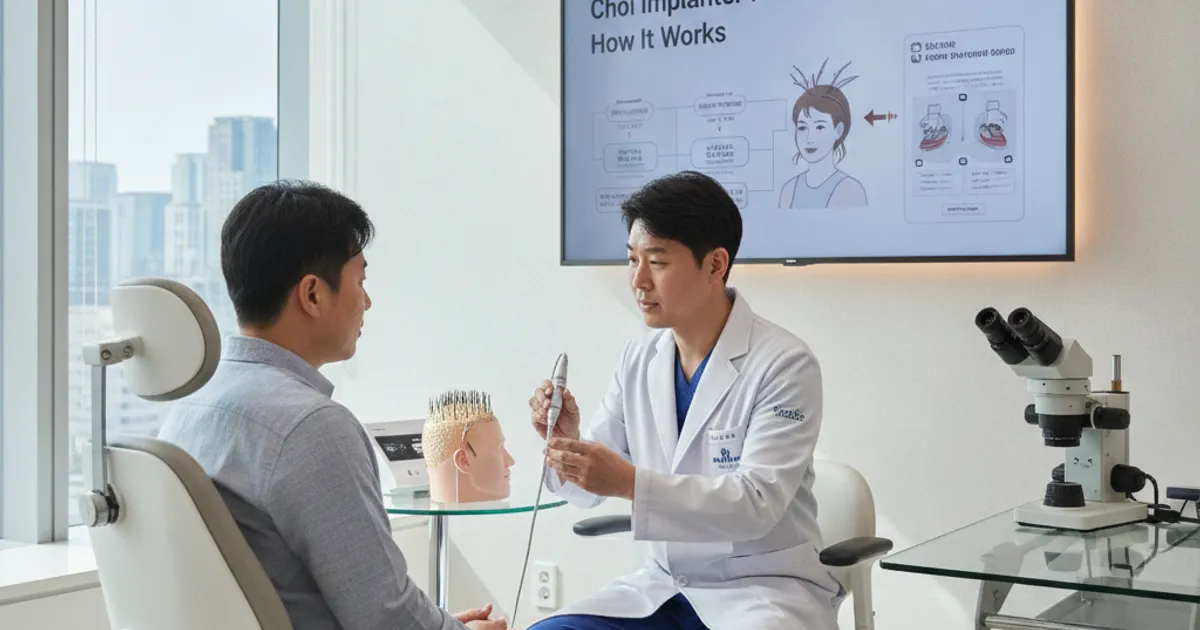
What Is a Choi Implanter Pen?
The Choi Implanter Pen is a surgical instrument used during hair transplant procedures to place hair grafts into the scalp. Instead of making a recipient site with one tool and then pushing the graft in with forceps, the Choi pen does both jobs at once. The graft is loaded into a hollow needle at the tip of the pen, the needle makes a tiny slit in the scalp, and a plunger deposits the graft into that slit in a single motion. It's a mechanical device, not a technique on its own, but it changes how the placement stage of a transplant is performed.
- Also called an implanter pen, Choi implanter, or hair implanter pen
- Loads, inserts, and releases a single graft in one step
- Comes in different needle gauges to match graft size (single-hair, double-hair, multi-hair grafts)
- Used mainly during the recipient-site and placement phase of FUE and some FUT procedures
- Can be operated manually or with motorised assistance depending on the clinic
How the Choi Implanter Pen Is Used During a Hair Transplant
The Choi pen is used during the placement stage, after grafts have been extracted and sorted. The surgeon or a trained technician loads each graft into the pen's needle, positions the tip at the planned recipient site, and presses the plunger. The needle creates the channel and the graft slides into place. Because the graft goes in immediately, it spends less time outside the body compared to techniques where all sites are pre-made first and grafts are placed afterwards.
The Choi pen places a graft in one motion — needle, channel, and release combined.
Recovery After a Choi Pen Hair Transplant
Recovery after a Choi pen transplant follows the same general timeline as other FUE procedures. The pen itself doesn't change the healing biology — it changes how the sites are made, which can influence how much trauma the scalp experiences. Because the needle creates a snug channel and the graft is placed immediately, some surgeons report less popping or graft handling, but the visible recovery stages are broadly similar.
- Avoid strenuous exercise for the first week to reduce swelling and bleeding risk
- Don't scratch or pick at scabs — let them fall off on their own
- Follow your clinic's washing instructions exactly; they vary between surgeons
- Stay out of direct sun on the recipient area for the first few weeks
- Some redness can persist for several weeks, especially in lighter skin
Results and Graft Survival: What to Expect
Graft survival depends on how carefully grafts are handled from extraction through placement. The Choi pen's main theoretical advantage is speed and reduced handling — the graft goes from holding solution to scalp in one motion, with less time exposed and fewer tools touching it. Whether that translates to measurably higher survival than other placement methods is debated. What matters more in practice is the skill of the surgeon and team, the time grafts spend out of the body, and how well the recipient sites are planned.
- Final density depends on graft count, graft quality, and how well the surgeon matches sites to graft size
- Hairline work with single-hair grafts tends to look most natural when placed at the correct angle and direction
- Crown results often need more grafts and can look thinner than the front, regardless of technique
- Results are permanent for the transplanted follicles, but native hair can continue to thin without medication
Who Is a Good Candidate for Choi Implanter Pen Surgery?
The Choi pen is a placement tool, so candidacy is mostly about whether you're a good candidate for a hair transplant at all. That means stable or slowly progressing hair loss, a healthy donor area with enough density, realistic expectations, and no active scalp conditions that would interfere with healing. The pen itself doesn't restrict who can have it — but some surgeons prefer it for certain cases, like dense packing in the hairline or working in areas where angle control matters.
- Good donor density on the back and sides of the scalp
- Hair loss that has stabilised or is managed with medication
- Realistic goals — a transplant restores density, it doesn't create a full head of teenage hair
- No active scalp infections, psoriasis flare-ups, or uncontrolled skin conditions
- Willingness to follow aftercare instructions closely
| Candidate profile | Suitability | Notes |
|---|---|---|
| Early hair loss, stable | Good | Smaller sessions, often hairline-focused |
| Moderate hair loss | Good | Most common group; mid-scalp and crown work |
| Advanced hair loss | Case-dependent | Needs high graft counts; donor limits apply |
| Diffuse thinning (DUPA) | Often poor | Donor area may be unstable |
| Active scalp disease | Not suitable until resolved | Treat the condition first |
| Very young patients | Usually deferred | Hair loss pattern not yet clear |
Choi Implanter Pen Cost: What Affects the Price
The Choi pen doesn't have its own price tag. It's part of the overall hair transplant cost, which is driven by graft count, surgeon experience, clinic location, and what's bundled into the quote. Some clinics charge per graft, others per session, and some quote a flat fee for a defined case. The pen is one of several tools a clinic might use, and its use is usually included in the procedure fee rather than billed separately.
- Graft count — the single biggest driver of cost
- Surgeon reputation and whether the surgeon performs the key steps personally
- Clinic location — major cities and high-demand markets cost more
- Whether the quote includes PRP, medication, follow-up visits, or accommodation
- Technique — FUE with manual or motorised extraction, and whether the Choi pen is standard or an add-on
- Number of sessions — advanced cases may need two procedures spaced months apart
Choi Implanter Pen vs. Other Hair Transplant Techniques
The Choi pen is one way to place grafts. The main alternative is the pre-made slit technique, where the surgeon creates all recipient sites first with a blade or needle, then places grafts into those sites with forceps. Both approaches are used in FUE and FUT procedures. The choice often comes down to surgeon preference, the type of case, and how the clinic organises its team.
| Method | How grafts are placed | Potential advantages | Potential drawbacks |
|---|---|---|---|
| Choi Implanter Pen | Loaded into pen, needle makes site and releases graft in one motion | Fast placement, less graft handling, tight site fit | Requires loading skill, needle gauge must match graft, some learning curve |
| Pre-made slits + forceps | Sites created first, grafts inserted with forceps | Surgeon controls all site angles before placement | Grafts sit outside body longer, more handling, risk of popping |
| DHI (Direct Hair Implantation) | Often uses a Choi-style implanter pen | Immediate placement, precise angle control | Slower per graft, higher cost at some clinics |
| Sapphire FUE | Sapphire blade makes sites, grafts placed with forceps | Fine, clean incisions | Placement method separate from site creation |
| FUT (strip) | Strip removed, grafts dissected, then placed | High graft yield in one session | Linear scar, longer recovery |
- The Choi pen is a placement tool, not an extraction method — it can be used with FUE or FUT
- DHI and Choi pen are sometimes used interchangeably in marketing, but DHI describes the overall approach, not just the tool
- No single method has been proven universally superior for graft survival; surgeon skill matters more
- Ask what method the clinic uses and why — a clear answer is a good sign
Choosing a Clinic for Choi Implanter Pen Hair Transplant
If you're specifically looking for a clinic that uses the Choi Implanter Pen, ask directly. Not every clinic advertises which placement tool they use, and some use the pen for certain cases only. The questions below are worth asking before you book a consultation.
- Does the surgeon use the Choi pen routinely, or only for specific cases?
- Who loads the grafts — the surgeon, a technician, or an assistant?
- How many grafts per session do they typically place, and what density do they target?
- What's included in the quote — PRP, medication, follow-up, accommodation?
- Can they show before-and-after photos of cases similar to yours?
- What's their policy on revisions or touch-ups if growth is poor?
Frequently Asked Questions About the Choi Implanter Pen
Is the Choi Implanter Pen better than other hair transplant methods?
Not necessarily better — different. The pen places grafts quickly and with less handling, which some surgeons prefer. But graft survival and final density depend far more on surgeon skill, graft count, and case planning than on the placement tool alone. A well-executed procedure with forceps can outperform a poorly planned one with a Choi pen.
Does the Choi pen hurt more or less than other techniques?
The pen itself doesn't change the pain profile much. The procedure is done under local anaesthetic, so you shouldn't feel the placement. Discomfort after the procedure comes from the recipient sites and swelling, which is similar across placement methods.
Can any clinic use a Choi Implanter Pen?
Any clinic can buy the instrument, but using it well takes practice. Loading grafts correctly, matching needle gauge to graft size, and controlling angle and depth are skills that develop over time. Ask how long the surgeon has been using it and how often.
How long does a Choi pen hair transplant take?
Session length depends on graft count. A typical session of 1,500 to 3,000 grafts can take most of a day, sometimes longer. The Choi pen can speed up placement compared to forceps, but extraction, sorting, and breaks all add time. Your clinic should give you a realistic estimate based on your case.
More Guides
- Hair Transplant for Curly Hair: Graft and Technique Tips
A plain-English guide to hair transplants for curly hair: how surgeons adapt graft harvesting and placement, recovery, results, costs, and who it suits.
- How Long Does a Hair Transplant Last? Long-Term Durability
How long does a hair transplant last? We explain the procedure, recovery, durability, costs by stage of hair loss, and how it compares to alternatives.
- Hair Transplant Revision: When a Second Procedure Makes Sense
Considering a hair transplant revision? Learn how a second procedure works, who it suits, recovery, results, and costs. Expert explainer from Clinic Reccy.
- Hair Transplant for Norwood 6 and 7: What's Possible
A clear look at hair transplant options for Norwood 6 and 7 hair loss: graft limits, staging, recovery, costs, and realistic results.