
DHI Hair Transplant: Technique, Recovery, and Cost Factors
DHI hair transplant explained: how the Choi pen technique works, recovery timeline, results, who it suits, and what influences cost. Compare DHI vs FUE vs FUT.
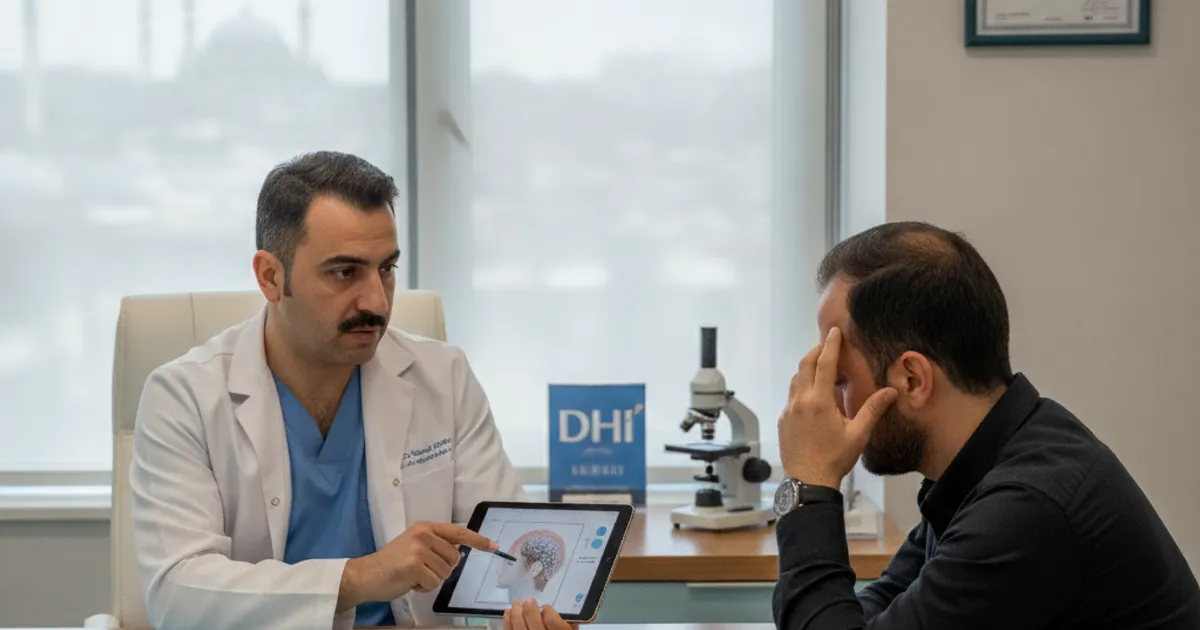
What Is a DHI Hair Transplant?
DHI stands for Direct Hair Implantation. It's a hair transplant technique where the surgeon uses a specialized tool called a Choi implanter pen to place hair follicles directly into the scalp, without creating separate recipient sites beforehand. The extraction step is still done individually, similar to FUE, but the implantation is what sets DHI apart: the surgeon loads each graft into the pen and uses it to create the site and deposit the graft in one motion. The idea is to minimize the time follicles spend outside the body and give the surgeon more control over angle, depth, and direction of each graft. DHI is often described as a refinement of FUE, but the key difference is that implantation happens directly with the Choi pen rather than making incisions first and then inserting grafts separately.
How DHI Works: Step-by-Step Technique
The procedure follows a structured sequence. While exact protocols vary by clinic, the core steps are consistent across reputable providers. Here's what a typical DHI session looks like from start to finish.
- Consultation and planning: The surgeon assesses your donor area, hair loss pattern, and goals, then designs a hairline and maps out how many grafts are needed.
- Donor area preparation: The back and sides of the scalp are trimmed and numbed with local anesthesia.
- Extraction: Individual follicular units are removed using a micro-punch tool. Each graft is inspected and kept in a holding solution.
- Loading the implanter: Extracted grafts are loaded into the Choi implanter pen one by one.
- Implantation: The surgeon uses the pen to create the recipient site and deposit the graft in a single motion, controlling angle and depth.
- Post-op care: The scalp is cleaned, aftercare instructions are given, and a follow-up schedule is set.
DHI vs. FUE vs. FUT: Key Differences
All three techniques aim to restore hair, but they differ in how grafts are harvested and placed. FUE (Follicular Unit Extraction) removes individual follicles with a punch and then creates recipient sites before inserting grafts. FUT (Follicular Unit Transplantation) removes a strip of scalp from the donor area and dissects it into grafts under a microscope. DHI is essentially FUE harvesting combined with direct implantation using a Choi pen. The table below summarizes the practical differences.
| Feature | DHI | FUE | FUT |
|---|---|---|---|
| Harvesting method | Individual extraction with micro-punch | Individual extraction with micro-punch | Strip excision from donor area |
| Implantation method | Direct with Choi implanter pen | Recipient sites created first, then grafts inserted | Recipient sites created first, then grafts inserted |
| Scarring | Tiny dot scars | Tiny dot scars | Linear scar |
| Session length | Longer (slower, precise placement) | Moderate | Shorter |
| Graft handling | Grafts held in solution before loading into pen; minimal time outside body during implantation | Grafts held in solution between extraction and implantation | Grafts dissected under microscope and held in solution |
| Suitable for | Small to moderate areas, precise hairlines | Small to large areas | Large areas, high graft counts |
| Recovery | Similar to FUE | Similar to DHI | Longer due to strip scar |
Recovery Timeline After DHI
Recovery from DHI is broadly similar to FUE because the donor area is still punctured rather than cut as a strip. Most people can return to desk work within a few days, though visible redness and scabbing persist for a week or two. The timeline below reflects typical experiences, not guarantees — healing varies by individual and by clinic protocol.
- Days 1–3: Swelling and tenderness in the donor and recipient areas. Sleep elevated, avoid touching the grafts.
- Days 4–7: Scabs begin to form and dry. Gentle washing per clinic instructions.
- Weeks 2–3: Scabs flake off. Transplanted hairs may shed — this is normal and expected.
- Months 1–3: 'Ugly duckling' phase. Shedding continues, new growth is not yet visible.
- Months 4–6: Early growth becomes noticeable. Texture may be fine or uneven.
- Months 9–12: Most of the final result is visible. Density and texture continue to mature up to 18 months.
| Phase | Typical timeframe | What to expect |
|---|---|---|
| Initial healing | First 7–10 days | Redness, scabbing, tenderness |
| Shedding | 2–4 weeks | Transplanted hairs fall out; follicles rest |
| Early growth | 3–6 months | Fine new hairs appear |
| Visible result | 6–9 months | Noticeable density improvement |
| Final result | 12–18 months | Full maturation of grafts |
Results: What to Expect and When
DHI results depend heavily on surgeon skill, graft quality, and how well you follow aftercare. Because the Choi pen allows precise control over angle and direction, DHI is often chosen for hairline work where natural-looking direction matters. That said, no technique can guarantee a specific density or outcome. The final result is a combination of your donor hair characteristics, the number of grafts placed, and how your body heals.
- Natural hairline direction: DHI's precision helps create cowlicks and angles that mimic natural growth.
- Density: Limited by donor supply and the number of grafts moved. DHI doesn't create more donor hair.
- Scarring: Minimal dot scars, similar to FUE. Not invisible, but easily hidden with short hair.
- Longevity: Transplanted follicles are typically resistant to pattern baldness, but native hair can continue to thin.
- Revision potential: Some patients need a second session for density, especially in larger areas.
Who Is a Good Candidate for DHI?
DHI suits many people, but it's not the right choice for everyone. The best candidates have realistic expectations, stable hair loss, and enough donor hair to support the planned restoration. Because DHI sessions move fewer grafts per hour than FUT, it's often better for smaller to moderate areas rather than extensive baldness.
- Early to moderate hair loss: Norwood 2–4 patterns where precision matters most.
- Stable loss: Hair loss that has stabilized, ideally for a year or more.
- Good donor density: Enough hair in the back and sides to harvest without visible thinning.
- Realistic goals: Understanding that density is limited and a second session may be needed.
- Preference for minimal scarring: People who wear short hair and want to avoid a linear scar.
- Healthy scalp and general health: No active scalp infections or uncontrolled medical conditions.
DHI Cost: What Influences Price
DHI pricing varies widely by country, clinic reputation, surgeon experience, and the number of grafts required. There's no single market rate, and quotes can differ significantly even within the same city. Because pricing is market-dependent and no real-time database context was provided, specific cost figures are not quoted here. Instead, it's more useful to understand what drives the cost and how pricing scales with the stage of hair loss.
- Graft count: More grafts means more time, more materials, and higher cost.
- Surgeon involvement: Procedures where the surgeon performs extraction and implantation personally cost more than technician-heavy models.
- Clinic location: Labor and overhead costs vary by country and city.
- Technique and tools: DHI's Choi pens and slower pace can add to the base price compared to standard FUE.
- Aftercare and follow-up: Some clinics bundle PRP, medications, and follow-up visits; others charge separately.
- Anesthesia and facility fees: Usually included, but confirm what's covered.
What to Check When Choosing a DHI Clinic
Choosing a clinic is arguably more important than choosing a technique. DHI requires specific training and experience with the Choi pen, and not every clinic that offers FUE is equally skilled at DHI. Use the checklist below to vet providers before booking a consultation.
- Surgeon credentials: Verify medical licensure and specific DHI training or experience.
- Who does what: Confirm whether the surgeon performs extraction and implantation or delegates to technicians.
- Before-and-after photos: Ask to see results for cases similar to yours, not just showcase patients.
- Consultation process: A thorough consultation should include donor area assessment and realistic graft estimates.
- Aftercare and follow-up: Clarify what's included and how complications are handled.
- Transparent pricing: Get a written quote that itemizes what's covered.
- Reviews and complaints: Look beyond the clinic's own testimonials; check independent review platforms.
Frequently Asked Questions
Is DHI better than FUE?
Not inherently. DHI offers more precise control over graft placement and minimizes time outside the body, which can be an advantage for hairline work. FUE is often more efficient for larger sessions. The better choice depends on your hair loss pattern, donor supply, and the surgeon's skill with each technique.
How long does DHI take?
DHI sessions typically take longer than FUE for the same number of grafts because each graft is implanted individually with the Choi pen. A session can range from several hours to a full day, depending on graft count and clinic protocol.
Does DHI leave scars?
DHI leaves tiny dot scars in the donor area, similar to FUE. There is no linear scar like FUT. The scars are usually small enough to be hidden with short hair, though they are not completely invisible.
Can I get DHI if I'm completely bald?
DHI is generally less suitable for advanced baldness because it moves fewer grafts per session. If you have limited donor hair or need extensive coverage, FUT or high-volume FUE may be more efficient. A surgeon should assess your donor area to determine what's realistic.
More Guides
- Hair Transplant for Curly Hair: Graft and Technique Tips
A plain-English guide to hair transplants for curly hair: how surgeons adapt graft harvesting and placement, recovery, results, costs, and who it suits.
- How Long Does a Hair Transplant Last? Long-Term Durability
How long does a hair transplant last? We explain the procedure, recovery, durability, costs by stage of hair loss, and how it compares to alternatives.
- Hair Transplant Revision: When a Second Procedure Makes Sense
Considering a hair transplant revision? Learn how a second procedure works, who it suits, recovery, results, and costs. Expert explainer from Clinic Reccy.
- Hair Transplant for Norwood 6 and 7: What's Possible
A clear look at hair transplant options for Norwood 6 and 7 hair loss: graft limits, staging, recovery, costs, and realistic results.