
Do Tight Hairstyles Accelerate Genetic Hair Loss?
Can tight hairstyles speed up genetic hair loss? Learn the evidence, symptoms, diagnosis, treatment options, and whether a hair transplant is right for you.
Do Tight Hairstyles Accelerate Genetic Hair Loss?
If you regularly wear tight braids, a slicked-back ponytail, or a weave that pulls at your scalp, you have probably wondered whether that tension is speeding up hair loss. The short answer is that tight hairstyles do not cause genetic hair loss, but they can absolutely make it worse and can cause a separate type of hair loss that looks similar. Understanding the difference matters because the treatments are not the same, and the timing of treatment often decides how much hair you keep.
What Is Genetic Hair Loss (Androgenetic Alopecia)?
Androgenetic alopecia is the medical term for pattern hair loss. It affects both men and women, though it usually looks different in each. In men, it typically starts with a receding hairline and thinning at the crown. In women, it tends to show as diffuse thinning along the part line while the frontal hairline stays mostly intact. The condition is progressive, meaning it gets worse over time without treatment. It is caused by a combination of genetics and the hormone dihydrotestosterone (DHT), which gradually shrinks susceptible hair follicles until they stop producing visible hair.
- Inherited sensitivity to DHT is the main driver, not stress or poor circulation.
- It follows a predictable pattern: temples and crown in men, part line and mid-scalp in women.
- Miniaturization is the key process, where thick hairs become fine and short before disappearing.
- It is chronic and progressive, so early treatment usually preserves more hair than late treatment.
- It is not caused by wearing hats, washing too often, or having tight hairstyles.
How Tight Hairstyles Affect the Scalp and Hair Follicles
When hair is pulled tightly for long periods, the tension travels down the hair shaft to the follicle. Over time, this constant pulling can inflame the follicle and cause it to produce thinner, weaker hairs. If the tension continues, the follicle can scar and stop producing hair altogether. This is called traction alopecia. It is most common along the hairline, temples, and the sides of the scalp, exactly where tight styles put the most stress. Unlike genetic hair loss, traction alopecia is caused by something you can change, which is why it is often reversible if caught early.
- Braids, cornrows, tight ponytails, buns, and extensions create the most tension.
- Weaves and glued-in tracks can pull on the same follicles for weeks at a time.
- Repeated styling without breaks prevents the follicle from recovering.
- Chemical relaxers and dyes can add to the damage by weakening the hair shaft.
- Early traction alopecia often shows as small bumps, soreness, or a receding hairline.
Can Tight Hairstyles Accelerate Genetic Hair Loss? The Evidence
The honest answer is that tight hairstyles do not change your genes or your hormone levels, so they do not cause androgenetic alopecia. But they can accelerate visible hair loss in people who already have it. Here is why: a follicle that is already miniaturizing from DHT is weaker and more vulnerable to physical stress. Add constant pulling, and that follicle may fail sooner than it would have on its own. The two conditions can also overlap in the same area, which makes diagnosis trickier. A receding hairline in a man could be early genetic loss, traction loss, or both. That is why a proper scalp exam matters more than guessing from photos.
| Factor | Genetic Hair Loss | Traction Hair Loss |
|---|---|---|
| Main cause | Genetics and DHT sensitivity | Repeated physical pulling |
| Typical pattern | Temples, crown, part line | Hairline, temples, sides |
| Reversibility | Progressive, not fully reversible | Often reversible if caught early |
| Scalp symptoms | Usually none | Pain, tenderness, bumps, itching |
| Treatment focus | Medication, PRP, transplant | Stop tension, scalp care, sometimes transplant |
Symptoms and Diagnosis: Telling the Difference
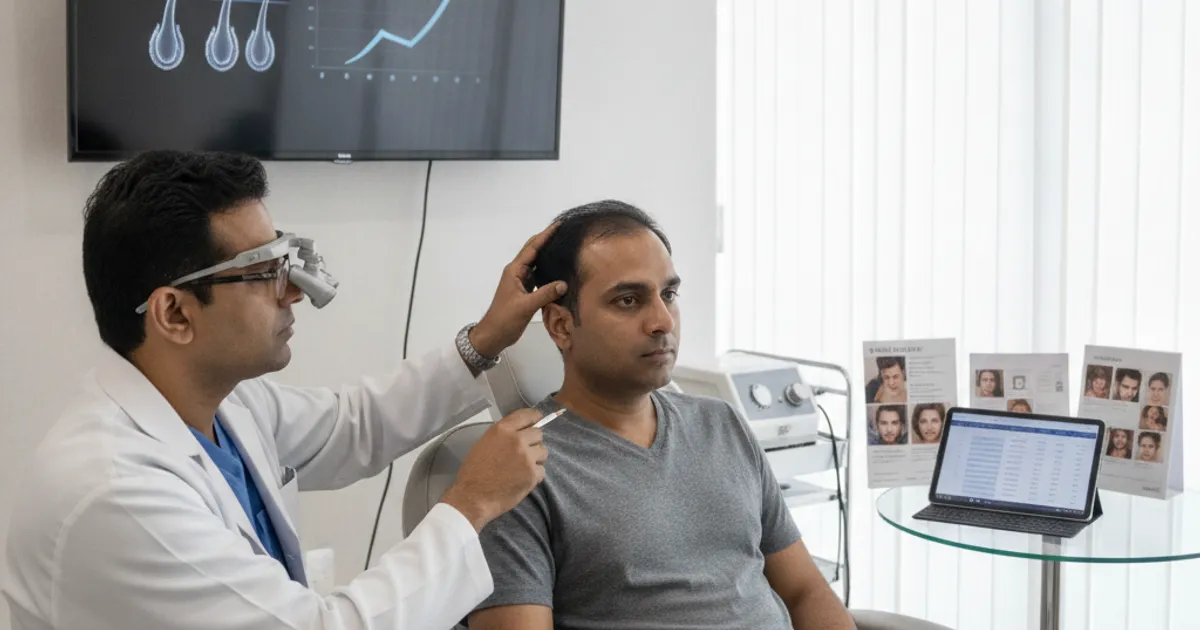
Diagnosis starts with a scalp exam and a detailed history of your styling habits. A dermatologist or hair restoration specialist will look at the pattern of loss, check for miniaturized hairs, and may use a dermoscope to see the follicles up close. Blood tests can rule out thyroid issues, iron deficiency, or other causes. If the loss is along the hairline and you have a history of tight styling, traction alopecia is likely. If the loss follows a genetic pattern and there is a family history, androgenetic alopecia is more likely. Many people have both, and the treatment plan needs to address both.
- Pattern: genetic loss follows a predictable shape, traction loss follows the pull points.
- Timing: traction loss often improves within months of stopping the tight style.
- Family history: a strong family history points toward genetic loss.
- Scalp feel: tenderness or bumps suggest traction damage.
- Hair pull test: your doctor may gently pull hairs to see how many come out.
- Dermoscopy: a magnified view can show miniaturization and follicle damage.
| Sign | More Likely Genetic | More Likely Traction |
|---|---|---|
| Receding temples | Yes | Possible |
| Thinning crown | Yes | Rare |
| Pain or tenderness | No | Yes |
| Loss along braid lines | No | Yes |
| Family history | Common | Not required |
| Improves after changing style | No | Often yes |
Treatment Options for Genetic Hair Loss
Treatment for genetic hair loss works best when started early. The goal is to slow or stop miniaturization and, in some cases, regrow hair. Finasteride and minoxidil are the two most well-known options. Finasteride is an oral prescription that lowers DHT levels and is generally used by men. Minoxidil is a topical solution or foam that improves blood flow and prolongs the growth phase, and it is used by both men and women. Platelet-rich plasma (PRP) injections use your own blood plasma to stimulate follicles and are often combined with medication. Low-level laser therapy is another option some people use. None of these are cures, and results vary, but they can make a real difference when used consistently.
- Finasteride: oral prescription, lowers DHT, mainly for men.
- Minoxidil: topical, available over the counter, used by men and women.
- PRP: injections of concentrated platelets, usually a series of sessions.
- Low-level laser therapy: devices that emit red light to stimulate follicles.
- Ketoconazole shampoo: sometimes used to support scalp health.
- Hair transplant: surgical relocation of healthy follicles to thinning areas.
| Treatment | How It Works | Best For | Notes |
|---|---|---|---|
| Finasteride | Blocks DHT production | Men with early to moderate loss | Prescription only |
| Minoxidil | Improves follicle blood flow | Men and women | Over the counter |
| PRP | Growth factors from your blood | Early to moderate loss | Often combined with medication |
| Low-level laser | Light energy to follicles | Mild loss | Results vary |
| Hair transplant | Moves healthy follicles | Stable loss, good donor area | Surgical, permanent results |
Is a Hair Transplant Suitable for You?
A hair transplant can be a good option for genetic hair loss, but it is not right for everyone. The best candidates have stable loss, a healthy donor area at the back of the scalp, and realistic expectations. If your loss is still progressing quickly, a transplant without medication may not look good long-term because the surrounding hair will continue to thin. For traction alopecia, a transplant can work if the scalp is no longer under tension and the area has healed. In some cases, scar tissue from long-term traction can limit graft survival, so a proper evaluation is essential. A surgeon will assess your donor density, scalp elasticity, and the pattern of loss before recommending surgery.
- Good candidates: stable loss, strong donor area, realistic goals.
- Less ideal: active, rapidly progressing loss without medication.
- Traction cases: tension must be stopped before surgery.
- Scarring: significant scarring can reduce graft survival.
- Age: younger patients may need to wait until the pattern is clearer.
- Medication: most surgeons recommend continuing finasteride or minoxidil after surgery.
Prevention and Scalp Care: Reducing Traction Damage
If you want to protect your hair from traction damage, the most important step is to change your styling habits. Give your scalp regular breaks from tight styles. Avoid braids, weaves, and ponytails that pull at the hairline. If you must wear your hair up, keep it loose. Treat your scalp gently, and see a doctor if you notice pain, thinning, or a receding hairline that does not improve. For genetic hair loss, prevention means starting treatment early and sticking with it. There is no shampoo or vitamin that will stop androgenetic alopecia on its own, so be skeptical of products that promise otherwise.
- Alternate tight styles with loose ones to give follicles a rest.
- Avoid chemical relaxers and dyes if your scalp is already irritated.
- Do not sleep in tight braids or ponytails.
- Use gentle, sulfate-free shampoos and conditioners.
- Massage your scalp to improve circulation, but do not pull.
- See a specialist if you notice persistent soreness or thinning.
Frequently Asked Questions (FAQ)
Do tight hairstyles cause genetic hair loss?
No. Genetic hair loss is caused by inherited sensitivity to DHT. Tight hairstyles can cause a separate condition called traction alopecia and can make existing genetic loss look worse, but they do not change your genes.
Can traction alopecia be reversed?
Yes, if it is caught early and the tension is stopped. Hair often regrows within months. If the follicle has scarred, regrowth may not happen, and a transplant may be an option.
How do I know if my hair loss is genetic or from tight styles?
A dermatologist can tell by examining your scalp and asking about your styling habits. Genetic loss follows a pattern, while traction loss follows the pull points and often comes with tenderness.
Should I stop wearing tight hairstyles if I have genetic hair loss?
Yes. Even if your main issue is genetic, reducing tension helps protect vulnerable follicles and prevents traction alopecia from adding to the problem.
Can I get a hair transplant if I have traction alopecia?
Sometimes. The tension must be stopped first, and the scalp needs to be healthy. If there is significant scarring, graft survival may be lower, so a proper evaluation is important.
What treatments work for genetic hair loss?
Finasteride, minoxidil, PRP, and low-level laser therapy are common options. A hair transplant can help in suitable candidates. Results vary, and consistency matters.
More Guides
- Minoxidil Contact Dermatitis: Signs and Alternatives
Learn the signs of minoxidil contact dermatitis, how it's diagnosed, treatment options, and alternatives like finasteride, PRP, and hair transplant surgery.
- Can Radiotherapy Cause Hair Loss? What to Expect
Radiotherapy can cause temporary or permanent hair loss. Learn the causes, symptoms, diagnosis, treatment options, and whether a hair transplant is suitable.
- Hair Loss After Illness or High Fever: When Does It Stop?
Hair loss after illness or high fever is usually temporary telogen effluvium. Learn causes, symptoms, diagnosis, treatment, and when a hair transplant may help.
- Can Dandruff Cause Hair Loss? Facts vs Folklore
Does dandruff cause hair loss? We separate fact from folklore, explain the real connection, diagnosis, treatments, and when a hair transplant makes sense.