
High DHT, Prostate Problems and Hair Loss: What to Know
Does high DHT cause prostate problems and hair loss together? Learn the link, symptoms, diagnosis, treatment options, and whether a hair transplant is suitable.
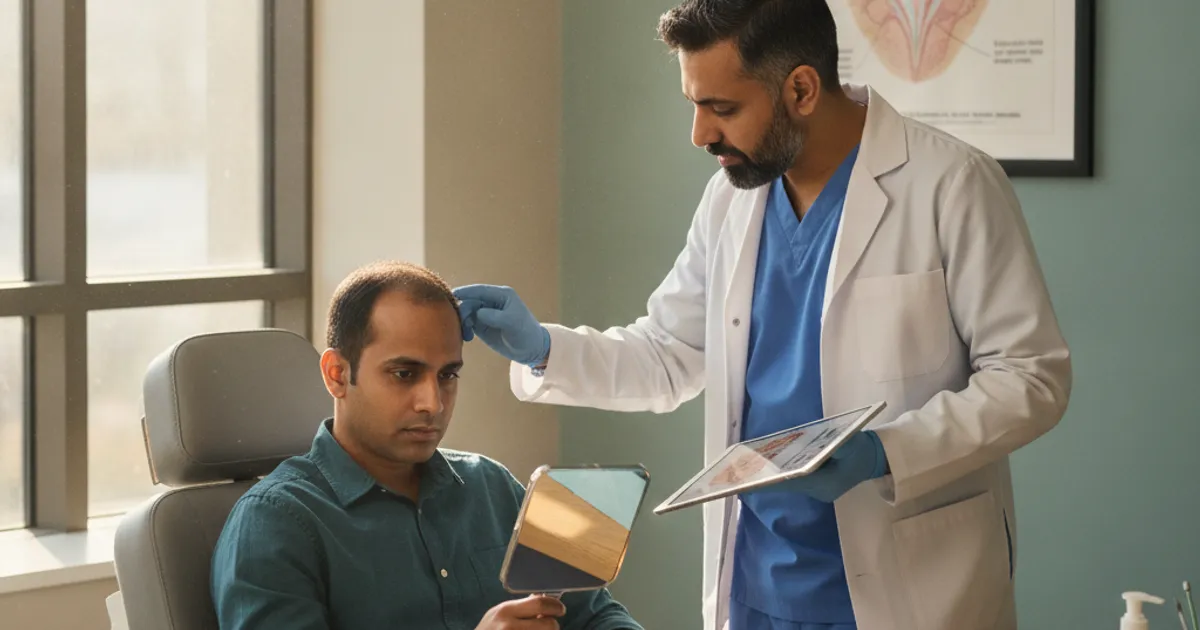
The DHT–Prostate–Hair Loss Connection
If you are losing hair and also dealing with prostate issues, you have probably wondered whether the two are connected. The short answer is yes, they can be, and the common link is a hormone called dihydrotestosterone, or DHT. DHT is a potent androgen that plays a central role in both male pattern hair loss and prostate enlargement. Understanding how DHT works helps you make sense of why treatments for one condition often overlap with the other.
What Is DHT and Why Does It Matter?
DHT is made from testosterone by an enzyme called 5-alpha-reductase. It is a more potent androgen than testosterone, though the exact multiplier varies by source and is often cited as somewhere between two and five times stronger. While testosterone circulates throughout the body, DHT acts locally in tissues that contain the enzyme. Two types of 5-alpha-reductase exist: type 1 is found in the skin and liver, and type 2 is concentrated in the prostate and hair follicles. This distribution explains why blocking DHT can affect both the prostate and the scalp.
- DHT is produced from testosterone by the enzyme 5-alpha-reductase.
- It binds to androgen receptors in the prostate, hair follicles, and other tissues.
- Genetic sensitivity determines how strongly a tissue responds to DHT.
- Men with a family history of early hair loss or prostate enlargement are more likely to experience DHT-related effects.
How High DHT Affects the Prostate
The prostate is a walnut-sized gland that sits below the bladder. It depends on DHT for normal growth and function. However, as men age, DHT can contribute to benign prostatic hyperplasia (BPH), a non-cancerous enlargement of the prostate. BPH is extremely common and can cause urinary symptoms such as a weak stream, frequent urination, and difficulty emptying the bladder. While DHT is not the sole cause of BPH, it is a key driver, which is why drugs that block DHT are used to treat the condition.
- DHT stimulates prostate cell growth, leading to enlargement over time.
- BPH is not prostate cancer, but the symptoms can overlap.
- High DHT levels are not always measurable in blood; tissue sensitivity matters more.
- Medications that inhibit 5-alpha-reductase can shrink the prostate and improve urinary flow.
How High DHT Causes Hair Loss
In genetically predisposed men, DHT binds to androgen receptors in hair follicles on the scalp, particularly at the temples and crown. This binding triggers a process called miniaturization, where hair follicles shrink and produce thinner, shorter hairs until they stop producing visible hair altogether. This pattern is known as androgenetic alopecia, or male pattern baldness. It affects millions of men worldwide and is the most common cause of hair loss.
- DHT shortens the growth phase of hair and lengthens the resting phase.
- Follicles in the frontal hairline and crown are most sensitive to DHT.
- Hair on the sides and back of the scalp is typically resistant to DHT, which is why it is used for transplantation.
- The process is gradual and can start as early as the late teens or early twenties.
Symptoms: Prostate vs. Hair Loss
| Condition | Common Symptoms | Typical Age of Onset |
|---|---|---|
| Benign Prostatic Hyperplasia (BPH) | Frequent urination, weak urine stream, urgency, nocturia, incomplete emptying | Often after age 50, but can start earlier |
| Androgenetic Alopecia (Male Pattern Baldness) | Thinning at temples and crown, receding hairline, widening part | Can begin in late teens to 40s, sometimes later |
| Prostate Cancer | Often no symptoms in early stages; later may include blood in urine, bone pain | More common after age 60, but can occur earlier |
It is possible to have both BPH and male pattern baldness at the same time, especially as you get older. The two conditions share a common hormonal driver but are not causally linked in the sense that one directly causes the other. Instead, they are both manifestations of how your body responds to DHT. If you notice symptoms in either area, it is worth discussing them with a doctor, as they may point to an underlying hormonal pattern.
Diagnosis: Tests and Evaluations
Diagnosing DHT-related conditions involves a combination of medical history, physical examination, and sometimes laboratory tests. For hair loss, a dermatologist or hair restoration specialist will examine your scalp, look for patterns of miniaturization, and may use a trichoscope to assess follicle health. For prostate issues, a urologist will perform a digital rectal exam, check your PSA levels, and may order a urine flow test or ultrasound.
- Blood tests to measure testosterone, DHT, and PSA levels.
- Scalp biopsy in rare cases to rule out other causes of hair loss.
- Trichoscopy to evaluate hair shaft variability and follicle density.
- Uroflowmetry and post-void residual urine measurement for prostate function.
- Family history and medication review to identify contributing factors.
Treatment Options for DHT-Related Prostate Issues and Hair Loss
Treatment for DHT-related conditions depends on which symptoms are most bothersome and your overall health. Some medications can address both prostate enlargement and hair loss, which is convenient if you are dealing with both. Others are targeted to one area. Always consult a doctor before starting any treatment, as some can have side effects that affect sexual function or mood.
- Finasteride: blocks type 2 5-alpha-reductase, reducing DHT levels. Used for both BPH and male pattern hair loss. Available as a prescription.
- Dutasteride: blocks both type 1 and type 2 5-alpha-reductase. Used for BPH and sometimes off-label for hair loss.
- Minoxidil: a topical or oral vasodilator that promotes hair growth but does not affect DHT. Often used alongside finasteride.
- PRP (platelet-rich plasma): injections of concentrated platelets from your own blood to stimulate hair follicles. Not a DHT blocker but can improve hair density.
- Alpha-blockers (e.g., tamsulosin): relax prostate muscles to improve urinary flow but do not affect DHT or hair loss.
- Surgery: procedures like TURP for severe BPH; hair transplant for permanent hair loss.
| Treatment | Targets Prostate | Targets Hair Loss | Prescription Needed |
|---|---|---|---|
| Finasteride | Yes | Yes | Yes |
| Dutasteride | Yes | Off-label | Yes |
| Minoxidil | No | Yes | No (topical), Yes (oral) |
| PRP | No | Yes | No |
| Alpha-blockers | Yes | No | Yes |
Is a Hair Transplant Suitable for DHT-Related Hair Loss?
A hair transplant can be an excellent option for men with stable DHT-related hair loss, but it is not a cure for the underlying condition. The procedure moves DHT-resistant follicles from the back and sides of the scalp to thinning areas. These transplanted hairs will continue to grow for a lifetime because they are not sensitive to DHT. However, your existing hair may continue to thin if you do not use medication to block DHT. Most surgeons recommend a combination of hair transplant and ongoing medical therapy for the best long-term results.
- Best candidates have stable hair loss and good donor hair density.
- Young men with early hair loss may be advised to wait until the pattern stabilizes.
- Medication like finasteride is often recommended before and after transplant to protect native hair.
- Transplanted hair is permanent, but surrounding hair can still be lost without DHT suppression.
- A hair transplant does not affect prostate health or DHT levels systemically.
FAQ: DHT, Prostate Problems, and Hair Loss
Does high DHT always cause prostate problems?
No. DHT contributes to prostate enlargement, but not everyone with high DHT develops BPH. Genetics, age, and other hormones also play a role.
Can treating hair loss with finasteride also help my prostate?
Yes. Finasteride is approved for both male pattern hair loss and benign prostatic hyperplasia. It lowers DHT levels, which can shrink the prostate and slow hair loss.
Will a hair transplant stop my hair loss from progressing?
A hair transplant restores hair in bald areas, but it does not stop the underlying DHT-driven miniaturization of other follicles. Without medication, you may continue to lose native hair.
Are there natural ways to lower DHT?
Some supplements like saw palmetto and pumpkin seed oil are sometimes promoted for DHT blocking, but evidence for their effectiveness is mixed and they are not as effective as prescription medications. Always talk to your doctor before using supplements.
Can I take finasteride if I have prostate cancer?
Finasteride can affect PSA levels, which are used to screen for prostate cancer. If you have or are being evaluated for prostate cancer, discuss finasteride with your oncologist or urologist first.
The relationship between DHT, prostate health, and hair loss is complex but well-understood. If you are experiencing symptoms in either area, a medical evaluation can help clarify what is happening and what treatments are appropriate. For hair loss, a hair transplant combined with DHT-blocking medication offers a durable solution for many men. Always consult a qualified professional before making decisions about your care.
More Guides
- Minoxidil Contact Dermatitis: Signs and Alternatives
Learn the signs of minoxidil contact dermatitis, how it's diagnosed, treatment options, and alternatives like finasteride, PRP, and hair transplant surgery.
- Can Radiotherapy Cause Hair Loss? What to Expect
Radiotherapy can cause temporary or permanent hair loss. Learn the causes, symptoms, diagnosis, treatment options, and whether a hair transplant is suitable.
- Hair Loss After Illness or High Fever: When Does It Stop?
Hair loss after illness or high fever is usually temporary telogen effluvium. Learn causes, symptoms, diagnosis, treatment, and when a hair transplant may help.
- Can Dandruff Cause Hair Loss? Facts vs Folklore
Does dandruff cause hair loss? We separate fact from folklore, explain the real connection, diagnosis, treatments, and when a hair transplant makes sense.