
Does Minoxidil Work on Temples? What the Evidence Says
Does minoxidil work on temples? Learn how it affects temple hair loss, what it can and can't do, and when a hair transplant is the better option.
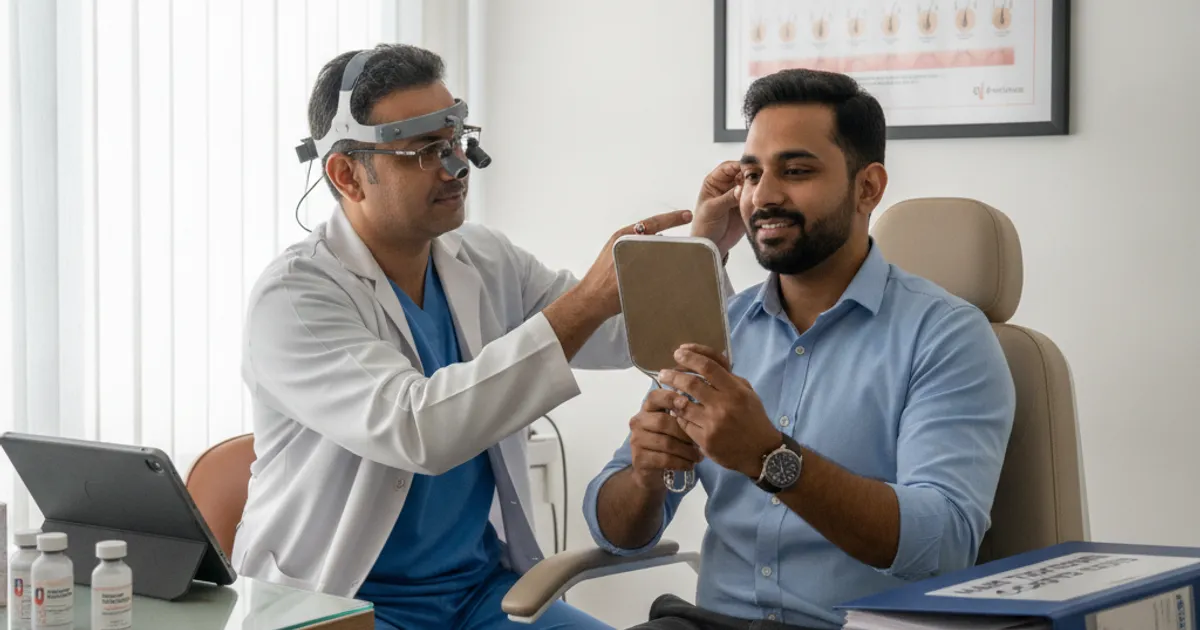
Does Minoxidil Work on Temples? The Short Answer
Yes, minoxidil can work on the temples, but the results are usually modest and often disappointing compared to what it does on the crown or mid-scalp. The temples are one of the hardest areas to regrow hair because the follicles there are more sensitive to DHT and tend to miniaturise earlier. Minoxidil can slow further loss, thicken existing miniaturised hairs, and occasionally produce visible regrowth at the hairline edge — but it rarely rebuilds a fully receded temple corner. If your temples are completely smooth and shiny, minoxidil alone is unlikely to bring them back.
Why Temple Hair Loss Is Different
Temple recession follows a different pattern from thinning on the crown. The hairline and temples are the first areas to show androgenetic alopecia in most men, and the follicles there are genetically programmed to shrink in response to DHT. Once a temple follicle has fully miniaturised and the skin has gone smooth, the stem cells in that area are often depleted. That's why treatments that work well on the crown — including minoxidil — tend to underperform at the temples.
- Temple follicles are more DHT-sensitive than crown follicles, so they miniaturise earlier and more aggressively.
- The hairline and temples have a lower density of follicles to begin with, so any loss is more visible.
- Once a temple area is completely bald and shiny, the follicle is usually gone — no topical can revive it.
- Minoxidil works best on hairs that are still present but thinning, not on bare skin.
- Temple regrowth, when it happens, is often fine, wispy hair rather than the thick terminal hair you had before.

What Minoxidil Can and Cannot Do at the Temples
| What Minoxidil Can Do | What Minoxidil Cannot Do |
|---|---|
| Slow down further temple recession in some users | Regrow hair on completely bald, shiny temple skin |
| Thicken existing miniaturised hairs at the hairline edge | Restore a juvenile hairline or lower the hairline |
| Improve density slightly in the early stages of temple thinning | Replace the volume lost from a fully receded temple corner |
| Buy time before considering a transplant | Work equally well for everyone — response varies widely |
| Work better when combined with finasteride or derma-rolling | Reverse scarring or non-androgenetic hair loss |
The honest take: minoxidil is a maintenance tool at the temples, not a restoration tool. If you catch temple thinning early — when hairs are still there but finer and shorter — you have a reasonable chance of thickening them up. If the temple corners are already smooth, minoxidil won't turn them back into hair. It may still be worth using to protect the hairs you have left, but don't expect a dramatic cosmetic change.
Minoxidil vs Other Temple Hair Loss Treatments
| Treatment | How It Works | Effectiveness at Temples | Notes |
|---|---|---|---|
| Topical minoxidil | Vasodilator; extends growth phase | Modest — best on thinning hairs | Easy to use, no prescription |
| Oral minoxidil | Same mechanism, systemic | May be slightly better than topical for some users | Prescription only; side effects possible |
| Finasteride | Blocks DHT conversion | Good for slowing temple loss | Prescription; not for women of childbearing age |
| Dutasteride | Blocks both DHT enzymes | May be stronger than finasteride for some | Off-label for hair loss in many countries |
| Derma-rolling + minoxidil | Improves absorption | May enhance results compared to minoxidil alone | Follow device instructions; frequency varies by needle length |
| Hair transplant | Moves DHT-resistant follicles | The only way to restore hair to bare temples | Surgical; cost varies by graft count |
If your goal is to actually rebuild the temple corners, a hair transplant is the only reliable option. Medication can slow things down and protect the mid-scalp and crown, but it won't create new follicles where they've already disappeared. Many surgeons suggest being on finasteride and/or minoxidil for a period of months before a transplant to stabilise loss and protect the donor area, though protocols vary.
How to Use Minoxidil on the Temples (Step-by-Step)
Using minoxidil on the temples isn't complicated, but consistency matters more than technique. Here's a simple routine that works for most people:
- Start with a clean, dry scalp. Wash your hair and wait for it to dry completely before applying.
- Measure the dose according to the product label. For the foam version, the label typically specifies a half-capful; for the liquid, it's usually 1 mL. That's enough for both temples.
- Part your hair to expose the thinning temple area. Use your fingers or a comb to create a clear path to the skin.
- Apply directly to the scalp, not the hair. Dab or spray the minoxidil onto the temple skin and gently rub it in with your fingertips.
- Wash your hands immediately after applying. You don't want minoxidil on your hands, face, or eyes.
- Let it dry for at least 4 hours before washing or styling. If you apply at night, it can stay on while you sleep.
- Repeat twice daily — morning and evening — for best results. If you miss a dose, just resume your normal schedule; don't double up.
- Be patient. It takes several months of consistent use to see any change, and temple regrowth is often subtle.
When to Consider a Hair Transplant for Temple Recession
If your temple corners are smooth and you want them filled in, a transplant is the realistic path. The best candidates are men with stable hair loss, good donor density at the back of the scalp, and realistic expectations about density and hairline placement. A surgeon can rebuild the temple corners with a number of grafts that depends on how much recession you have and how aggressive you want the hairline to look.
- Your temples are completely bald and have been for a while.
- You've been on medication for several months and loss has stabilised.
- You have good donor hair density at the back and sides of the scalp.
- You want a permanent fix rather than a daily topical routine.
- You understand that transplanted hairline density won't match your original juvenile hairline.
Temple Hair Transplant: What to Expect
A temple transplant is usually done under local anaesthetic and takes several hours depending on graft count. The surgeon extracts follicles from the donor area (usually the back of the scalp), creates tiny incisions at the temples, and implants the grafts at angles that match your natural hair direction. You'll see scabbing for about a week to ten days, then shock loss for a few weeks, and real growth starting a few months later. Final results are typically visible after a year or more.
- Procedure time: several hours for temple restoration alone.
- Recovery: about a week of visible scabbing; most people return to work within a few days.
- Growth timeline: new hair starts growing after a few months, matures over a year or more.
- Cost: depends on graft count and clinic location — see our cost guide for averages.
- Long-term: transplanted temple hair is typically DHT-resistant and can last for many years, though individual results vary.
Frequently Asked Questions
Can minoxidil regrow hair on completely bald temples?
No. Once a temple area is completely smooth and shiny, the follicle is usually gone. Minoxidil can't create new follicles — it can only thicken and prolong the growth of hairs that are still there.
How long does minoxidil take to work on temples?
Most people need at least a few months of consistent use to see any change. Some notice thickening around month three, but temple regrowth is slow and often subtle. If you see no improvement after twelve months, it's unlikely to work for you.
Is minoxidil or finasteride better for temple hair loss?
Finasteride is generally better at slowing temple recession because it addresses the root cause — DHT. Minoxidil can help thicken existing hairs, but it doesn't block DHT. Many people use both together for the best chance of maintaining their hairline.
Will minoxidil make my temple hair worse before it gets better?
Yes, shedding in the first few weeks is normal. It happens because minoxidil pushes resting hairs into the growth phase, causing old hairs to fall out first. Don't panic and stop — the shedding is temporary.
Can I use minoxidil on my temples forever?
You can, but you'll need to keep using it indefinitely to maintain any benefit. If you stop, you'll likely lose the hair you gained within a few months. It's a long-term commitment, not a one-off treatment.
Is a temple hair transplant worth it if minoxidil didn't work?
For many people, yes. A transplant is the only way to restore hair to bare temple corners. If you've stabilised your loss with medication and have good donor hair, a temple transplant can give you a permanent, natural-looking hairline.
More Guides
- Hair Transplant Cost in Germany 2026: What to Expect
Explore the average hair transplant cost in Germany for 2026, broken down by hair loss stage. Understand factors influencing prices and compare with global opti
- Hair Transplant Cost in Australia 2026: A Detailed Guide
Planning a hair transplant in Australia for 2026? Get a comprehensive breakdown of costs, factors influencing price, and comparisons with international options.
- Hair Transplant Cost in Bangkok 2026: Your Guide to Pricing
Explore the average hair transplant cost in Bangkok for 2026. Get detailed pricing by hair loss stage, compare with global rates, and understand what influences
- Hair Transplant Cost in Turkey 2026: What to Expect
Explore the comprehensive guide to hair transplant costs in Turkey for 2026, including average prices, clinic comparisons, package inclusions, and factors influ