
Finasteride Side Effects Percentage: What the Research Shows
What percentage of men get finasteride side effects? We explain why exact rates are hard to pin down and what the placebo-controlled research actually tells us.
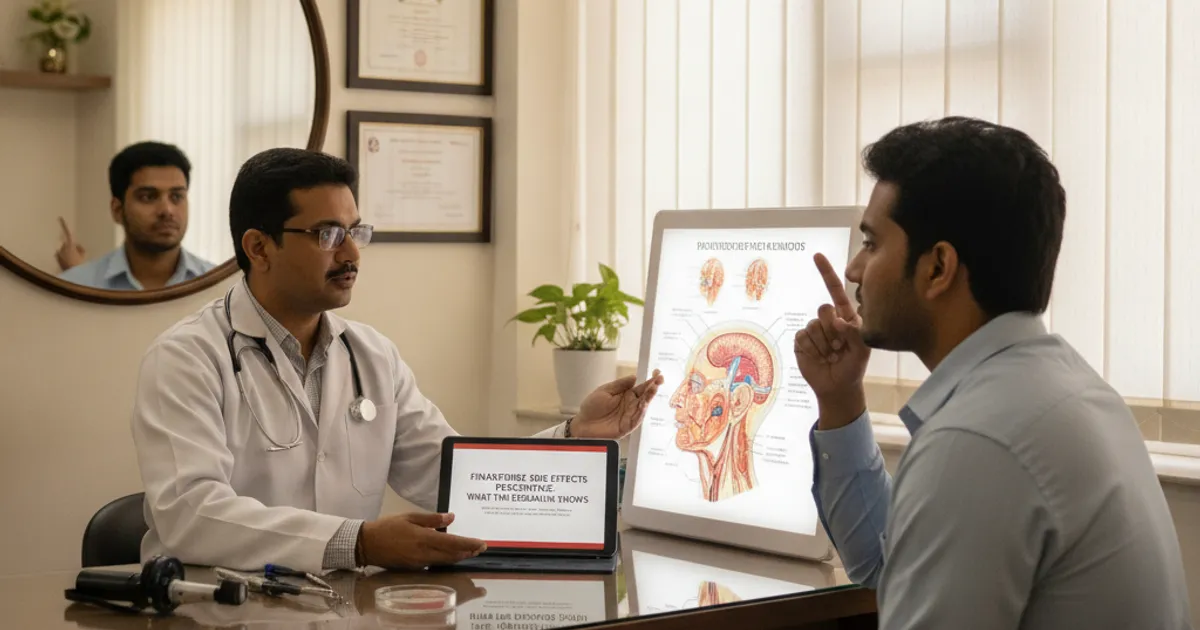
What Percentage of Men Experience Finasteride Side Effects?
If you search for a finasteride side effects percentage, you'll find a dozen different numbers. Some articles say 2 percent. Some say 10 percent. Some say it's basically zero. The honest answer is that the exact percentage depends entirely on which study you're reading, how the researchers defined a side effect, and whether the study had a placebo control. What we can say with confidence is that in the large, placebo-controlled trials that got finasteride approved for hair loss, side effects were uncommon, usually mild, and only slightly more frequent than in men taking a sugar pill. The gap between finasteride and placebo is the number that actually matters — and it's small.
Why Exact Finasteride Side Effect Percentages Are Hard to Pin Down
Clinical trials and real-world experience measure different things. A trial asks men a fixed set of questions at fixed intervals and compares their answers to a placebo group. Real-world reporting is messier: men who had a bad experience are more likely to post about it online, and men who are fine mostly stay quiet. That's not a conspiracy — it's just how reporting bias works. It means the percentage you see on a forum is not the same kind of number as the percentage you see in a trial. Both are real, but they answer different questions. If you want to estimate your own risk, the placebo-controlled data is the better guide.
Finasteride Side Effects: What the Placebo-Controlled Trials Show
The core evidence comes from the large randomized trials that led to finasteride's approval for male pattern hair loss, plus the long-term extension studies that followed those men for several years. Across those studies, the pattern is consistent: sexual side effects are the most commonly reported, they occur in a low single-digit percentage of men, and the placebo group reports many of the same complaints. The table below summarizes the general pattern from that body of research. Because different studies used different definitions and follow-up periods, the figures are best understood as approximate ranges rather than precise rates.
| Side Effect | Relative Frequency in Trials | Notes |
|---|---|---|
| Decreased libido | Most commonly reported sexual side effect | Usually mild; often resolves on its own |
| Erectile dysfunction | Reported, but only slightly above placebo | Placebo group reports similar complaints |
| Ejaculation disorder | Less common than libido or ED | Includes reduced volume or delayed ejaculation |
| Breast tenderness or enlargement | Rare | More common at higher doses used for prostate conditions |
| Depressed mood | Uncommon and close to placebo rate | Baseline mood history matters more than the drug |
| Any sexual side effect | Low single digits overall | Gap versus placebo is small |
The ranges reflect differences between studies, how symptoms were defined, and how long men were followed. The pattern is consistent: finasteride side effects are real, but they're uncommon, and the placebo group isn't far behind.
How Side Effect Rates Compare: Finasteride vs. Placebo
Finasteride 1 mg
Low single-digit side effect rate
- ✓ Sexual side effects: most commonly reported category
- ✓ Breast changes: rare
- ✓ Mood changes: uncommon and close to placebo
- ✓ Most symptoms resolve after stopping
Placebo
Similar but slightly lower rate
- ✓ Sexual side effects: reported by a meaningful share of men
- ✓ Breast changes: very rare
- ✓ Mood changes: similar to finasteride group
- ✓ Shows how much is expectation or nocebo
The placebo comparison is the most important part of this whole topic. If a meaningful share of men on placebo report sexual side effects, then a big chunk of what gets blamed on finasteride is actually just background noise — anxiety, relationship stress, age, or the nocebo effect. The true drug-attributable rate is the difference between the two columns, which is small. That's why the headline percentage you see quoted is often misleading: it lumps together everything the finasteride group reported, without subtracting what the placebo group reported too.
Sexual Side Effects: How Common Are They Really?
- Decreased libido is the most commonly reported finasteride side effect in trials.
- Erectile dysfunction is reported, but only slightly more often than in the placebo group.
- Ejaculation problems (reduced volume, delayed ejaculation) are less common than libido or ED complaints.
- Combined, any sexual side effect shows up in a low single-digit percentage of men on finasteride, with a similar but slightly lower rate on placebo.
- Real-world observational studies sometimes report higher rates, but these lack placebo controls and are prone to reporting bias.
The gap between clinical trial numbers and online forum numbers is worth understanding. Trials ask men directly and compare against placebo. Forums attract people who had a bad experience. Both are real, but they measure different things. If you're trying to estimate your own risk, the placebo-controlled data is the better guide.
Do Side Effects Go Away? Persistence and Recovery
For the vast majority of men who develop side effects, symptoms resolve within weeks to a few months of stopping finasteride. In the clinical trials, side effects typically disappeared after discontinuation, and the rates of persistent symptoms were very low. A small minority of men report symptoms lasting beyond three months after stopping — sometimes called post-finasteride syndrome — but this is not well understood and remains a subject of ongoing research rather than a clearly defined, measurable rate. The honest position is that persistent symptoms are reported, they're rare, and the research is still evolving.
- Most sexual side effects resolve within days to weeks after stopping the drug.
- In trials, the number of men with side effects that persisted after stopping was extremely small.
- Some men choose to lower the dose rather than stop completely, and report fewer symptoms.
- Persistent symptoms beyond three months after stopping are reported but rare and not well quantified in controlled studies.
- If you experience side effects, talk to your prescriber before stopping — abrupt changes can be confusing to track.
Who Is More Likely to Get Side Effects?
There's no reliable way to predict who will get side effects, but some patterns show up in the data. Age, baseline sexual function, and psychological factors all seem to play a role. Men who are already anxious about sexual performance or who have underlying mood issues tend to report more side effects — which is part of why placebo rates are so high.
- Older men tend to report slightly more sexual side effects, though the difference is modest.
- Men with pre-existing sexual dysfunction are more likely to notice changes.
- Anxiety and depression at baseline correlate with higher reporting of side effects.
- Men who read extensively about side effects before starting report them more often — a classic nocebo pattern.
- Higher doses used for prostate conditions have a higher reported side effect rate than the 1 mg hair loss dose.
How to Reduce Your Risk of Finasteride Side Effects
None of this is a guarantee. Some men do get side effects and have to stop. But the odds are strongly in your favor, and a few practical steps make it easier to separate a real drug effect from background noise. Start at the standard dose rather than experimenting on your own. Keep a simple log of how you feel for the first few months so you have something concrete to discuss with your prescriber. And if you're already anxious about sexual performance, address that separately — it's a bigger driver of reported side effects than most men realize.
Finasteride Side Effects: What the Research Says
The core research comes from the finasteride 1 mg trials published in the late 1990s and early 2000s, plus long-term extension studies that followed men for several years. Those studies consistently found side effect rates in the low single digits and a small but real gap versus placebo. Later observational studies have reported higher rates, but they lack the controls that make the trial data trustworthy. The honest summary: finasteride side effects are uncommon, usually mild, usually reversible, and the percentage of men affected is much smaller than the internet would have you believe.
If you're weighing finasteride against other treatments, it helps to see how it fits into the bigger picture. Our guide to hair loss treatment options covers the full range, and if you're considering a transplant alongside medication, comparing clinics near you can help you understand what's available.
Frequently Asked Questions About Finasteride Side Effects
What percentage of men get side effects from finasteride?
In placebo-controlled trials, side effects occur in a low single-digit percentage of men on finasteride, with a similar but slightly lower rate on placebo. Sexual side effects are the most common, but the gap between finasteride and placebo is small. Exact percentages vary by study and how symptoms were defined.
Are finasteride side effects permanent?
For most men, no. Side effects typically resolve within weeks to a few months after stopping the drug. A small number of men report symptoms lasting longer than three months after stopping, but this is rare and not well quantified in controlled research.
Does lowering the dose reduce side effects?
Many men who experience side effects at the standard dose find that a lower dose still helps with hair loss while reducing symptoms. Talk to your prescriber before changing your dose — they can help you decide whether lowering it makes sense for you.
Is finasteride safe for long-term use?
Long-term extension studies of finasteride for hair loss have not shown new or unexpected safety signals, and side effect rates remain low over time. As with any medication, regular check-ins with your doctor are sensible, especially if you notice any changes.
Can finasteride cause depression?
Mood changes are reported in a small percentage of users in trials, which is close to the placebo rate. If you have a history of depression, discuss it with your doctor before starting finasteride.
The bottom line: finasteride side effects are real but uncommon, and the percentage of men affected is small — especially when you subtract the placebo effect. If you're considering finasteride for hair loss, the odds are good that you'll tolerate it fine. If you do get side effects, they usually go away after stopping. And if you're exploring a transplant alongside medication, comparing clinics is a smart next step.
More Guides
- Finasteride Sexual Side Effects: Permanent or Reversible?
Can finasteride sexual side effects be permanent? Research on persistent symptoms, post-finasteride syndrome, and what to do if side effects don't resolve.
- Hair Transplant Cost: What You'll Actually Pay
Hair transplant costs vary by graft count, technique, and location. Learn how pricing works by hair loss stage and what factors affect your final bill.
- Does Finasteride Work for a Receding Hairline?
Finasteride can slow or stop a receding hairline in many men. Learn how it works, what to expect, and when a hair transplant makes more sense.
- How Much Does Finasteride Cost Per Month?
Finasteride cost per month varies by generic vs brand, dose, and pharmacy. Learn what affects your monthly bill and how to keep costs down.