
Follicle Inflammation and Fibrosis: Permanent Hair Loss?
Can follicle inflammation and fibrosis cause permanent hair loss? Learn causes, symptoms, diagnosis, treatment options, and whether a hair transplant can help.
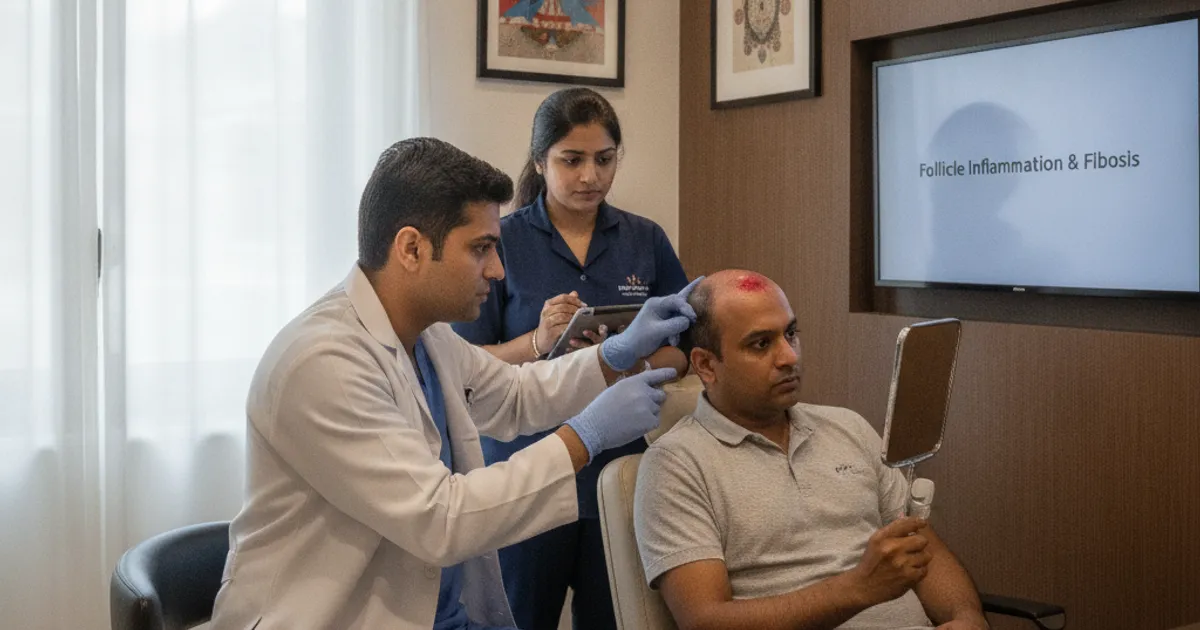
What Is Follicle Inflammation and Fibrosis?
Follicle inflammation and fibrosis is a condition where the hair follicles become inflamed, and over time, this inflammation leads to the formation of scar tissue (fibrosis) that replaces the follicle. Once fibrosis sets in, the follicle is destroyed and cannot regrow hair. This is different from common pattern hair loss, where follicles miniaturize but remain alive. In fibrotic scalp conditions, the damage is permanent. The most well-known form is scarring alopecia, also called cicatricial alopecia. It can affect people of any age, though it's more common in adults. The inflammation may start subtly, with itching or tenderness, and progress to visible hair loss and scalp changes. Because the follicle is replaced by scar tissue, early diagnosis and treatment are critical to saving remaining hair.
How Follicle Inflammation Progresses to Fibrosis
The progression from inflammation to fibrosis is a multi-step process. It often starts with an immune reaction or infection that irritates the hair follicle. If the trigger persists, the body's repair mechanisms kick in, laying down collagen and other fibrous tissue. This scar tissue gradually replaces the normal follicle structure. The speed of progression varies. Some people experience rapid hair loss over months, while others see slow thinning over years. Recognizing the early signs is key to intervening before fibrosis becomes widespread.
- Trigger: An immune attack, infection, or physical trauma initiates inflammation around the follicle.
- Chronic inflammation: The body continues to send inflammatory cells, causing ongoing damage.
- Fibrosis: Fibroblasts produce collagen, forming scar tissue that replaces the follicle.
- Follicle destruction: The hair shaft is lost, and the follicle is no longer able to produce hair.
- Permanent baldness: The area becomes smooth and shiny, with no visible openings where hair once grew.
Common Causes and Risk Factors
Several conditions can lead to follicle inflammation and fibrosis. The exact cause isn't always clear, but it often involves an autoimmune response or an infection. Risk factors include genetics, certain skin conditions, and lifestyle factors. Understanding these can help you identify if you're at risk and seek early evaluation.
- Autoimmune conditions: Lichen planopilaris, discoid lupus erythematosus, and frontal fibrosing alopecia are common culprits.
- Infections: Folliculitis decalvans, a bacterial infection, can cause severe inflammation and scarring.
- Physical trauma: Repeated pulling (traction alopecia) or chemical burns can lead to scarring.
- Genetic predisposition: Some people are more prone to inflammatory scalp conditions.
- Environmental factors: Harsh hair care practices, tight hairstyles, and exposure to certain chemicals may contribute.
| Condition | Typical Cause | Key Feature |
|---|---|---|
| Lichen planopilaris | Autoimmune | Perifollicular scaling, redness, and scarring |
| Discoid lupus | Autoimmune | Disc-shaped lesions, often on sun-exposed areas |
| Folliculitis decalvans | Bacterial infection | Painful pustules, crusting, and tufted hairs |
| Frontal fibrosing alopecia | Autoimmune (hormonal link) | Receding hairline, eyebrow loss, band-like scarring |
| Traction alopecia | Physical trauma | Hair loss along the hairline, often from tight braids |
Symptoms and Warning Signs
The symptoms of follicle inflammation and fibrosis can be subtle at first. Many people dismiss itching or mild tenderness as normal. But when these signs persist, they may indicate an underlying inflammatory process. Early symptoms include itching, burning, and tenderness in the scalp. As the condition progresses, you may notice hair thinning, patches of hair loss, and changes in the scalp's appearance. The scalp may become smooth, shiny, and lose its natural texture. In some cases, redness, scaling, and pustules are visible. If you experience any of these, see a dermatologist promptly.
- Itching, burning, or pain in the scalp
- Redness, scaling, or flaking around hair follicles
- Patches of hair loss that expand over time
- Smooth, shiny scalp where hair has been lost
- Loss of follicular openings (no visible pores)
- Eyebrow or eyelash loss (in frontal fibrosing alopecia)
How Is It Diagnosed?
Diagnosing follicle inflammation and fibrosis requires a thorough evaluation by a dermatologist. Your doctor will start with a medical history and scalp examination. They may use a dermatoscope to look closely at the follicles and scalp surface. In many cases, a scalp biopsy is necessary to confirm the diagnosis and rule out other conditions. Blood tests may be ordered to check for underlying autoimmune diseases or infections. Early diagnosis is crucial because once fibrosis occurs, the damage is permanent.
- Medical history: Discuss symptoms, duration, and any known autoimmune conditions.
- Physical exam: Visual inspection and palpation of the scalp.
- Dermoscopy: Magnified view of the scalp to assess follicle openings and signs of inflammation.
- Scalp biopsy: A small tissue sample examined under a microscope to confirm fibrosis and inflammation.
- Blood tests: To detect autoimmune markers or infections.
| Diagnostic Tool | What It Shows | When It's Used |
|---|---|---|
| Dermoscopy | Loss of follicular openings, perifollicular scaling, redness | Initial evaluation |
| Scalp biopsy | Presence of inflammatory cells and fibrous tissue | To confirm diagnosis |
| Blood tests | Autoimmune antibodies, infection markers | If autoimmune cause suspected |
Treatment Options: Can Inflammation and Fibrosis Be Reversed?
Once fibrosis has occurred, it cannot be reversed. The scar tissue permanently replaces the follicle. However, treatment can stop the inflammation from spreading and preserve remaining hair. The goal is to control symptoms, halt progression, and manage any underlying condition. Treatment options depend on the cause and severity. They include topical and oral medications, injections, and procedures like platelet-rich plasma (PRP) therapy. In some cases, hair transplantation may be considered for areas of permanent loss, but only after the inflammation is controlled.
- Topical corticosteroids: Reduce inflammation and itching.
- Oral medications: Immunosuppressants (e.g., hydroxychloroquine) for autoimmune causes; antibiotics for bacterial infections.
- Intralesional steroid injections: Directly into affected areas to calm inflammation.
- Minoxidil: May help stimulate hair growth in non-scarred areas.
- Finasteride: Sometimes used off-label for certain types of scarring alopecia, but not standard.
- PRP therapy: Emerging option to promote healing and reduce inflammation.
- Hair transplant: Only after inflammation is controlled and stable.
| Treatment | Purpose | Effectiveness |
|---|---|---|
| Topical corticosteroids | Reduce inflammation | Effective for mild cases |
| Oral immunosuppressants | Control autoimmune response | Variable, requires monitoring |
| Antibiotics | Treat bacterial infection | Effective for folliculitis decalvans |
| PRP therapy | Promote healing | Limited evidence, may help |
| Hair transplant | Restore hair in scarred areas | Possible if inflammation is controlled |
Is a Hair Transplant Suitable for Fibrotic Scalp?
A hair transplant can be an option for people with fibrotic scalp, but it's not straightforward. The success depends on whether the inflammation is fully controlled and how much scar tissue is present. In scarred areas, blood supply is often reduced, which can affect graft survival. Therefore, a transplant is usually considered only after the underlying condition has been inactive for at least a year. Even then, the results may be less predictable than in non-scarred scalp. A skilled surgeon will assess the scalp's condition and discuss realistic expectations. In some cases, a test transplant of a few grafts may be done to see how well they grow.
- Inflammation must be completely controlled before surgery.
- Scar tissue reduces blood flow, which can compromise graft survival.
- A test transplant may be recommended to assess graft take.
- Results are often less dense than in normal scalp.
- Only experienced surgeons should perform transplants on scarred scalps.
Preventing Permanent Hair Loss: What You Can Do
Prevention focuses on early detection and prompt treatment. If you have a known autoimmune condition or notice early symptoms, see a dermatologist. Avoid harsh hair treatments and tight hairstyles that can cause traction. Manage underlying conditions with the help of your doctor. Once fibrosis occurs, it's permanent, so the best strategy is to act before scarring develops.
- Monitor your scalp for early signs: itching, redness, tenderness.
- Seek medical advice if symptoms persist beyond a few weeks.
- Follow your treatment plan consistently to control inflammation.
- Avoid tight hairstyles and harsh chemicals.
- Manage autoimmune conditions with your healthcare provider.
Frequently Asked Questions
Can follicle inflammation and fibrosis be cured?
There is no cure for fibrosis once it occurs. Treatment focuses on controlling inflammation and preventing further hair loss.
Is hair loss from fibrosis permanent?
Yes, hair loss from fibrosis is permanent because the follicle is replaced by scar tissue and cannot regenerate.
Can a hair transplant fix scarring alopecia?
A hair transplant can help in some cases, but only after the inflammation is controlled. Results may be less predictable due to reduced blood flow in scarred areas.
What treatments are available for follicle inflammation?
Treatments include topical and oral corticosteroids, immunosuppressants, antibiotics, PRP therapy, and minoxidil. The choice depends on the underlying cause.
How can I prevent permanent hair loss from fibrosis?
Early diagnosis and treatment are key. If you notice scalp symptoms, see a dermatologist promptly. Avoid harsh hair practices and manage underlying conditions.
More Guides
- Minoxidil Contact Dermatitis: Signs and Alternatives
Learn the signs of minoxidil contact dermatitis, how it's diagnosed, treatment options, and alternatives like finasteride, PRP, and hair transplant surgery.
- Can Radiotherapy Cause Hair Loss? What to Expect
Radiotherapy can cause temporary or permanent hair loss. Learn the causes, symptoms, diagnosis, treatment options, and whether a hair transplant is suitable.
- Hair Loss After Illness or High Fever: When Does It Stop?
Hair loss after illness or high fever is usually temporary telogen effluvium. Learn causes, symptoms, diagnosis, treatment, and when a hair transplant may help.
- Can Dandruff Cause Hair Loss? Facts vs Folklore
Does dandruff cause hair loss? We separate fact from folklore, explain the real connection, diagnosis, treatments, and when a hair transplant makes sense.