
FUE Graft Survival Rate: What Affects How Many Grafts Take
FUE graft survival rate explained: what it is, factors that affect how many grafts take, recovery timeline, results, and how FUE compares to other techniques.
What Is FUE Graft Survival Rate?
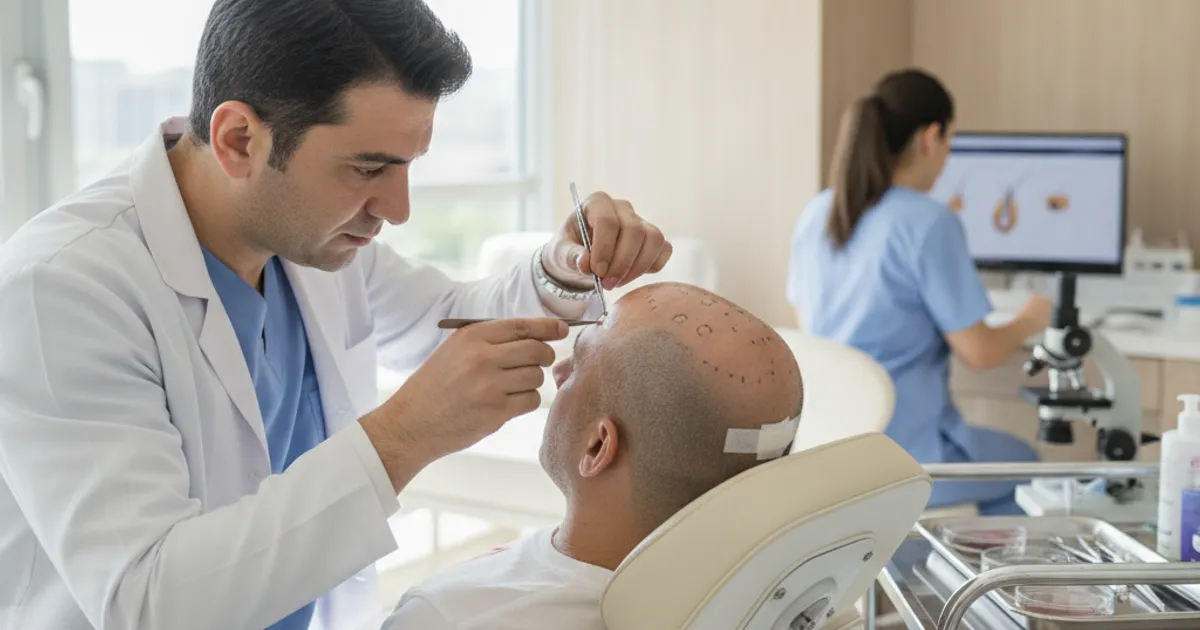
FUE graft survival rate is the percentage of individual hair follicles that are successfully transplanted during a Follicular Unit Extraction (FUE) procedure and go on to grow healthy hair in their new location. When a surgeon extracts a graft, it goes through a period without a blood supply. How well that graft is handled, stored, and implanted determines whether it survives the transplant and produces a hair shaft long-term. Survival rate is not the same as 'take rate' — a graft can survive but produce a thin or weak hair. Most experienced surgeons aim for a high survival rate, but the exact figure depends on many variables covered below.
How FUE Surgery Affects Graft Survival
FUE involves punching tiny circular incisions around individual follicular units and pulling them out one by one. Because each graft is handled individually, the technique places more mechanical stress on follicles than strip surgery (FUT), where a single strip of scalp is removed and dissected under a microscope. That said, modern FUE with small punch sizes, sharp instruments, and careful handling can achieve survival rates comparable to FUT. The key stages that affect survival are:
- Extraction: punch size, angle, depth, and speed. Too much trauma or heat can kill the follicle.
- Holding solution: grafts must be kept in a cold, pH-balanced solution (like saline or HypoThermosol) to stay viable.
- Out-of-body time: the longer a graft is outside the body, the lower its chance of survival.
- Implantation: how gently the graft is placed into the recipient site. Crushing or popping the graft damages it.
- Recipient site creation: pre-made slits vs. stick-and-place. Both work, but technique affects trauma.
| Surgical Factor | Effect on Graft Survival | What Good Looks Like |
|---|---|---|
| Punch size | Smaller punches reduce trauma but require more skill | Smaller punches for most scalp hair |
| Graft handling | Rough handling crushes follicles and lowers survival | Forceps only on the fat, not the bulb |
| Storage solution | Wrong temperature or pH kills grafts | Cold holding solution, changed regularly |
| Time out of body | Longer time = lower survival | Minimize time out of body |
| Implantation method | Forceful placement damages grafts | Gentle, no-touch or low-touch technique |
Key Factors That Determine How Many Grafts Take
Not all grafts are equal. Some patients have robust follicles that survive almost anything, while others see more shedding. The main factors fall into three buckets: patient biology, surgeon skill, and post-op care. Here is what matters most.
- Donor hair quality: thicker, darker hair with good density tends to survive better than fine, light hair.
- Scalp condition: scarring, inflammation, or poor blood flow in the recipient area can reduce survival.
- Smoking: nicotine constricts blood vessels and lowers oxygen delivery to grafts. Smokers often see lower survival.
- Surgeon experience: a skilled surgeon extracts and places grafts faster and with less trauma.
- Graft count: very large sessions can push the limits of out-of-body time and team fatigue.
- Post-op adherence: following aftercare instructions (no scratching, no sun, proper washing) protects grafts.
| Factor | Impact on Survival | Can You Control It? |
|---|---|---|
| Smoking | High negative impact | Yes — stop before and after |
| Surgeon skill | High positive impact | Yes — choose an experienced clinic |
| Donor hair quality | Moderate impact | No — genetic |
| Graft storage time | Moderate negative impact | Partly — choose a clinic with efficient workflow |
| Scalp blood flow | Moderate impact | Partly — treat scalp conditions first |
| Post-op care | Moderate positive impact | Yes — follow instructions exactly |
The FUE Recovery Timeline and Graft Survival
The first two weeks after FUE are critical for graft survival. During this window, grafts are establishing a new blood supply. Most clinics advise gentle washing, no strenuous exercise, and no direct sun exposure. Around day 10–14, scabs fall off and you can usually return to normal activities. The transplanted hair often sheds between weeks 2 and 8 — this is normal and does not mean the graft died. The follicle remains alive under the skin and starts producing new hair around month 3–4. Full results are typically seen at 12–18 months.
- Days 1–3: Grafts are fragile. Sleep upright, avoid touching the recipient area.
- Days 4–7: First gentle wash. Scabs begin to form and dry.
- Days 8–14: Scabs fall off naturally. Most grafts are now anchored.
- Weeks 2–8: Shock loss and shedding of transplanted hair. Grafts are alive but dormant.
- Months 3–4: New hair starts to grow. This is when you see early survival results.
- Months 6–12: Hair thickens and matures. Final survival rate is visible.
- Months 12–18: Full results. Any gaps or thin areas are now clear.
Expected Results: What Survival Rate Means for Your Hair
If a clinic quotes a high survival rate, it means that out of every 100 grafts transplanted, most will grow hair. For a typical session, that translates to a high number of surviving grafts. Each graft can contain multiple hairs, so the total hair count is higher. A high survival rate matters most for patients with limited donor hair — every lost graft is a wasted resource. For those with abundant donor supply, a slightly lower survival rate may still produce a good result, but it is still worth aiming high.
- Survival rate affects density: more surviving grafts = thicker, fuller result.
- It affects how many procedures you need: low survival may require a second session.
- It affects cost-effectiveness: you pay per graft, so wasted grafts are wasted money.
- It affects donor area preservation: poor survival means more grafts harvested than necessary.
Who Is a Good Candidate for High FUE Graft Survival?
Not everyone is equally suited to FUE. The best candidates for high graft survival tend to have certain characteristics. That said, even if you have some risk factors, a skilled surgeon can often adjust the plan to improve outcomes.
- Good donor density: enough hair on the back and sides of the scalp.
- Healthy scalp: no active infections, psoriasis, or severe scarring.
- Non-smoker or willing to quit: smoking significantly reduces survival.
- Realistic expectations: understanding that FUE is not a cure for ongoing hair loss.
- Stable hair loss: waiting until loss pattern is clear helps avoid wasting grafts.
- Good general health: conditions like diabetes or autoimmune disorders can affect healing.
Cost Considerations for FUE Graft Survival
FUE pricing is usually per graft, and the total cost depends on how many grafts you need. The stage of hair loss largely determines that number. Below are average case prices for early, moderate, and advanced hair loss. These are median figures from clinic listings and are meant as a general guide, not a quote. Prices vary by clinic, surgeon experience, and location.
FUE vs. Other Techniques: Graft Survival Comparison
FUE is not the only option. FUT (strip surgery) and DHI (Direct Hair Implantation) are two common alternatives. Each has trade-offs for graft survival. FUT generally has a slightly higher survival rate because grafts are dissected under a microscope with less mechanical stress. DHI is a variant of FUE where grafts are implanted immediately after extraction, which can reduce out-of-body time. The table below compares them.
| Technique | Typical Survival Rate | Pros | Cons |
|---|---|---|---|
| FUE | High | No linear scar, faster recovery, versatile | More handling per graft, can be slower |
| FUT | High | Higher survival in some studies, good for large sessions | Linear scar, longer recovery |
| DHI | Similar to FUE | Immediate implantation, precise angle control | Slower, often more expensive |
Choosing a Clinic to Maximize Graft Survival
The clinic and surgeon you choose have the biggest impact on graft survival that you can control. Here is what to look for when comparing providers.
- Surgeon involvement: does the surgeon perform the extraction and implantation, or do technicians?
- Experience with your hair type: some clinics specialize in certain ethnicities or hair textures.
- Graft handling protocol: ask about holding solutions, time out of body, and team size.
- Before-and-after photos: look for consistent results, not just one good case.
- Reviews and testimonials: check independent sources, not just the clinic website.
- Consultation: a good clinic will assess your donor area and discuss realistic survival expectations.
FAQ: FUE Graft Survival Rate
What is a good FUE graft survival rate?
Most experienced surgeons aim for a high survival rate. However, survival rate is not the only measure — hair thickness and growth direction also matter.
Can I increase my graft survival rate after surgery?
Yes. Following post-op instructions exactly — no smoking, no scratching, gentle washing, avoiding sun and strenuous exercise — can protect grafts during the critical first two weeks. Some clinics also recommend PRP therapy to support healing, though evidence for its effect on survival is mixed.
Does FUE have a lower survival rate than FUT?
Historically, FUT had a slightly higher survival rate because grafts are dissected under a microscope with less handling. However, modern FUE with small punches and careful technique can achieve comparable survival rates. The skill of the surgeon matters more than the technique itself.
How soon can I judge my FUE graft survival?
You cannot judge survival until at least 6 months after surgery. Transplanted hair sheds in the first 2–8 weeks, which is normal. New growth starts around month 3–4, and final survival rate is visible at 12–18 months.
More Guides
- Hair Transplant for Curly Hair: Graft and Technique Tips
A plain-English guide to hair transplants for curly hair: how surgeons adapt graft harvesting and placement, recovery, results, costs, and who it suits.
- How Long Does a Hair Transplant Last? Long-Term Durability
How long does a hair transplant last? We explain the procedure, recovery, durability, costs by stage of hair loss, and how it compares to alternatives.
- Hair Transplant Revision: When a Second Procedure Makes Sense
Considering a hair transplant revision? Learn how a second procedure works, who it suits, recovery, results, and costs. Expert explainer from Clinic Reccy.
- Hair Transplant for Norwood 6 and 7: What's Possible
A clear look at hair transplant options for Norwood 6 and 7 hair loss: graft limits, staging, recovery, costs, and realistic results.