
Hair Transplant for Curly Hair: What to Expect
A plain-English guide to hair transplants for curly hair: how surgeons adapt the technique, recovery, results, candidacy, cost by stage, and alternatives.
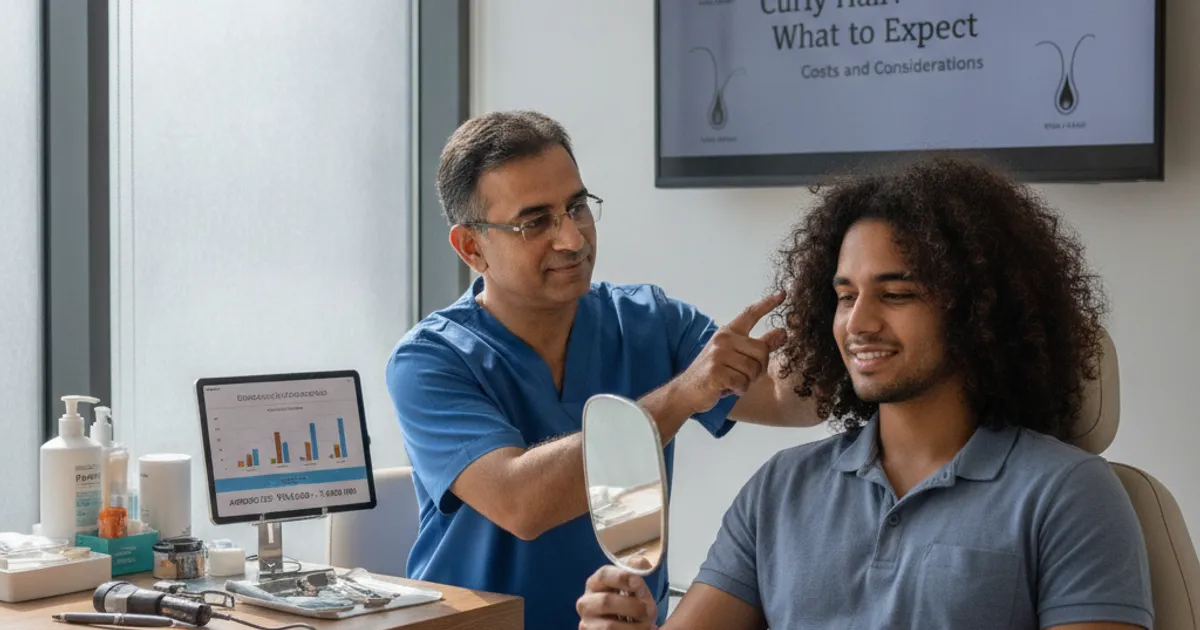
What Is a Hair Transplant for Curly Hair?
A hair transplant for curly hair is the same basic idea as any other hair transplant: hair follicles are moved from a donor area (usually the back and sides of the scalp) into thinning or bald spots. The difference is in the details. Curly and coily hair grows in tight spirals, which changes how grafts are extracted, how they sit in the scalp, and how the final result looks as it grows out. It is not a different surgery so much as a different set of surgical decisions made around your curl pattern.
How Curly Hair Changes the Surgical Approach
The main challenge with curly hair is that the follicle curves under the skin. Straight hair follicles tend to run fairly parallel to the surface, so a surgeon can predict the angle and depth with reasonable confidence. Curly follicles can bend, twist, and sit at unexpected angles, which makes extraction more delicate. Get the punch angle wrong and you can transect (cut) the follicle, which means that graft is wasted. This is why curly hair transplants tend to take longer and why surgeon skill matters so much.
- Follicles curve beneath the skin, so extraction angles are harder to predict than with straight hair.
- Grafts are often handled more gently and placed with slightly more spacing to avoid popping or compression.
- Donor area scarring can be more visible if the surrounding hair is very curly, because the curl pattern breaks up around the scar.
- Shock loss after surgery can look more dramatic on curly hair because the shed hairs are longer and more noticeable.
- Graft counts may need to be higher in some cases to achieve the same visual density, since curly hair covers less scalp per strand.
How the Procedure Is Performed
The day itself follows a fairly standard rhythm, but with curly-hair-specific adjustments. Most surgeons use FUE (follicular unit extraction) for curly hair because it avoids a linear strip scar and lets the surgeon pick individual grafts. FUT (strip surgery) is still an option, especially for advanced loss, but the strip scar can be harder to hide under tight curls. Here is the general sequence.
Recovery Timeline and Aftercare
Recovery for curly hair transplants is broadly similar to straight-hair transplants, but there are a few curly-specific wrinkles. The main one is that you cannot easily hide the donor area with a fade or a short cut, because cutting curly hair short can look uneven. Many people grow their hair out a bit before surgery so the donor area is easier to cover during the first few weeks. Scabbing, redness, and tenderness are normal. The transplanted hairs usually shed within two to eight weeks, then regrow over the following months.
| Timeframe | What to Expect | Curly-Hair Notes |
|---|---|---|
| Days 1–3 | Swelling, tenderness, small scabs | Sleep propped up; avoid rubbing the donor area |
| Week 1 | Scabs loosen, first wash at clinic or at home | Use a gentle, sulphate-free shampoo |
| Weeks 2–4 | Redness fades, transplanted hairs start to shed | Shedding can look more dramatic with long curls |
| Months 2–4 | Dormant phase, little visible growth | Donor area may look patchy if hair is short |
| Months 5–8 | New hairs grow in, often finer and curlier at first | Curl pattern may look tighter or looser than surrounding hair |
| Months 9–12 | Maturation, density and texture settle | Final result is usually judged around 12 months |
| 12–18 months | Full result, any touch-up considered | Some clinics wait 18 months before a second session |
Results: What Curly Hair Grafts Look Like as They Grow
The honest answer is that curly hair transplants can look excellent, but the first year is a bit of a rollercoaster. Newly transplanted hairs often grow in with a different curl pattern than the surrounding hair, at least at first. They may look straighter, kinkier, or finer. Over time, most grafts settle into a pattern that blends reasonably well, but it is rare for the match to be perfect. The goal is coverage and a natural-looking hairline, not a strand-for-strand replica.
- Early growth (months 3–6) often looks thin and uneven, which is normal.
- Curl pattern can change slightly after transplantation; some grafts grow straighter, some tighter.
- Density builds gradually, so patience is part of the process.
- Hairline design matters more with curly hair because the curl can soften or exaggerate the line.
- A second session is sometimes needed to reach the density you want, especially for advanced loss.
Who Is a Good Candidate?
Curly hair does not disqualify you from a transplant, but it does narrow the pool of surgeons who are a good fit. The best candidates have a stable donor area, realistic expectations, and enough donor density to support the number of grafts needed. If your hair loss is still progressing quickly, most surgeons will suggest stabilising it with medication first. Curly hair can actually be an advantage in one way: the volume and coverage per strand is higher, so you may need fewer grafts to get a good visual result.
- You have a healthy donor area with good density at the back and sides.
- Your hair loss pattern has been stable for at least a year, or you are on treatment to slow it down.
- You understand that curl pattern may not match perfectly and that results take 12 months or more.
- You are willing to follow aftercare instructions carefully, especially in the first two weeks.
- You have realistic expectations about density, coverage, and the possibility of a second session.
Cost Considerations for Curly Hair Transplants
Pricing for curly hair transplants is usually quoted per graft, per session, or as a flat fee based on the number of grafts. Because curly hair transplants can take longer and may require more careful handling, some clinics charge a modest premium, but many do not. The biggest cost driver is the number of grafts needed, which depends on your stage of hair loss. Below are averaged case prices by stage, based on typical clinic pricing data. These are averages, not quotes, and your actual price will depend on the clinic, the surgeon, and your specific case.
| Stage of Hair Loss | Typical Graft Range | Average Case Price (USD) | Notes |
|---|---|---|---|
| Early (Norwood 2–3) | 1,000–1,800 grafts | 2,500–4,500 | Hairline and temples, single session usually enough |
| Moderate (Norwood 4–5) | 1,800–3,000 grafts | 4,500–8,000 | Mid-scalp and crown may need coverage |
| Advanced (Norwood 6–7) | 3,000–5,000+ grafts | 8,000–15,000 | Often two sessions; donor supply is the limiting factor |
How It Compares to Alternatives
A hair transplant is not the only option, and for some people it is not the best first step. Medication, scalp micropigmentation, hair systems, and simply growing your hair longer can all change how thinning looks. The table below compares the main alternatives on the things that usually matter: upfront cost, how long results last, and how much maintenance is involved.
| Option | Upfront Cost (USD) | Duration of Result | Maintenance | Best For |
|---|---|---|---|---|
| Hair transplant (FUE/FUT) | 2,500–15,000+ | Long-term (grafts are permanent) | Minimal after healing | Stable loss, good donor area |
| Medication (finasteride/minoxidil) | Low monthly cost | Only while used | Daily or ongoing | Slowing loss, early stages |
| Scalp micropigmentation | 1,000–4,000 | 2–5 years before touch-up | Touch-ups every few years | Short hair, camouflage |
| Hair system / toupee | 500–3,000+ | Months per unit | Regular replacement and upkeep | Quick cosmetic fix |
| Growing hair longer / styling | Low | Temporary | Regular cuts and care | Hiding mild thinning |
Choosing a Clinic for Curly Hair
The single most important factor in a curly hair transplant is the surgeon, not the clinic's marketing. You want someone who has a portfolio of curly-hair cases, who can show you before-and-after photos of clients with a similar curl pattern, and who is honest about what is achievable. Ask about graft handling, punch sizes, and how they plan the hairline around your curl direction. If you are travelling, ask about aftercare support and whether the clinic offers remote follow-ups.
- Ask to see before-and-after photos of clients with your curl type, not just straight-hair cases.
- Confirm whether the surgeon or a technician performs the extraction and implantation.
- Ask how many curly-hair cases the clinic does per month.
- Check what aftercare is included: follow-up visits, medication, PRP, or wash kits.
- Read the fine print on revision policies and what happens if you need a second session.
- If travelling, confirm whether airport pickup, accommodation, or a translator is included.
Frequently Asked Questions
Can you get a hair transplant if you have curly or coily hair?
Yes. Curly and coily hair can be transplanted successfully. The surgery is the same in principle as for straight hair, but the surgeon needs experience with curved follicles because extraction angles are harder to predict. Ask to see cases with a similar curl pattern before you book.
Will the transplanted hair keep its curl pattern?
Usually, yes, but not always perfectly. Transplanted follicles tend to retain their original characteristics, so curly donor hair usually grows back curly. However, the first growth phase can look straighter, finer, or kinkier than the surrounding hair, and it may take 12 months or more for the pattern to settle.
Is a curly hair transplant more expensive?
Not necessarily. Pricing is usually based on graft count and clinic overhead, not curl pattern. Some clinics charge a small premium because curly-hair cases take longer, but many do not. The main cost driver is how many grafts you need, which depends on your stage of hair loss.
How long does it take to see results?
Transplanted hairs typically shed within two to eight weeks, then regrow over the following months. You will usually see early growth around months 3 to 6, noticeable density around months 6 to 9, and a mature result around 12 months. Some clinics wait up to 18 months before judging the final outcome.
More Guides
- Hair Transplant for Curly Hair: Graft and Technique Tips
A plain-English guide to hair transplants for curly hair: how surgeons adapt graft harvesting and placement, recovery, results, costs, and who it suits.
- How Long Does a Hair Transplant Last? Long-Term Durability
How long does a hair transplant last? We explain the procedure, recovery, durability, costs by stage of hair loss, and how it compares to alternatives.
- Hair Transplant Revision: When a Second Procedure Makes Sense
Considering a hair transplant revision? Learn how a second procedure works, who it suits, recovery, results, and costs. Expert explainer from Clinic Reccy.
- Hair Transplant for Norwood 6 and 7: What's Possible
A clear look at hair transplant options for Norwood 6 and 7 hair loss: graft limits, staging, recovery, costs, and realistic results.