
Hair Transplant for Norwood 6 and 7: What's Possible
A clear look at hair transplant options for Norwood 6 and 7 hair loss: graft limits, staging, recovery, costs, and realistic results.
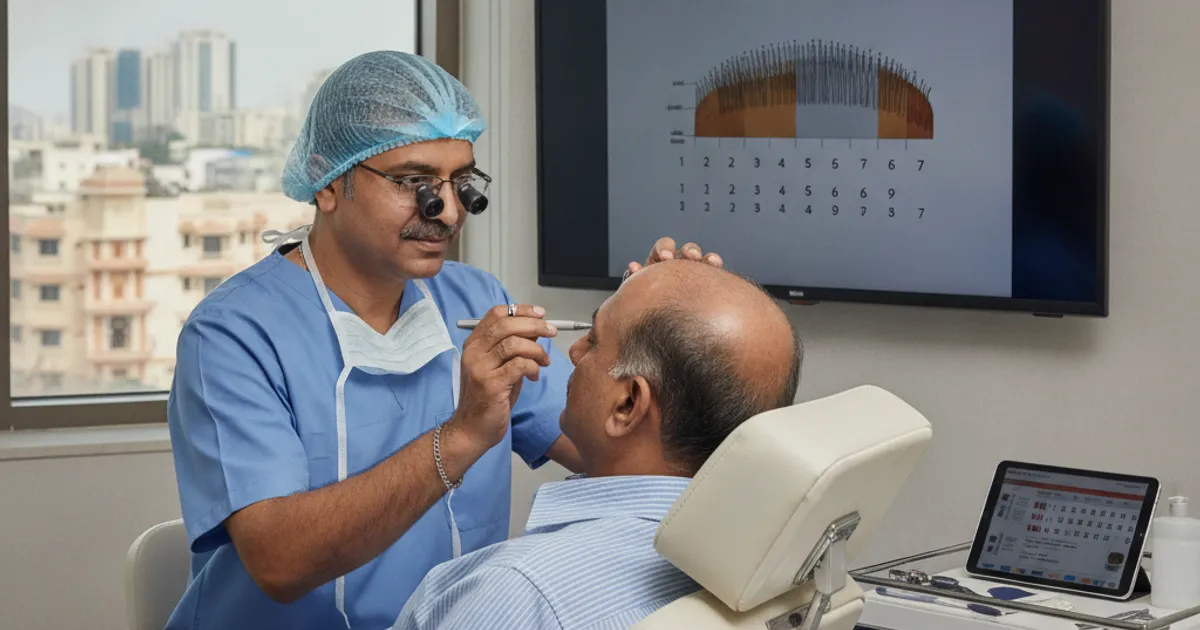
What Norwood 6 and 7 Actually Mean
The Norwood scale is the standard way doctors classify male pattern baldness. Norwood 6 and 7 sit at the far end of that scale. At Norwood 6, the hairline is largely gone, the frontal and mid-scalp areas are heavily thinned or bald, and the remaining hair forms a horseshoe band around the sides and back. The crown may still have some sparse coverage, but the bridge between the front and the crown is mostly empty. Norwood 7 is the most advanced stage: the horseshoe band itself narrows, the crown is fully bald, and the donor area on the sides and back is smaller and often thinner. In practical terms, these stages mean the area needing coverage is large and the supply of permanent donor hair is limited. That mismatch is the central challenge of surgery at this stage.
What a Hair Transplant Can and Cannot Achieve at Norwood 6–7
A hair transplant at Norwood 6 or 7 is not about restoring a dense teenage hairline. It is about redistribution. The surgeon moves permanent hair from the back and sides of the scalp into the bald areas, and the result is a change in appearance rather than a full head of hair. What you can expect is a defined hairline, some coverage across the front and mid-scalp, and a natural-looking transition. What you should not expect is full density, a completely covered crown, or hair that looks thick when wet. The goal is usually a mature, age-appropriate look that frames the face and reduces the contrast between bald scalp and hair.
- Can achieve: a recreated hairline, coverage of the frontal third to half of the scalp, and a softer, more balanced look.
- Can achieve: a natural transition zone using single-hair grafts at the front and multi-hair grafts behind.
- Cannot achieve: full density across the entire bald area in one session.
- Cannot achieve: a low, straight hairline that looks like a teenager's — the donor supply will not support it.
- Cannot achieve: complete crown coverage in most cases; the crown often needs a second pass or is left with lighter coverage.
How the Procedure Is Performed for Advanced Hair Loss
The surgical steps are the same as any follicular unit transplant, but the planning and execution differ. At Norwood 6–7, the surgeon has to be conservative with donor harvesting and strategic with graft placement. Most large sessions use either FUT (strip harvesting) or FUE (follicular unit extraction). FUT can yield a higher number of grafts in a single session and is often preferred when the donor area is limited. FUE is popular for its recovery profile but may require more than one session to reach the same graft count. Some surgeons combine both techniques. The procedure is typically done under local anesthesia and can take a full day or longer for a large session.
Graft Requirements and Donor Area Limits
The number of grafts needed depends on the size of the bald area and the density you want to achieve. At Norwood 6–7, the bald area can be large, and the donor area is finite. As a general guide — not a sourced statistic — many surgeons estimate that a typical Norwood 6–7 case requires somewhere between 3,000 and 6,000 grafts for a meaningful improvement, and some may need more than one session. The donor area can usually supply a certain number of grafts safely; pushing beyond that risks thinning the back and sides and leaving visible scarring. The table below gives a rough guide to graft ranges by stage. These are general estimates, not promises — your own donor density and scalp laxity will determine what is possible.
| Stage | Typical graft range (single session) | Coverage focus |
|---|---|---|
| Norwood 6 | 3,000–5,000 grafts | Frontal third to mid-scalp; crown may need a second pass |
| Norwood 7 | 4,000–6,000+ grafts (often staged) | Frontal band and mid-scalp; crown usually left with light coverage or addressed later |
Recovery Timeline After a Large Session
Recovery from a large session is similar to any hair transplant, but the first week can be more uncomfortable because more area is involved. You will have scabs and redness in the recipient area, and the donor area will be sore. Most people take a few days off work. The timeline below is a general guide; individual healing varies.
- Plan for at least a week of low-key activity; as general guidance, strenuous exercise is often best avoided for 2–3 weeks.
- As general guidance, avoid direct sun on the scalp for the first few months.
- Expect the transplanted hair to shed before it grows — this is part of the cycle.
- Follow your surgeon's washing and medication instructions closely to protect the grafts.
Realistic Results: Density, Coverage, and Staging
At Norwood 6–7, the word 'density' needs context. A surgeon can create the illusion of density by placing grafts close together at the hairline and using a staggered transition. But the overall number of hairs per square centimeter will be lower than in a person with early hair loss. The result is often described as 'coverage' rather than 'fullness'. Many patients need two sessions: the first to establish the hairline and front, the second to add density or address the crown. Staging is common and often the most sensible approach. It also lets you and your surgeon assess how the first session healed and how the donor area responded.
- First session: focus on the hairline and frontal third. This gives the biggest visual change.
- Second session (if needed): add density behind the hairline or cover the crown.
- Final look: a mature hairline that frames the face, with thinner coverage toward the back.
- Lighting and styling matter: fibers and careful styling can enhance the result, but they are not a substitute for surgery.
Who Is a Suitable Candidate for Norwood 6–7 Surgery
Not everyone at Norwood 6 or 7 is a good candidate. The ideal candidate has a stable donor area with good density, realistic expectations, and no active scalp conditions. Age matters too: younger patients may still be losing hair, and a transplant now could look odd as the bald area expands. As general guidance, many surgeons prefer to wait until hair loss has stabilized, often in the late 20s or 30s. General health and the ability to follow post-op instructions are also important.
- Good donor density and scalp laxity — assessed by the surgeon.
- As general guidance, hair loss that has been stable for at least a year, or is controlled with medication.
- Realistic expectations: you understand that coverage will be moderate, not dense.
- No uncontrolled medical conditions that affect healing.
- Willingness to commit to a long-term plan, including possible second session.
Cost Considerations for Advanced Hair Loss
Cost for Norwood 6–7 is higher than for early hair loss because more grafts are needed and the procedure takes longer. Pricing models vary: some clinics charge per graft, others by session. The table below shows illustrative average case pricing by stage of hair loss. These are not sourced from a live database and are not quotes — your actual cost depends on the clinic, your graft count, and your location.
| Cost factor | Impact on price |
|---|---|
| Graft count | Higher graft numbers increase cost; Norwood 6–7 typically requires 3,000–6,000 grafts. |
| Technique (FUE vs FUT) | FUE is often priced per graft and can be more expensive for large sessions; FUT may be more cost-effective for high graft counts. |
| Clinic location | Prices vary widely by country and city; travel costs may offset lower procedure prices. |
| Surgeon experience | More experienced surgeons often charge more, but may be better at maximizing limited donor supply. |
| Staging | Two sessions cost more overall but may be necessary for advanced cases. |
How It Compares to Alternatives
Surgery is not the only option at Norwood 6–7. Some people choose non-surgical routes, while others combine treatments. The comparison below outlines the main alternatives and how they stack up against a transplant.
Hair transplant (FUT or FUE)
Varies by clinic and graft count; illustrative advanced-case estimates are around 7,000–12,000 USD (not sourced from a live database)
- ✓ Permanent relocation of hair
- ✓ Requires surgery and recovery
- ✓ Results depend on donor supply
- ✓ Often needs two sessions for Norwood 6–7
Non-surgical options (medication, hair systems, scalp micropigmentation)
Varies; generally lower upfront cost but ongoing expenses
- ✓ No surgery or downtime
- ✓ Medication can slow loss but not restore a hairline
- ✓ Hair systems offer immediate coverage but require maintenance
- ✓ Scalp micropigmentation creates the look of stubble
- Medication (finasteride, minoxidil) can help preserve existing hair but rarely regrows a full head at Norwood 6–7.
- Hair systems provide instant coverage but need regular upkeep and replacement.
- Scalp micropigmentation is a cosmetic tattoo that mimics short hair; it does not give you real hair.
- Combining a transplant with medication is common to protect the result over time.
FAQ
Can I get a full head of hair back at Norwood 7?
No. A transplant at Norwood 7 can restore a hairline and some coverage across the front and mid-scalp, but it will not give you the density of a full head of hair. The donor supply is limited, and the bald area is large. The goal is a natural, mature look with moderate coverage.
How many grafts will I need for Norwood 6?
As a general guide, many Norwood 6 cases require roughly 3,000 to 5,000 grafts for a single session, depending on the size of the bald area and your donor density. Some patients need a second session to add density or cover the crown. Your surgeon will give you a personalized estimate after assessing your scalp.
Is it better to do one large session or two smaller ones?
It depends on your donor supply and the surgeon's assessment. A single large session can give a good result, but staging allows the surgeon to see how the first session healed and to adjust the plan. Many surgeons prefer staging for advanced hair loss to avoid overharvesting the donor area.
Will I need to take medication after a transplant?
Many surgeons recommend medication such as finasteride or minoxidil to protect the existing hair and slow further loss. It is not always mandatory, but it can help maintain the result over time. Discuss the pros and cons with your doctor.
More Guides
- Hair Transplant for Curly Hair: Graft and Technique Tips
A plain-English guide to hair transplants for curly hair: how surgeons adapt graft harvesting and placement, recovery, results, costs, and who it suits.
- How Long Does a Hair Transplant Last? Long-Term Durability
How long does a hair transplant last? We explain the procedure, recovery, durability, costs by stage of hair loss, and how it compares to alternatives.
- Hair Transplant Revision: When a Second Procedure Makes Sense
Considering a hair transplant revision? Learn how a second procedure works, who it suits, recovery, results, and costs. Expert explainer from Clinic Reccy.
- Hair Transplant Scar Revision: Options and Outcomes
Hair transplant scar revision can improve the look of donor scars. Learn how it's done, recovery, results, who suits it, and costs in this clear guide.