
How Long to Stay on Finasteride Before Giving Up
How long to stay on finasteride before giving up: how it works, dosage, timeline, side effects, cost, and how it compares to other hair loss treatments.
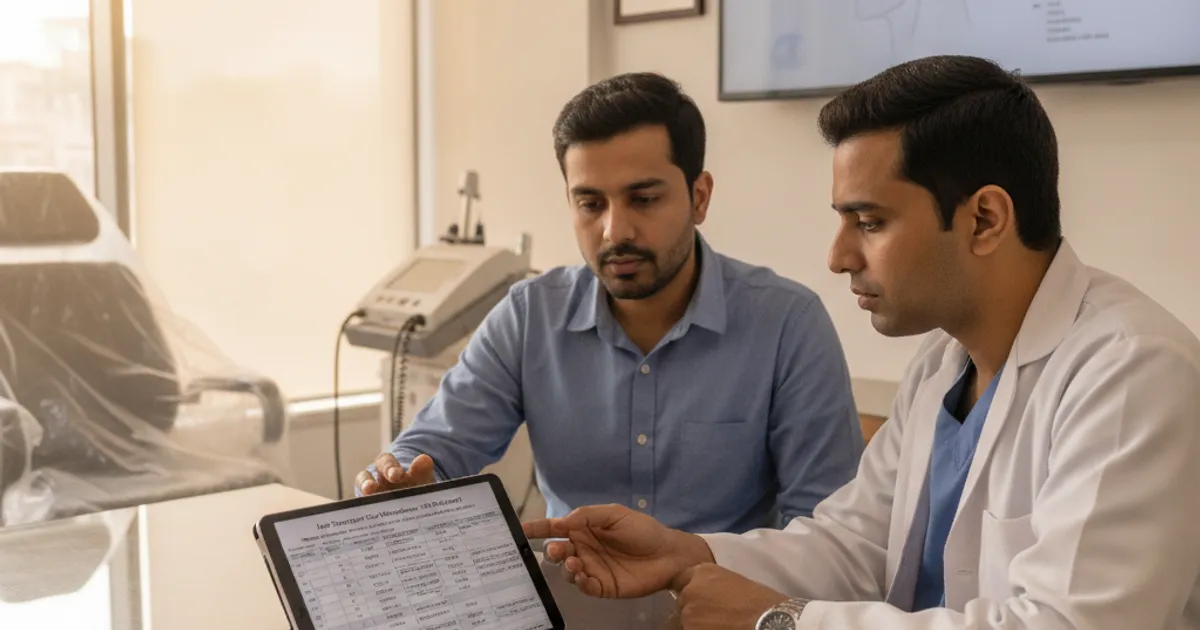
What Is Finasteride and How Does It Work?
Finasteride is an oral prescription medication originally developed for an enlarged prostate. It later turned out to be one of the few drugs that reliably slows down male pattern hair loss. It works by blocking the enzyme 5-alpha-reductase type II, which converts testosterone into dihydrotestosterone (DHT). DHT is the hormone that miniaturises hair follicles in genetically predisposed men, so lowering DHT gives those follicles a chance to recover and produce thicker hair again.
- Drug class: 5-alpha-reductase inhibitor (5ARI)
- Primary mechanism: reduces scalp and serum DHT, though the exact percentage varies by study and individual
- Form: oral tablet, typically 1 mg for hair loss and 5 mg for prostate issues
- Onset: measurable DHT suppression within 24 hours, visible hair changes take months
- Status: prescription-only in most countries, including the US, UK, and EU
The Evidence: Does Finasteride Actually Grow Hair?
Finasteride is one of the most studied hair loss treatments available. Large randomised controlled trials in men with androgenetic alopecia found that a significant proportion experienced measurable hair regrowth or at least no further loss over one to two years, compared with placebo. The effect is strongest on the crown and mid-scalp, and weaker at the temples, where follicles are often already lost.
- Approved by the FDA for male pattern hair loss (check FDA records for the exact approval date)
- Works best in men who still have visible miniaturised hair rather than bare scalp
- Effects are maintained only while you keep taking the drug
- Response varies widely; some men see clear improvement, others only stabilisation
- Not approved for women of childbearing age due to risk to a male fetus
| Outcome | What the research generally shows |
|---|---|
| Hair count | Statistically significant increase vs placebo in most trials |
| Hair thickness | Improvement in many users, especially on the crown |
| Hairline | Limited regrowth; mainly slows recession |
| Stopping treatment | Any gains are typically lost within several months to a year |
| Long-term use | Benefits appear to persist with continued daily use |
How to Use Finasteride: Dosage, Frequency, and Formulations
For hair loss, the standard dose is 1 mg taken once daily, with or without food. Some doctors prescribe 5 mg tablets split into quarters as a cost-saving measure, though this is off-label for hair loss. Consistency matters more than timing. If you miss a day, take the next dose as normal and do not double up.
- Standard dose: 1 mg once daily (verify with your prescriber)
- Alternative: 5 mg tablet split into four pieces (off-label, only if your doctor agrees)
- Timing: same time each day is easiest to remember
- Formulations: oral tablets are standard; topical finasteride exists but is less well studied
- Prescription required in most countries
| Formulation | Typical dose | Notes |
|---|---|---|
| Oral tablet (1 mg) | 1 mg daily | Standard for hair loss |
| Oral tablet (5 mg) | 5 mg daily or split | Approved for prostate; often split for hair loss |
| Topical solution | Varies | Less evidence, sometimes used to reduce systemic exposure |
| Compounded creams | Varies | Quality and absorption can vary between pharmacies |
Expected Results and Timeline: When Will You See Changes?
This is the part most people get wrong. Finasteride is not a quick fix. Hair grows slowly, and the follicles need time to respond to lower DHT levels. Based on general clinical experience, most men who respond will notice something between three and six months, with the clearest changes at twelve months. If you are going to judge whether it is working, twelve months is the minimum fair trial. Some doctors suggest eighteen to twenty-four months before calling it a failure. These timelines are typical but not guaranteed; individual response varies.
Side Effects and Risks: What You Need to Know
Finasteride is generally well tolerated, but it is not side-effect free. The most commonly reported issues are sexual: reduced libido, erectile difficulties, and lower ejaculate volume. These usually resolve after stopping the drug, though a small number of men report persistent symptoms. There is also a risk of depression and mood changes, and finasteride is not safe for women who are or may become pregnant because it can cause birth defects in a male fetus.
- Sexual side effects: reported in a minority of users in trials
- Mood changes: possible, especially in men with a history of depression
- Breast tenderness or swelling: uncommon but worth reporting to a doctor
- Persistent sexual side effects after stopping: rare but documented
- Pregnancy risk: women should not handle crushed or broken tablets
Who Is Finasteride Suitable For?
Finasteride is most suitable for men with early to moderate androgenetic alopecia who still have active hair follicles in the thinning areas. It is less useful for men with advanced baldness where the follicles are already gone, and it is not a treatment for other types of hair loss such as alopecia areata or telogen effluvium. Women should generally avoid it, particularly if they could become pregnant.
- Best candidates: men with early crown or mid-scalp thinning
- Less suitable: men with advanced baldness and smooth, shiny scalp
- Not suitable: women who are pregnant or may become pregnant
- Not suitable: people with certain liver conditions
- Discuss with a doctor: anyone taking other medications or with mood disorders
| Profile | Suitability |
|---|---|
| Young man, early thinning | Good candidate |
| Man with moderate crown loss | Good candidate |
| Man with advanced baldness | Limited benefit, consider transplant |
| Woman of childbearing age | Not recommended |
| Man with liver disease | Only under medical supervision |
Cost of Finasteride: What to Expect
Finasteride is one of the cheapest hair loss treatments available. Generic versions cost far less than the original brand, and prices vary by country, pharmacy, and whether you get a private or NHS prescription. Because prices change frequently, it is best to check current costs at your local pharmacy or a reputable online provider. As a general guide, generic finasteride is usually inexpensive, but exact figures depend on your location and insurance coverage.
- Generic finasteride is much cheaper than brand-name Propecia
- Splitting 5 mg tablets can reduce monthly cost further
- Insurance may cover it for prostate issues but often not for hair loss
- Online prescriptions can be convenient but check the pharmacy is legitimate
- Cost should not be the main factor; effectiveness and side effects matter more
How Finasteride Compares to Other Hair Loss Treatments
Finasteride is not the only option. Minoxidil is a topical treatment that improves blood flow and prolongs the growth phase. It works differently and can be used alongside finasteride. Hair transplants move DHT-resistant follicles from the back of the scalp to thinning areas, but they do not stop ongoing loss, so most surgeons recommend medication too. Low-level laser therapy and microneedling have weaker evidence. The best approach for many men is a combination of finasteride and minoxidil, with a transplant if needed.
| Treatment | How it works | Evidence | Cost |
|---|---|---|---|
| Finasteride | Lowers DHT | Strong | Low |
| Minoxidil | Improves blood flow | Moderate | Low to moderate |
| Hair transplant | Moves follicles | Strong for suitable candidates | High |
| Laser therapy | Stimulates follicles | Weak | Moderate |
| Microneedling | Stimulates healing | Emerging | Low |
- Finasteride and minoxidil can be used together and often are
- A transplant without medication may look good short-term but lose ground later
- Finasteride is the only oral prescription drug widely approved for hair loss
- No treatment works for everyone; response is individual
Frequently Asked Questions
How long should I stay on finasteride before giving up?
Give it at least 12 months. Most responders see changes between 3 and 6 months, but the full effect takes a year. Some doctors suggest 18 to 24 months before deciding it is not working for you. These are general estimates; your experience may differ.
What happens if I stop taking finasteride?
Any hair you gained or maintained will likely be lost within 6 to 12 months, and your hair loss will return to its natural progression. Finasteride only works while you take it.
Can I take finasteride with minoxidil?
Yes. They work in different ways and are often used together. Many doctors recommend combining them for better results than either alone.
Is finasteride safe for long-term use?
For most men, yes. It has been used for decades. However, a small number of men report persistent sexual side effects, so it is worth discussing risks with your doctor before starting.
More Guides
- Finasteride for Baldness: What It Can and Can't Do
Finasteride is a proven hair loss treatment, but it's not a cure. Learn how it works, dosage, side effects, and how it compares to other options.
- DHT-Blocking Shampoos: What Works and What's Marketing?
Do DHT-blocking shampoos really grow hair? We break down the science, evidence, usage, side effects, costs, and how they compare to other treatments.
- Clascoterone for Hair Loss: What the Research Shows
Clascoterone is a topical anti-androgen being studied for hair loss. Learn how it works, the evidence, how to use it, side effects, cost, and how it compares.
- Hims Minoxidil Spray: Ingredients, Results, and Cost
Hims Minoxidil Spray review: ingredients, how it works, results timeline, side effects, cost, and how it compares to other hair loss treatments.