
How to Calculate Total Grafts for Full Norwood Coverage
Learn how surgeons calculate total grafts for full Norwood coverage, from early to advanced hair loss, plus recovery, costs, and candidacy.
What Is Graft Calculation for Full Norwood Coverage?
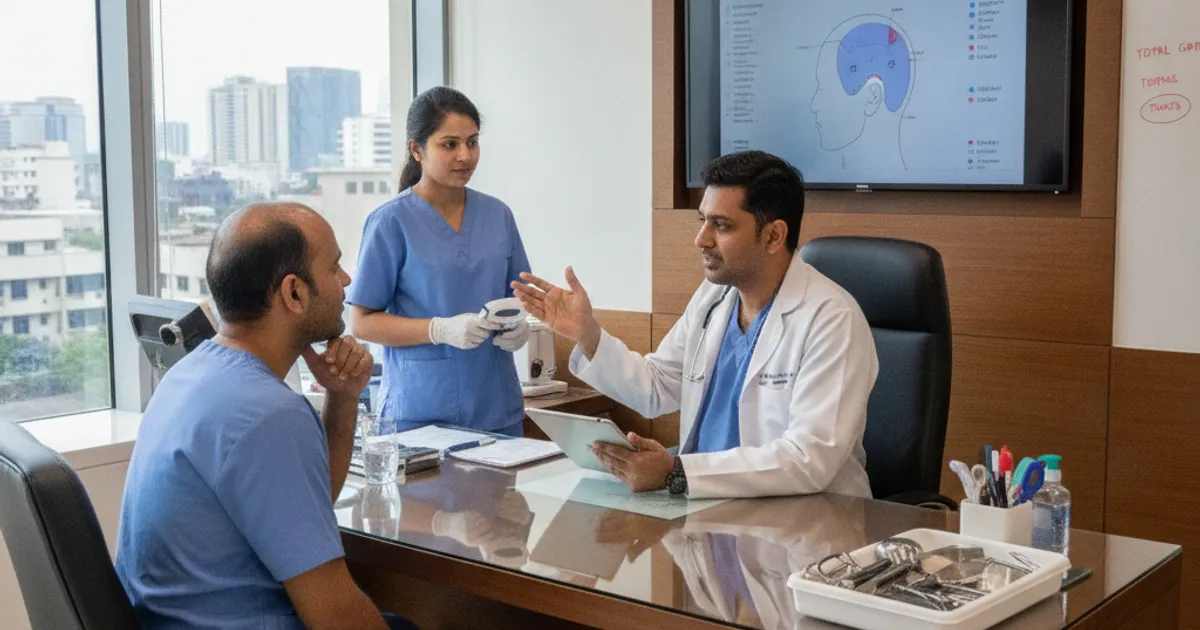
Graft calculation for full Norwood coverage is the process of estimating how many individual hair grafts are needed to restore hair across the entire balding area, from the hairline through the crown. It is not a single number pulled from a chart. It is a surgical planning exercise that combines your Norwood stage, the size of your recipient area, your donor hair density, hair calibre, and the cosmetic goals you and your surgeon agree on. The result is a graft count that guides how many follicular units are extracted, how they are distributed, and whether one session can achieve the coverage or whether a staged approach makes more sense.
How Graft Requirements Are Estimated: The Core Formula
Most surgeons start with the surface area of the balding zone, measured in square centimetres, and multiply it by a target density. That target density is not the same as your natural density. It is a cosmetic density chosen to create the illusion of fullness while respecting donor limits. The formula is simple in principle but nuanced in practice.
- Measure the recipient area: hairline, mid-scalp, and crown are measured separately because they need different densities.
- Set a target density per square centimetre: your surgeon will choose a density based on your hair characteristics and goals.
- Multiply area by target density to get a baseline graft estimate.
- Adjust for hair calibre: coarse hair covers more scalp per graft than fine hair, so fine-haired patients often need higher graft counts for the same visual result.
- Adjust for colour contrast: dark hair against light skin shows more scalp, so it may need higher density than light hair against dark skin.
- Check donor supply: if the estimate exceeds what the donor area can safely provide, the plan is staged or the density target is reduced.
| Variable | Why It Matters | Effect on Graft Count |
|---|---|---|
| Recipient area size | Larger balding zones need more grafts | Higher area = higher graft count |
| Target density | Cosmetic density drives the look | Higher density = higher graft count |
| Hair calibre | Coarse hair covers more scalp | Fine hair often needs more grafts |
| Hair colour vs skin | Contrast affects perceived fullness | High contrast may need more grafts |
| Donor density | Sets the safe upper limit | Low donor density caps the count |
| Hair curl | Curly hair adds volume | Straight hair may need more grafts |
Graft Estimates by Norwood Stage
The Norwood scale is a useful shorthand, but it is not a prescription. Two people at the same Norwood stage can need different graft counts because of hair characteristics and the exact shape of their balding pattern. The ranges below are general planning guides, not guarantees.
| Norwood Stage | Typical Balding Pattern | Common Graft Range |
|---|---|---|
| Norwood 2 | Minor recession at temples | 800 to 1,500 grafts |
| Norwood 3 | Deep temple recession, early hairline loss | 1,500 to 2,500 grafts |
| Norwood 4 | Frontal and mid-scalp thinning | 2,500 to 3,500 grafts |
| Norwood 5 | Frontal and crown loss with a bridge | 3,000 to 4,500 grafts |
| Norwood 6 | Frontal and crown merged, wide loss | 4,000 to 6,000 grafts |
| Norwood 7 | Extensive loss, only donor fringe remains | 5,000 to 7,000+ grafts, often staged |
- Norwood 2 and 3 cases are usually single-session procedures with conservative hairline design.
- Norwood 4 and 5 cases often need careful density planning to avoid a thin crown.
- Norwood 6 and 7 cases frequently require two sessions to protect donor supply.
- Some Norwood 7 patients are better served by a focused approach that restores the front and mid-scalp rather than chasing full crown coverage.
How the Procedure Is Performed: From Calculation to Implantation
Once the graft estimate is agreed, the surgical day follows a structured sequence. The calculation is not just a pre-op exercise. It guides every step, from how the donor strip or extraction zones are marked to how the grafts are sorted and placed.
Recovery After a Large-Graft Session
Recovery after a high-graft session is similar to a smaller procedure, but the first week tends to be more uncomfortable because more of the scalp is involved. Most people can return to desk work within a few days, but strenuous activity and direct sun exposure need to wait longer.
- First few days: swelling, tightness, and tenderness are common. Sleep propped up to reduce facial swelling.
- First week: scabs begin to form and the donor area may feel itchy. Gentle washing is usually allowed after a few days, following clinic instructions.
- Second and third weeks: scabs flake away and the transplanted hairs often shed as part of the normal cycle.
- Months 2 to 4: the resting phase. The scalp may look thinner than before the procedure.
- Months 4 to 6: new growth becomes visible, usually starting at the hairline.
- Months 9 to 12: the majority of the final result is visible. Crown areas often mature later than the front.
- Months 12 to 18: full maturation for many patients, especially after large sessions.
Results: What Full Norwood Coverage Realistically Looks Like
Full Norwood coverage does not mean returning to your teenage hairline. It means restoring a natural-looking frame to the face and reducing the contrast between balding and non-balding areas. The result depends on how well the graft calculation matched your donor supply and how the grafts were distributed.
- A restored hairline and mid-scalp usually has the biggest visual impact.
- The crown is the most graft-hungry area and often looks thinner than the front, even after a large session.
- Density is highest at the hairline and decreases toward the crown, which mimics natural hair distribution.
- Some patients need a second session to add density or address areas that were deliberately under-planted in the first pass.
- Results look most natural when the hairline is slightly irregular rather than a straight line.
Who Is a Suitable Candidate?
Not everyone with advanced hair loss is a good candidate for a single large session. The limiting factor is almost always donor supply. If the donor area cannot provide enough grafts to meet the calculated requirement, the surgeon may recommend a staged plan, a more conservative hairline, or a different approach altogether.
- Good donor density and hair calibre: enough permanent hair to support the calculated graft count.
- Stable hair loss: the pattern has not changed dramatically in the past year or two.
- Realistic expectations: understanding that coverage is an illusion of density, not a full restoration of original hair.
- Good general health: no uncontrolled conditions that affect healing or bleeding.
- Willingness to commit to aftercare and, in some cases, a second procedure.
- Age considerations: younger patients with early loss may be advised to wait or start with medication to preserve donor hair.
Cost Considerations for High-Graft Procedures
Cost for high-graft procedures is usually quoted per graft or as a flat case price. The more grafts you need, the higher the total. The figures below are averaged case pricing by stage of hair loss, not per-graft rates, and they are intended as general reference points rather than quotes.
| Cost Factor | How It Affects Price | Notes |
|---|---|---|
| Graft count | More grafts = higher total | Per-graft rate may drop at higher volumes |
| Technique | FUE vs FUT pricing differs | FUE is often priced higher per graft |
| Surgeon involvement | Senior surgeons charge more | Hairline design is usually surgeon-led |
| Location | Local market rates vary | Cross-border pricing can differ significantly |
| Staging | Two sessions cost more overall | Spacing is usually 9 to 12 months |
| Aftercare | Some clinics bundle, some charge extra | Check what is included before booking |
How Graft Calculation Compares to Alternative Approaches
Graft calculation is the planning backbone of surgical hair restoration, but it is not the only option for advanced hair loss. Medication, scalp micropigmentation, and hair systems each play a different role. The right choice depends on your goals, budget, and how much donor hair you have.
| Approach | What It Does | Best For | Limitations |
|---|---|---|---|
| Graft calculation + transplant | Restores hair with your own follicles | Stable loss with adequate donor supply | Donor limits, cost, recovery time |
| Medication (finasteride/minoxidil) | Slows loss and may regrow some hair | Early to moderate loss | Does not restore large bald areas |
| Scalp micropigmentation | Creates the look of a shaved hairline | Patients wanting low-maintenance coverage | Does not grow hair, needs touch-ups |
| Hair system | Instant full coverage | Patients wanting immediate density | Maintenance, adhesive, ongoing cost |
| Staged transplant | Spreads grafts over two sessions | Advanced loss with limited donor | Longer timeline, higher total cost |
- Medication is often recommended alongside surgery to protect existing hair.
- Scalp micropigmentation can complement a transplant by adding the illusion of density.
- Hair systems are reversible but require regular maintenance and replacement.
- Staged transplants are common for Norwood 6 and 7 cases where a single session would over-harvest the donor area.
Choosing a Clinic for Full Norwood Coverage
Large-graft procedures are technically demanding. The clinic you choose matters as much as the graft count. Look for surgeons who routinely handle advanced Norwood cases, who explain donor limits honestly, and who show you results from patients with similar hair characteristics to yours.
- Ask how many large-graft cases the surgeon performs per month.
- Request a written graft plan broken down by zone.
- Check whether the clinic offers online consultations if you are travelling.
- Ask what is included in the price: medication, PRP, follow-up visits, and accommodation vary widely.
- Look for before-and-after photos of Norwood 5 to 7 patients, not just early-stage cases.
- Confirm who performs the extraction and implantation: the surgeon, technicians, or a mix.
Frequently Asked Questions
How many grafts do I need for full Norwood coverage?
It depends on your Norwood stage, recipient area size, hair calibre, and donor density. General planning ranges run from about 800 to 1,500 grafts for early recession up to 5,000 to 7,000+ grafts for Norwood 6 and 7 cases, often staged across two sessions. Only an in-person assessment can give you an accurate number.
Can I get full Norwood 7 coverage in one session?
Sometimes, but not always. A single session for Norwood 7 may be possible if donor density is high and the goal is a conservative hairline with lighter crown coverage. Many surgeons prefer two sessions to protect the donor area and allow the first result to mature before adding more grafts.
Does a higher graft count always mean a better result?
No. Beyond a certain point, packing more grafts into the same area can reduce survival and waste donor hair. A well-planned 3,000-graft session can look better than a poorly distributed 5,000-graft session. Density, angle, and hairline design matter as much as the total count.
How long after a large-graft session will I see results?
Transplanted hairs typically shed in the first few weeks, then new growth starts around month four. Most patients see a meaningful change by month six to nine, with full maturation around 12 to 18 months. Crown areas often take longer to fill in than the hairline.
More Guides
- Hair Transplant for Curly Hair: Graft and Technique Tips
A plain-English guide to hair transplants for curly hair: how surgeons adapt graft harvesting and placement, recovery, results, costs, and who it suits.
- How Long Does a Hair Transplant Last? Long-Term Durability
How long does a hair transplant last? We explain the procedure, recovery, durability, costs by stage of hair loss, and how it compares to alternatives.
- Hair Transplant Revision: When a Second Procedure Makes Sense
Considering a hair transplant revision? Learn how a second procedure works, who it suits, recovery, results, and costs. Expert explainer from Clinic Reccy.
- Hair Transplant for Norwood 6 and 7: What's Possible
A clear look at hair transplant options for Norwood 6 and 7 hair loss: graft limits, staging, recovery, costs, and realistic results.