
Curly or Wavy Hair After Transplant: What to Expect
Why transplanted hair can grow curly or wavy, how technique affects curl pattern, recovery, results, and how to choose a clinic for curly hair transplants.
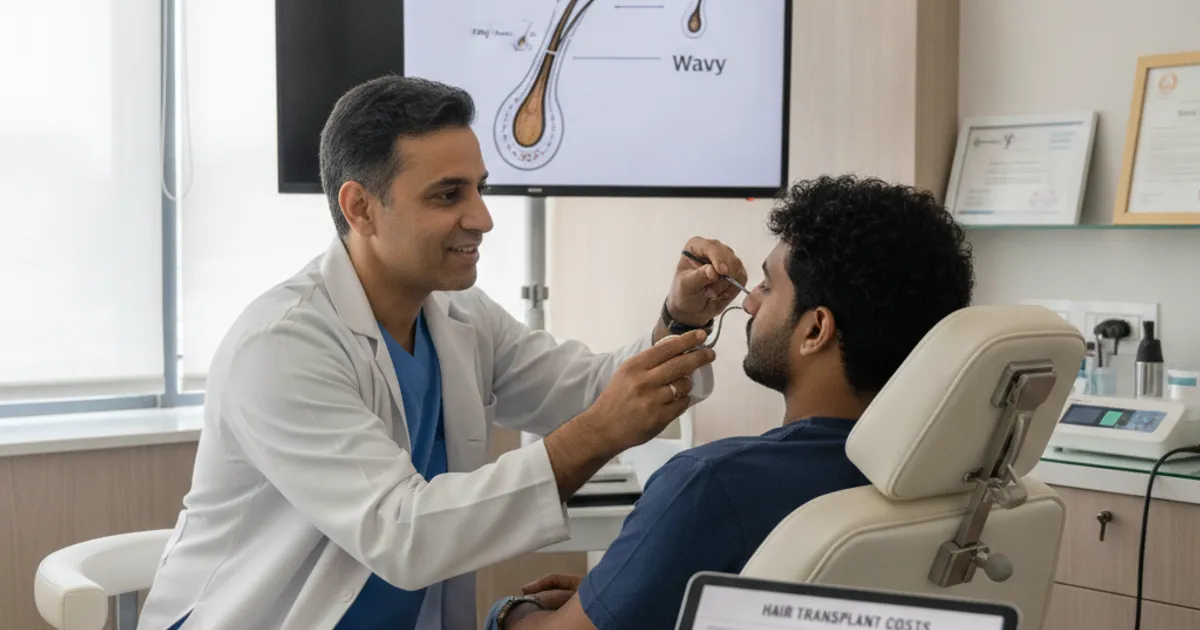
If you have had a hair transplant and the new hair is coming in curly or wavy, you are not imagining it. Many people expect their transplanted hair to match the straight, smooth texture they had before losing it, and then find themselves dealing with bends, kinks, or an entirely different curl pattern. This is one of the most common questions people ask after surgery, and the answer is usually reassuring: in most cases, the texture change is temporary, and even when it is not, it is manageable.
What It Is: The Science of Hair Texture After Transplant
Hair texture is determined by the shape of the hair follicle and the way the hair shaft emerges from the scalp. Round follicles tend to produce straight hair, oval follicles produce wavy hair, and more elliptical or kidney-shaped follicles produce curly hair. When a surgeon moves follicles from the back or sides of the scalp to the top or hairline, the follicles keep their original genetic programming. That means the transplanted hair will usually grow with the same texture it had in the donor area, not the texture it had in the area where it is now placed.
- Donor dominance: transplanted follicles retain the characteristics of the donor site, including curl pattern.
- Surgical trauma: handling, dehydration, and placement can temporarily distort the follicle and change how the hair grows.
- Healing response: scar tissue and inflammation around the new follicle can affect the angle and shape of growth.
- Growth cycle reset: after transplant, follicles enter a resting phase and then regrow, often with a different initial texture.
- Natural curl pattern: if your donor hair was always slightly wavy, the new hair may simply be revealing that trait.
How It Is Performed: Techniques That Influence Curl Pattern
The technique used during your hair transplant can influence how curly or wavy the new hair appears. Follicular unit extraction (FUE) and follicular unit transplantation (FUT) both involve moving individual follicular units, but the way the grafts are handled, the size of the punch, and the angle of placement all matter. Surgeons who specialize in curly hair understand that the curl pattern affects how grafts are extracted and placed, because curly hair follicles are often more curved and can be more fragile.
- FUE with small punches: less trauma to the follicle, which may help preserve the original curl pattern.
- FUT strip method: can be effective for curly hair, but the strip must be dissected carefully to avoid damaging curved follicles.
- Implanter pens: can help control the angle and depth of placement, which affects how the hair emerges.
- Manual placement: allows the surgeon to match the natural direction and curl of surrounding hair.
- Graft hydration: keeping grafts moist during the procedure reduces stress on the follicle and may reduce texture changes.
| Technique | Effect on Curl Pattern | Best For |
|---|---|---|
| FUE with small punches | May preserve natural curl better due to less follicle trauma | Patients with tight curls or coarse hair |
| FUT strip method | Can work well if dissection is careful; risk of distortion if not | Patients needing large graft numbers |
| Implanter pen placement | Helps control angle and direction, reducing odd bends | Precision hairline work |
| Manual placement | Surgeon can match existing curl and flow | Patients with mixed textures |
Recovery and Early Growth: What to Expect Month by Month
The first year after a hair transplant is a rollercoaster of changes. The newly transplanted hair typically falls out within the first few weeks, then regrows slowly. During this early phase, the hair often looks wiry, curly, or unruly. This is not the final result. As the follicle matures and the hair shaft thickens, the texture usually softens and may return to its original pattern.
- Month 1: transplanted hair sheds; scalp may be red or scabby.
- Months 2–3: follicles enter resting phase; little visible growth.
- Months 4–6: new hair starts to emerge, often fine and curly or wavy.
- Months 7–9: hair thickens and darkens; curl pattern may still be irregular.
- Months 10–12: texture begins to settle; many patients see a more natural pattern.
- Months 12–18: final texture is usually established; some curl may remain if donor hair was curly.
Results: When Curly or Wavy Hair Settles and How to Manage It
By the 12- to 18-month mark, most patients have a good idea of their final hair texture. If the new hair is still curly or wavy, it is likely because the donor hair itself had that characteristic. In that case, you are not dealing with a complication; you are dealing with your own natural texture showing up in a new location. Managing it is mostly about styling and care.
- Use a moisturizing shampoo and conditioner to reduce frizz and define curls.
- Avoid brushing wet hair aggressively; use a wide-tooth comb or your fingers.
- Consider a leave-in conditioner or curl cream to manage wave and curl.
- Regular trims help blend the new hair with existing hair.
- If the curl is very tight and you prefer a straighter look, talk to a stylist about gentle relaxing treatments.
- Give it time: some texture changes continue to soften up to 18 months post-op.
Who It Suits: Candidates for Curly or Wavy Transplant Hair
A hair transplant can work for almost anyone with a healthy donor area, but people with curly or wavy hair need to be aware of how their texture will interact with the procedure. The best candidates are those who understand that the transplanted hair will likely match their donor hair, not their original hairline texture. If you have tight curls, you may need a surgeon experienced with curly hair to avoid damaging follicles during extraction.
- Patients with realistic expectations about texture change.
- Those with a healthy donor area on the back and sides of the scalp.
- People willing to wait 12–18 months for final results.
- Individuals with curly or wavy donor hair who are comfortable with that texture.
- Patients who are prepared to style and care for curly hair after surgery.
Cost Considerations: What Influences Pricing for Curly Hair Transplants
The cost of a hair transplant varies widely depending on the clinic, the number of grafts needed, the technique used, and the surgeon's experience. Curly hair can sometimes require more time and skill, which may affect the price. Below are average case prices by stage of hair loss. These are median figures and should be used as a general guide only.
| Factor | Impact on Cost |
|---|---|
| Number of grafts | More grafts = higher cost |
| Technique (FUE vs FUT) | FUE often costs more per graft |
| Surgeon experience | Experienced surgeons charge more |
| Clinic location | Prices vary by city and country |
| Curly hair complexity | May require more time and skill, potentially increasing cost |
How It Compares to Alternatives: Other Ways to Address Curly Transplant Hair
If you are unhappy with the curl pattern of your transplanted hair, or if you are considering a transplant and want to know your options, there are several alternatives. Each has its own pros and cons. The table below compares a hair transplant to other common approaches for dealing with hair loss and texture changes.
| Option | How It Works | Pros | Cons |
|---|---|---|---|
| Hair transplant | Move follicles from donor area to thinning area | Permanent, natural-looking | Cost, recovery time, possible texture change |
| Medications (finasteride/minoxidil) | Slow hair loss and promote growth | Non-surgical, can be effective | Not permanent, side effects possible |
| Hair fibers/concealers | Cosmetic powder or spray to thicken hair | Instant, affordable | Temporary, messy, not for all hair types |
| Scalp micropigmentation | Tattoo dots to mimic hair follicles | Low maintenance, looks like short hair | Not real hair, can fade |
| PRP therapy | Platelet-rich plasma injections to stimulate growth | Non-surgical, uses your own blood | Results vary, multiple sessions needed |
- If you want a permanent solution and are okay with possible texture changes, a transplant may be best.
- If you want to avoid surgery, medications or PRP might help slow loss.
- If you want an immediate cosmetic fix, hair fibers or scalp micropigmentation can work.
- Combining treatments (e.g., transplant plus medication) is common and can improve results.
Choosing a Clinic: What to Look For When You Have Curly or Wavy Hair
Not all clinics are equally skilled with curly or wavy hair. Curly hair follicles are more curved and can be more difficult to extract without damage. Look for a surgeon who has experience with your hair type and can show you examples of previous patients with similar texture. Ask about their technique, how they handle grafts, and what they expect in terms of texture change.
- Ask for before-and-after photos of patients with curly or wavy hair.
- Confirm the surgeon's experience with your specific curl pattern.
- Ask how they minimize follicle damage during extraction.
- Discuss your expectations for texture and curl pattern.
- Check if the clinic offers follow-up care and styling advice.
- Read reviews from patients with similar hair types.
FAQ: Common Questions About Curly or Wavy Transplant Hair
Will my transplanted hair always be curly?
Not necessarily. Early curl or wave is often temporary and can settle within 12–18 months. If your donor hair is naturally curly, the transplanted hair will likely remain curly. If your donor hair is straight, the new hair may straighten out over time.
Can I get a hair transplant if I have very curly hair?
Yes, but it requires a surgeon experienced with curly hair. The curved follicles can be more fragile, so careful extraction and placement are important. Ask to see examples of previous work on curly hair.
How long does it take for transplanted hair to grow in normally?
The first year is a process. Hair typically sheds in the first month, starts growing around month 4, and matures by month 12–18. Texture often changes during this time.
What can I do to manage curly transplanted hair?
Use moisturizing products, avoid harsh brushing, and consider curl creams or leave-in conditioners. Regular trims help blend the new hair. If you want a straighter look, talk to a stylist about gentle relaxing treatments.
More Guides
- Hair Transplant for Curly Hair: Graft and Technique Tips
A plain-English guide to hair transplants for curly hair: how surgeons adapt graft harvesting and placement, recovery, results, costs, and who it suits.
- How Long Does a Hair Transplant Last? Long-Term Durability
How long does a hair transplant last? We explain the procedure, recovery, durability, costs by stage of hair loss, and how it compares to alternatives.
- Hair Transplant Revision: When a Second Procedure Makes Sense
Considering a hair transplant revision? Learn how a second procedure works, who it suits, recovery, results, and costs. Expert explainer from Clinic Reccy.
- Hair Transplant for Norwood 6 and 7: What's Possible
A clear look at hair transplant options for Norwood 6 and 7 hair loss: graft limits, staging, recovery, costs, and realistic results.