
KNU Implanter Pen: How It Works in Hair Transplant Surgery
A clear guide to the KNU Implanter Pen hair transplant technique: how it works, recovery, results, who it suits, cost and how it compares to other methods.
What Is the KNU Implanter Pen?
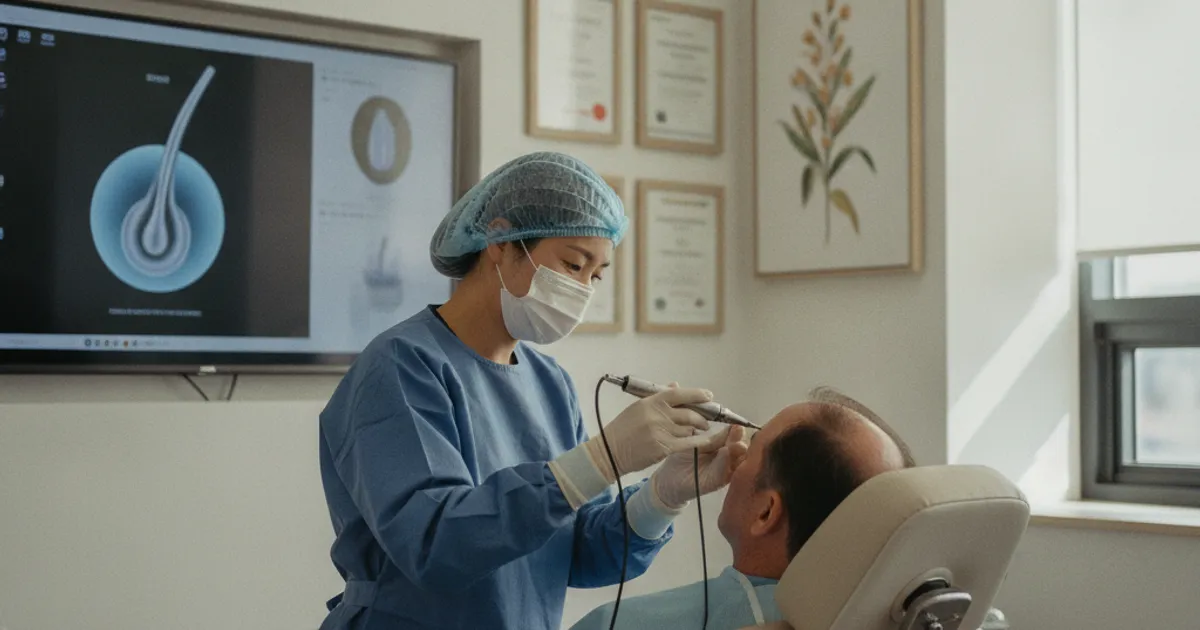
The KNU Implanter Pen is a surgical instrument used during hair transplant procedures to place hair follicles into the scalp. Instead of making a recipient site with one tool and then pushing the graft in with forceps, the KNU pen does both jobs at once. The graft is loaded into a hollow needle at the tip of the pen, the pen is pressed into the scalp, and a plunger deposits the follicle into the site. It is one of several implanter pen brands used in modern follicular unit extraction (FUE) surgery. It is not a type of hair transplant on its own. It is a tool that a surgeon may choose to use during an FUE procedure.
- A handheld pen-shaped device with a hollow needle and a plunger mechanism.
- Loads individual follicular unit grafts and implants them in a single motion.
- Used during the recipient-site phase of an FUE hair transplant.
- Designed to reduce handling of grafts and speed up the implantation step.
- Comes in different needle gauges to match graft size and hair characteristics.
How the KNU Implanter Pen Is Used During a Hair Transplant
The pen is used in the second half of an FUE hair transplant. By that point, the surgeon has already extracted follicular units from the donor area (usually the back and sides of the scalp) and the grafts are sitting in a holding solution. The recipient area has been numbed with local anaesthetic. What follows is the implantation phase, and this is where the KNU pen comes in.
The KNU Implanter Pen places each graft in one motion, combining site creation and implantation.
Recovery After a KNU Implanter Pen Procedure
Recovery from an FUE procedure using a KNU Implanter Pen follows the same general timeline as other FUE methods. The pen itself does not change the biology of healing, but because it creates small, precise recipient sites, some surgeons find that the scalp looks less traumatised in the first few days. That said, individual healing varies and no tool guarantees a faster recovery. Here is what the typical timeline looks like.
- Avoid strenuous exercise and heavy sweating for the first few days.
- Do not scratch or pick at scabs, as this can dislodge grafts.
- Sleep with your head elevated for the first few nights to reduce swelling.
- Avoid direct sun exposure on the scalp while healing.
- Follow the clinic's aftercare instructions closely, including any medication or washes.
Results and Realistic Expectations
The KNU Implanter Pen is one variable in a procedure with many variables. The final result depends far more on the surgeon's skill, the quality of the donor hair, the number of grafts placed, and how well the patient follows aftercare than on the pen itself. A skilled surgeon using an implanter pen can achieve dense, natural-looking hairlines. A less skilled surgeon using the same pen will not. The tool does not compensate for poor planning or technique.
- Hair transplants do not create new hair. They redistribute existing donor hair.
- Density depends on how many grafts are available and how they are distributed.
- Transplanted follicles are generally considered permanent, but native hair can continue to thin.
- A single session may not be enough for advanced hair loss. Some people need a second procedure.
- The pen does not change the fundamental limits of donor supply or healing.
Who Is a Good Candidate for the KNU Implanter Pen?
Candidacy for a KNU Implanter Pen procedure is essentially the same as candidacy for FUE hair transplant in general. The pen is a tool used during FUE, so if you are a good candidate for FUE, you may be a good candidate for a clinic that uses the KNU pen. The main factors are donor hair quality, the pattern and stability of your hair loss, your general health, and your expectations.
- People with a stable pattern of hair loss.
- Those with good donor density at the back and sides of the scalp.
- People who want a minimally invasive procedure with no linear scar.
- Those willing to commit to aftercare and a wait for final results.
- People with realistic expectations about density and coverage.
| Factor | Favourable for KNU Implanter Pen | Less Favourable |
|---|---|---|
| Hair loss pattern | Stable, moderate loss | Rapidly progressing or unpredictable loss |
| Donor density | Good density at back and sides | Poor donor density or diffuse thinning |
| Scalp condition | Healthy, no active skin conditions | Active scalp infections or severe psoriasis |
| General health | Well-controlled health conditions | Uncontrolled chronic illness or bleeding disorders |
| Expectations | Realistic about density and coverage | Expecting full original density |
Cost of KNU Implanter Pen Hair Transplants
The KNU Implanter Pen does not have its own price list. It is part of an FUE hair transplant, and the cost is the cost of that procedure. Pricing depends on the clinic, the country, the number of grafts, and the complexity of the case. Because costs vary so widely, it is best to get a personalised quote based on an in-person or photo assessment. Be cautious of prices that seem far below the market average.
KNU Implanter Pen vs. Other Hair Transplant Techniques
The KNU Implanter Pen is one way to place grafts during FUE. Other common approaches include manual FUE with forceps, motorised FUE, and the older strip method (FUT). Each has trade-offs. The table below compares the KNU pen approach with the two most common alternatives.
| Feature | KNU Implanter Pen (FUE) | Manual FUE with Forceps | FUT (Strip Method) |
|---|---|---|---|
| Scarring | Small dot scars | Small dot scars | Linear scar across donor area |
| Graft handling | Loaded into pen, less direct handling | Handled individually with forceps | Dissected from strip under microscope |
| Speed of implantation | Often faster per graft | Slower, more manual | Implantation similar to FUE |
| Surgeon control | High, but depends on training | High | High |
| Recovery | Similar to other FUE methods | Similar to other FUE methods | Longer, due to strip incision |
| Suitable for | Most FUE candidates | Most FUE candidates | Some cases where high graft numbers are needed |
- The KNU pen is not inherently better than manual FUE. It is a different way of doing the same step.
- Some surgeons may prefer it for speed and consistent graft placement.
- Others may prefer forceps for maximum control over angle and depth.
- FUT remains an option for some patients, but it leaves a linear scar.
- The best technique is the one your surgeon is most experienced and skilled with.
What to Look for in a Clinic Offering the KNU Implanter Pen
Not every clinic uses the KNU Implanter Pen, and not every clinic that claims to use it uses it well. When you are researching clinics, ask specific questions about the surgeon's experience with the device and the overall procedure. The pen is only one part of the picture.
- Ask about the surgeon's experience with the KNU Implanter Pen.
- Ask who performs the implantation step: the surgeon or technicians.
- Request before-and-after photos of patients with similar hair loss to yours.
- Check whether the clinic offers a consultation and whether it is free or paid.
- Ask about aftercare, follow-up appointments and what happens if you are unhappy with the result.
- Look for clinics that are transparent about pricing and graft counts.
Related Guides
Frequently Asked Questions
Is the KNU Implanter Pen better than other hair transplant methods?
It is not inherently better. It is a tool used during FUE to place grafts. Some surgeons may prefer it for speed and consistent placement, while others may prefer manual forceps. The outcome depends more on the surgeon's skill and your individual case than on the pen itself.
Does the KNU Implanter Pen leave scars?
It leaves the same small dot scars as other FUE methods. There is no linear scar. Individual scarring depends on your skin, healing and the surgeon's technique.
How long does recovery take after a KNU Implanter Pen procedure?
The initial healing phase is similar to other FUE procedures. Most people return to normal activities within a few days to a week. Final results take many months to fully develop.
How much does a KNU Implanter Pen hair transplant cost?
Costs are the same as FUE hair transplant costs, since the pen is part of that procedure. Pricing depends on the clinic, the country, the number of grafts, and the complexity of the case. Always get a personalised quote.
More Guides
- Hair Transplant for Curly Hair: Graft and Technique Tips
A plain-English guide to hair transplants for curly hair: how surgeons adapt graft harvesting and placement, recovery, results, costs, and who it suits.
- How Long Does a Hair Transplant Last? Long-Term Durability
How long does a hair transplant last? We explain the procedure, recovery, durability, costs by stage of hair loss, and how it compares to alternatives.
- Hair Transplant Revision: When a Second Procedure Makes Sense
Considering a hair transplant revision? Learn how a second procedure works, who it suits, recovery, results, and costs. Expert explainer from Clinic Reccy.
- Hair Transplant for Norwood 6 and 7: What's Possible
A clear look at hair transplant options for Norwood 6 and 7 hair loss: graft limits, staging, recovery, costs, and realistic results.