
Norwood 2 Hair Transplant: Is It Worth It?
Norwood 2 hair transplant: candidacy, costs, results, and Norwood 2 vs 3. Get clear answers before booking a consultation.
Norwood 2 Hair Transplant: Is It Worth It?
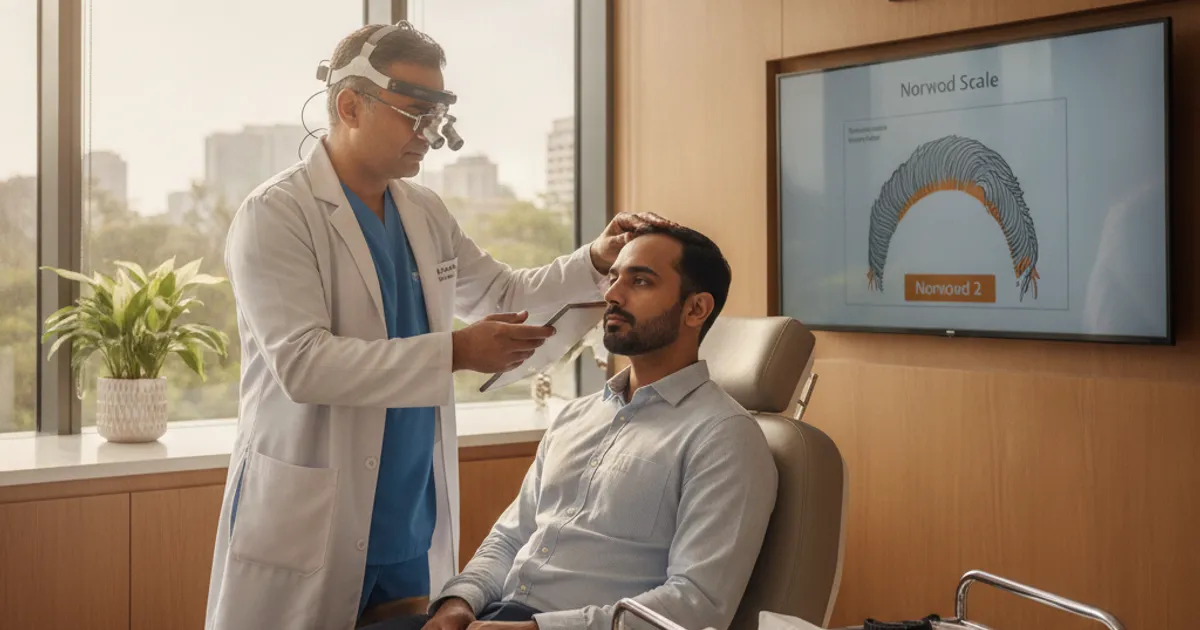
A Norwood 2 hair transplant is rarely necessary and often not recommended. At Norwood 2, you have mild recession at the temples but no significant thinning on the crown or mid-scalp. Most surgeons will suggest medication and monitoring first, because a transplant at this stage can waste grafts you may need later if your hair loss progresses.
What Is Norwood 2 Hair Loss?
The Norwood scale measures male pattern baldness from 1 (no loss) to 7 (extensive loss). Norwood 2 is the first stage where recession becomes visible. The hairline moves back at the temples, creating a slight M-shape, but the forehead still looks relatively full.
- Temple recession only — the mid-scalp and crown are intact.
- Hairline sits slightly higher than a juvenile hairline.
- No visible thinning on the top of the head.
- Often stable for years, but can progress to Norwood 3 or higher.
- Many men at this stage are the only ones who notice the change.
Am I a Candidate for a Norwood 2 Hair Transplant?
You might be a candidate if your hair loss has been stable for a reasonable period, you have realistic expectations, and you understand that future loss may require additional procedures. But most surgeons will advise against surgery at Norwood 2 unless there is a specific reason — such as a scar, an unusually high hairline, or a strong family history that suggests minimal future loss.
- Hair loss stable for a reasonable period (confirmed with photos).
- Good donor hair density and quality.
- Realistic expectations about density and future loss.
- Willingness to use medication (finasteride, minoxidil) to slow progression.
- No active scalp conditions or uncontrolled medical issues.
How Much Does a Norwood 2 Hair Transplant Cost?
Cost depends on the number of grafts, the clinic's location, and whether the price includes medication, PRP, or accommodation. For a Norwood 2 case, you typically need fewer grafts than more advanced stages. That places it in the early hair loss pricing band.
| Stage | Typical Grafts | Average Cost (USD) |
|---|---|---|
| Early (Norwood 1–2) | — | — |
| Moderate (Norwood 3–4) | — | — |
| Advanced (Norwood 5–7) | — | — |
What Results Can You Expect from a Norwood 2 Hair Transplant?
At Norwood 2, a transplant can restore a more solid hairline and fill in the temples. But because you still have a lot of native hair, the goal is subtle reinforcement, not a dramatic transformation. Results look natural when the surgeon matches the new hairline to your existing pattern and uses single-hair grafts at the front.
- Improved temple density and a more defined hairline.
- Natural look if the hairline is designed conservatively.
- Results take time to fully mature.
- You may still lose more native hair over time, so medication is often recommended.
- A second procedure may be needed if loss progresses.
Norwood 2 vs Norwood 3: What's the Difference?
Norwood 3 is deeper recession at the temples, often with a more pronounced M-shape. The key difference is that Norwood 3 usually involves more visible thinning and a higher hairline. Norwood 2 is early recession; Norwood 3 is moderate recession that is harder to hide.
Norwood 2
Early stage
- ✓ Mild temple recession
- ✓ Hairline still relatively full
- ✓ Often stable for years
- ✓ Transplant rarely recommended
Norwood 3
Moderate stage
- ✓ Deeper temple recession
- ✓ Visible M-shape
- ✓ More likely to progress
- ✓ Transplant more commonly considered
How to Choose a Clinic for a Norwood 2 Hair Transplant
Because Norwood 2 is a borderline case, you want a surgeon who will be honest about whether you need surgery at all. Look for clinics that specialise in early-stage hair loss and offer medication management alongside surgery. Avoid anyone who pushes a transplant without discussing future loss.
- Check before-and-after photos of similar Norwood 2 cases.
- Ask about their approach to long-term planning and medication.
- Confirm whether the price includes follow-up and PRP.
- Read independent reviews and verify surgeon credentials.
- Get at least two consultations before deciding.
Frequently Asked Questions
Is a Norwood 2 hair transplant worth it?
Usually not. At Norwood 2, hair loss is mild and often stable. Surgery can be premature because future loss may continue, leaving you with an unnatural pattern and limited donor hair. Medication and monitoring are typically the first step.
How many grafts do I need for Norwood 2?
The exact number depends on your hairline design, donor density, and how much temple recession you have. Your surgeon will determine the appropriate number during a consultation.
Can I get a hair transplant at Norwood 2?
Yes, but it is rarely recommended unless your hair loss has been stable for a reasonable period and you have a strong reason, such as a scar or a very high hairline. Most surgeons will suggest waiting and using medication first.
Will I need another transplant later if I have one at Norwood 2?
Possibly. If your hair loss progresses, you may need a second procedure to address new areas of thinning. That is why many surgeons prefer to wait until the pattern is more established.
More Guides
- Hair Transplant and Blood Thinners: Safety and Timing
Can you have a hair transplant on blood thinners? Learn why they matter, which ones raise bleeding risk, how long to stop before surgery, and when to restart.
- Finasteride and PSA Testing: What You Need to Know
Finasteride lowers PSA levels, so your test results need careful interpretation. Learn how finasteride affects PSA, the adjustment factor, and what to tell your
- Can You Cure a Receding Hairline? What's Realistic
Can you cure a receding hairline? Learn what's realistic with medications, transplants, and lifestyle changes, plus expected results and costs.
- Minoxidil Hair Thinning Before Growth: Is It Normal?
Is minoxidil hair thinning before growth normal? Yes, it's a common sign the treatment is working. Learn why it happens, how long it lasts, and when to worry.