
Norwood 3 Hair Transplant Grafts: How Many Do You Need?
Norwood 3 hair transplant grafts: learn what affects graft counts, costs by stage, and how to plan your procedure. No definitive numbers, just guidance.
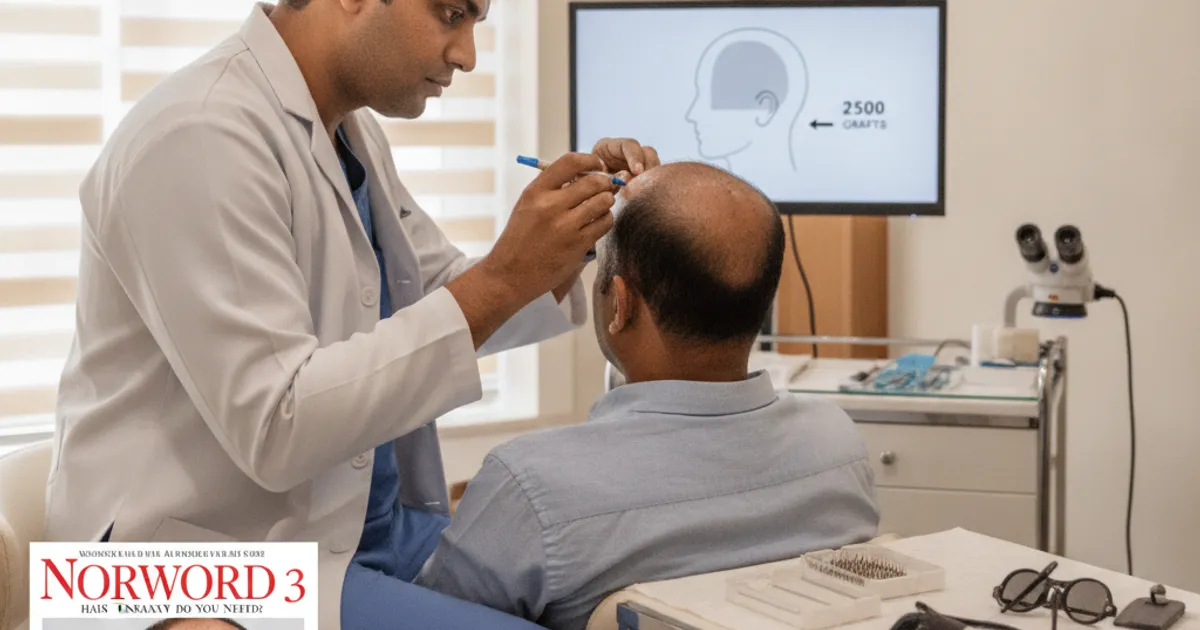
If you're at Norwood 3 on the hair loss scale, you're probably wondering how many grafts you'll need for a transplant. The honest answer is that it varies a lot from person to person. There's no single number that applies to everyone, and any clinic that promises a fixed count without examining your scalp is guessing. What we can do is walk through the factors that determine your graft count, how costs typically break down by stage of hair loss, and what to consider when deciding whether to get a transplant now or wait.
Norwood 3 is often the stage where people start thinking seriously about a hair transplant. You've got visible recession at the temples — the classic M-shape — but the crown is still intact. It's early enough that a modest number of grafts can make a noticeable difference, but late enough that waiting much longer might mean needing more grafts down the road. That said, everyone's hair loss progresses differently, so there's no universal rule.
What Does Norwood 3 Hair Loss Actually Look Like?
The Norwood scale is a common way to classify male pattern baldness. It's generally described as running from 1 (no noticeable loss) to 7 (extensive loss across the top of the scalp). Norwood 3 is typically defined by deep recession at the temples that forms a distinct M, U, or V shape. The mid-scalp and crown usually remain relatively full at this stage.
- Temple recession is clearly visible from the front and sides
- The hairline has moved back but hasn't yet connected to the crown
- Mid-scalp density is usually still good
- Crown shows little to no thinning
- Donor area (back and sides) is typically stable and dense
Because the crown is still intact, Norwood 3 can be a good time to address recession surgically. You're treating a defined area rather than chasing loss across the whole top of the scalp. But whether it's the right time for you depends on your age, how fast your loss is progressing, and your long-term goals.
How Many Grafts Do You Need for a Norwood 3 Hair Transplant?
There's no definitive graft count for Norwood 3. The number depends on your donor density, hair calibre, the size of the area to be covered, and the density you want to achieve. Some surgeons might plan a smaller session to rebuild the temples, while others might recommend a more comprehensive approach. The only way to get a precise estimate is an in-person consultation where the surgeon can assess your scalp.
| Norwood Stage | Typical Graft Range | Primary Treatment Area |
|---|---|---|
| Norwood 2 | Varies by patient | Early temple recession |
| Norwood 3 | Varies by patient | Temples and hairline |
| Norwood 4 | Varies by patient | Frontal scalp and mid-scalp |
| Norwood 5 | Varies by patient | Frontal, mid-scalp, early crown |
| Norwood 6 | Varies by patient | Extensive coverage including crown |
| Norwood 7 | Varies by patient | Near-total scalp coverage |
What Factors Change Your Graft Count?
Two people with the same Norwood stage can need very different graft numbers. Here's what surgeons actually look at:
- Donor density: How many follicular units per square centimetre you have in the back and sides
- Hair calibre: Thicker hair covers more scalp per graft than fine hair
- Hair-to-skin contrast: Dark hair on light skin creates more visual density with fewer grafts
- Hairline design: A more conservative hairline needs fewer grafts than an aggressive one
- Future loss planning: Surgeons often leave room for a second procedure if your loss progresses
- Scalp laxity: Tighter scalps limit how many grafts can be safely harvested in one session
How Much Does a Norwood 3 Hair Transplant Cost?
Cost tracks graft count. Since Norwood 3 sits in the early-to-moderate range, it's usually cheaper than later-stage procedures. Here are average case prices by stage of hair loss, based on data from Clinic Reccy:
Should You Get a Transplant at Norwood 3 or Wait?
There's no universal right answer, but here's how to think about it:
Get a Transplant Now
Varies by graft count
- ✓ Addresses recession while the crown is still intact
- ✓ Fewer grafts needed than waiting until Norwood 4 or 5
- ✓ Faster recovery and less shock loss risk
- ✓ You enjoy results during your younger years
Wait and Monitor
No surgery cost
- ✓ Hair loss may stabilise without intervention
- ✓ Medical therapy (finasteride, minoxidil) can slow progression
- ✓ Avoids surgery if your loss plateaus
- ✓ Risk: waiting too long means more grafts and higher cost later
What Should You Look for in a Norwood 3 Transplant Clinic?
Not every clinic handles early-stage cases well. Some overharvest. Some place hairlines too low. Here's what to check:
- Surgeon experience with early-stage cases, not just large sessions
- Realistic hairline design that accounts for future loss
- Clear graft count estimates before you commit
- Transparent pricing — per-graft or flat-rate, with no surprise fees
- Before-and-after photos of patients with similar hair type and loss pattern
How Do You Choose Between FUE and FUT at Norwood 3?
Both FUE and FUT work for Norwood 3. The choice usually comes down to your donor area, how short you want to wear your hair, and cost.
| Factor | FUE | FUT |
|---|---|---|
| Scarring | Small dot scars | Linear scar |
| Recovery | Faster | Slightly longer |
| Graft limit per session | Varies by patient | Varies by patient |
| Cost | Varies by clinic | Varies by clinic |
| Best for | Short hairstyles, smaller sessions | Larger sessions, budget-conscious |
Frequently Asked Questions
Can I get a hair transplant at Norwood 3?
Yes. Norwood 3 is a common stage for a first hair transplant. Many surgeons consider it a reasonable time because the crown is still intact and fewer grafts may be needed compared to later stages.
How many grafts for a Norwood 3 hairline?
There's no fixed number. It depends on your donor density, hair calibre, and how much density you want at the hairline. A surgeon can give you a personalised estimate after an examination.
Will I need a second transplant later?
Possibly. Hair loss is progressive. Many Norwood 3 patients get a second procedure years later if their loss advances. Starting medical therapy can reduce that risk.
Is Norwood 3 too early for a transplant?
It's not too early if your loss has stabilised and you have a good donor supply. Some surgeons prefer to wait until loss patterns are clearer, especially in younger patients. A consultation will help you decide.
Where to Find Norwood 3 Hair Transplant Clinics
Clinic Reccy lists hair transplant providers across multiple cities. You can filter by procedure type, price range, and patient reviews.
If you're in the early stages of research, start with a few consultations. Getting two or three opinions will give you a much clearer picture of what you actually need.
More Guides
- Hair Transplant and Blood Thinners: Safety and Timing
Can you have a hair transplant on blood thinners? Learn why they matter, which ones raise bleeding risk, how long to stop before surgery, and when to restart.
- Finasteride and PSA Testing: What You Need to Know
Finasteride lowers PSA levels, so your test results need careful interpretation. Learn how finasteride affects PSA, the adjustment factor, and what to tell your
- Can You Cure a Receding Hairline? What's Realistic
Can you cure a receding hairline? Learn what's realistic with medications, transplants, and lifestyle changes, plus expected results and costs.
- Minoxidil Hair Thinning Before Growth: Is It Normal?
Is minoxidil hair thinning before growth normal? Yes, it's a common sign the treatment is working. Learn why it happens, how long it lasts, and when to worry.