
Norwood 5 vs Norwood 6: What's the Difference?
Norwood 5 vs Norwood 6 hair loss explained: patterns, progression, transplant candidacy, and realistic results. Compare stages and plan next steps.
Norwood 5 vs Norwood 6: What's the Difference?
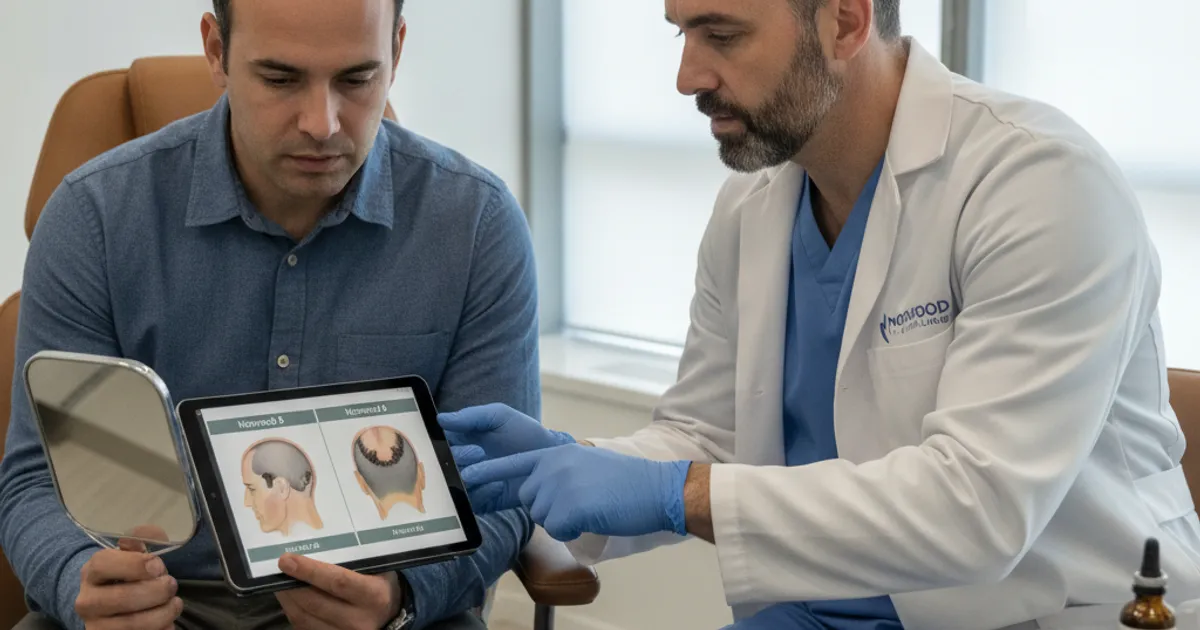
Norwood 5 and Norwood 6 are advanced stages of male pattern baldness on the Norwood scale. The main difference is how much hair remains in the mid-scalp and crown. At Norwood 5, you still have a bridge of hair across the top, even if it's thin. At Norwood 6, that bridge is gone, and the front, mid-scalp, and crown are largely bald. Both stages are treatable, but Norwood 6 usually requires more grafts and a more conservative plan.
What do Norwood 5 and Norwood 6 look like?
The Norwood scale describes patterns of hair loss, with higher numbers indicating more extensive baldness. Norwood 5 and 6 sit in the advanced range. The visual difference comes down to the mid-scalp bridge and how far back the bald area extends.
| Feature | Norwood 5 | Norwood 6 |
|---|---|---|
| Hairline | Receded deep at temples | Receded further, often with isolated forelock |
| Mid-scalp bridge | Thin but present | Absent or nearly absent |
| Crown | Large bald spot | Merges with mid-scalp baldness |
| Donor area | Usually still strong | May be thinner, needs careful assessment |
| Overall pattern | Two separate bald zones (front and crown) | One large continuous bald zone |
How does hair loss progression differ between Norwood 5 and 6?
Progression from Norwood 5 to 6 is usually gradual, but the jump matters because it changes what a transplant can achieve. At Norwood 5, the mid-scalp bridge still provides some natural coverage and anchoring for a transplant design. At Norwood 6, that bridge is gone, so the surgeon has to cover a much larger area with the same limited donor supply.
- Norwood 5: hair loss is advanced but still has a visible band of hair across the top.
- Norwood 6: the band has disappeared, creating a single large bald zone.
- Norwood 5 often stabilises for years before progressing.
- Norwood 6 is closer to Norwood 7, where donor hair may be limited.
- Both stages can keep progressing without medication, so timing matters.
Are you a candidate for a hair transplant with Norwood 5 or 6?
Yes, most men with Norwood 5 or 6 are candidates for a hair transplant, but candidacy depends on donor density, donor stability, and expectations. Norwood 6 patients need a more conservative hairline and often a two-procedure plan. A surgeon will assess your donor area with densitometry and sometimes a trichoscope to estimate usable grafts.
- Good donor density on the back and sides is the single biggest factor.
- Norwood 5 candidates usually have more flexibility in hairline design.
- Norwood 6 candidates often need to prioritise coverage over density.
- Medication (finasteride, minoxidil) is usually recommended to protect remaining hair.
- Realistic expectations are essential — neither stage will return to a juvenile hairline.
How many grafts are needed for Norwood 5 vs Norwood 6?
Graft numbers vary by hair calibre, colour contrast, and desired density, so no single figure fits every case. A surgeon will estimate the number of grafts based on your donor supply and the area to be covered. For Norwood 5, the goal is often to rebuild the hairline and add density to the mid-scalp while preserving the crown. For Norwood 6, the priority shifts to creating a natural-looking front and mid-scalp, often accepting lighter coverage at the crown.
| Stage | Common approach |
|---|---|
| Norwood 5 | Single session to rebuild hairline and mid-scalp; crown may be addressed later. |
| Norwood 6 | One large session or two staged sessions; conservative hairline, focus on front and mid-scalp. |
| Norwood 6 (limited donor) | Conservative hairline, prioritise front and mid-scalp; consider SMP for density illusion. |
What results can you expect from a hair transplant at Norwood 5 or 6?
Results depend on graft survival, donor quality, and how well you follow aftercare. Norwood 5 patients often achieve a more defined hairline with reasonable mid-scalp density. Norwood 6 patients typically get improved coverage and a more balanced appearance, but density will be lighter, especially at the crown.
- Norwood 5: fuller front and mid-scalp, crown may need a second pass.
- Norwood 6: defined hairline and improved top coverage, crown often thinner.
- Both: final results take time to mature; your surgeon will give you a personalised timeline.
- Both: medication helps maintain results long-term.
- Norwood 6: staged procedures often give better overall coverage than one mega-session.
What are the best treatment options for Norwood 5 and 6?
Treatment usually combines medication, surgery, and sometimes adjunct therapies. Medication slows loss and protects donor hair. Surgery restores coverage. Adjuncts like PRP or low-level laser therapy may support healing and graft survival, though evidence varies.
- Finasteride: reduces DHT, slows loss, protects remaining hair.
- Minoxidil: supports growth and density, especially in the crown.
- FUE or FUT transplant: main surgical options for both stages.
- PRP: sometimes used to support graft survival and healing.
- Scalp micropigmentation (SMP): can add density illusion for Norwood 6.
- Hair systems: non-surgical option for those wanting immediate coverage.
How do you choose a clinic for Norwood 5 or Norwood 6 hair transplant?
Advanced cases need surgeons who regularly handle Norwood 5 and 6 patients. Look for clinics that show before-and-after photos of similar cases, explain graft planning clearly, and offer a realistic plan rather than overpromising. Ask about donor management, session size, and what happens if you need a second procedure.
Frequently Asked Questions
Can a Norwood 6 get a full head of hair back?
No. A Norwood 6 transplant can restore a hairline and improve coverage, but density will be lighter than a full head of hair. The goal is a natural frame and better coverage, not original density.
Is Norwood 5 or 6 better for a hair transplant?
Norwood 5 is generally easier to treat because more native hair remains and the bald area is smaller. Norwood 6 is still treatable but usually needs more grafts and a more conservative plan.
How many grafts for a Norwood 6?
Graft numbers vary by donor density, hair calibre, and coverage goals. Your surgeon will provide a personalised estimate after assessing your donor area.
Can I wait if I'm Norwood 5?
You can, but waiting usually means more hair loss and a larger bald area to cover later. Starting medication early can slow progression and preserve donor hair for a future transplant.
More Guides
- Hair Transplant and Blood Thinners: Safety and Timing
Can you have a hair transplant on blood thinners? Learn why they matter, which ones raise bleeding risk, how long to stop before surgery, and when to restart.
- Finasteride and PSA Testing: What You Need to Know
Finasteride lowers PSA levels, so your test results need careful interpretation. Learn how finasteride affects PSA, the adjustment factor, and what to tell your
- Can You Cure a Receding Hairline? What's Realistic
Can you cure a receding hairline? Learn what's realistic with medications, transplants, and lifestyle changes, plus expected results and costs.
- Minoxidil Hair Thinning Before Growth: Is It Normal?
Is minoxidil hair thinning before growth normal? Yes, it's a common sign the treatment is working. Learn why it happens, how long it lasts, and when to worry.