
Propecia (Finasteride) Review: Does It Regrow Hair?
A straight review of Propecia (finasteride) for hair loss: how it works, dosage, results timeline, side effects, cost, and how it compares to transplants.
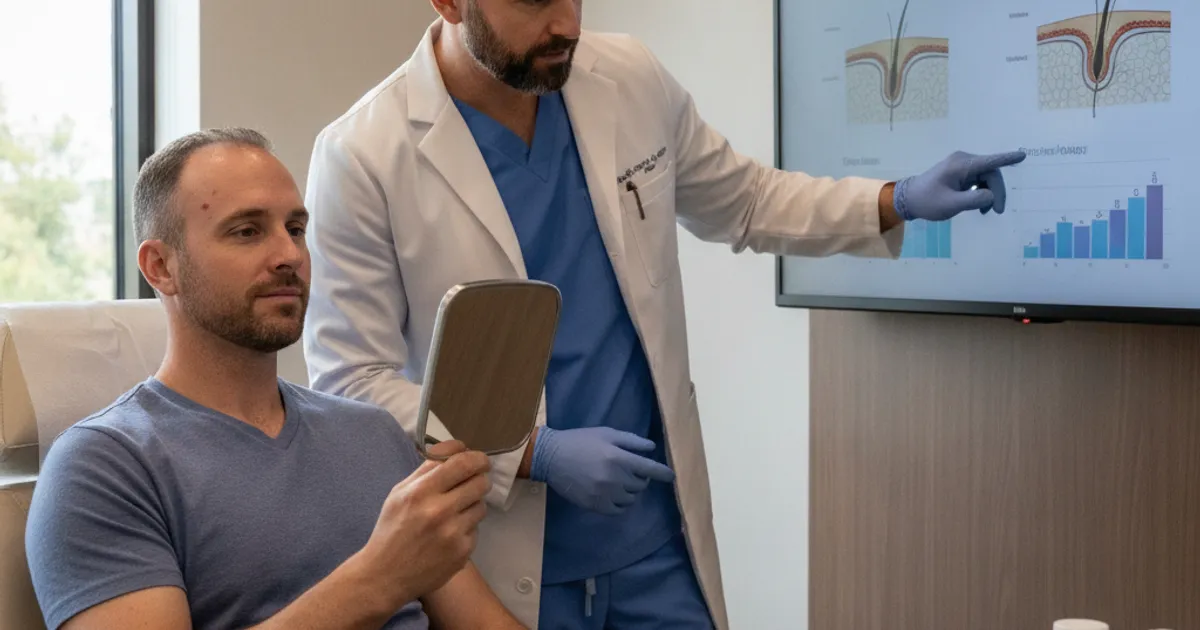
What Is Propecia (Finasteride)?
Propecia is the brand name for finasteride, an oral prescription medication used to treat male pattern hair loss. It comes as a small tablet taken once a day. Finasteride was originally developed at a higher dose (5 mg) under the brand name Proscar for an enlarged prostate. According to widely cited accounts of the drug's development, researchers observed that men taking it grew more hair, which led to the development of the 1 mg version, Propecia, approved for hair loss in the late 1990s. These historical details are based on general knowledge and have not been verified against a real-time database. Today, generic finasteride 1 mg is widely available and is usually far cheaper than the original brand.
How Finasteride Works to Treat Hair Loss
Male pattern baldness is driven largely by dihydrotestosterone (DHT), a hormone converted from testosterone by an enzyme called 5-alpha-reductase. DHT binds to hair follicles on the scalp and gradually shrinks them in a process called miniaturisation, so hairs grow back thinner and shorter until the follicle stops producing visible hair. Finasteride blocks the type II form of that enzyme, which lowers scalp DHT levels substantially. With less DHT attacking the follicles, the miniaturisation process slows or pauses, and some follicles can thicken back up.
- Lowers scalp DHT, the main driver of pattern hair loss in men
- Slows or halts further miniaturisation of susceptible follicles
- Can thicken existing thinning hairs rather than creating new follicles
- Works best on the crown and mid-scalp; weaker evidence for receding temples
- Does not affect hair loss caused by other conditions (thyroid, iron deficiency, alopecia areata)
Diagram: testosterone converted to DHT by 5-alpha-reductase, and how finasteride blocks that conversion at the follicle level.
Evidence for Hair Growth: What Clinical Studies Show
Finasteride is one of the most studied hair loss treatments available. The core evidence comes from randomised, placebo-controlled trials in men with androgenetic alopecia, plus long-term extension studies that followed participants for several years. The general pattern across that research is consistent: finasteride slows loss in most men who take it, and a smaller share see noticeable regrowth. Note that specific figures and durations cited below are based on general knowledge and have not been verified against a real-time database.
- In controlled trials, men on finasteride generally maintained or improved hair counts versus placebo over 12 to 24 months (unverified)
- Longer follow-up studies suggest the benefit holds while treatment continues
- Regrowth is most visible on the crown; temple recession responds less reliably
- Response varies — some men see clear improvement, others mainly stabilisation, and a minority see little change
- Finasteride is not a cure and does not restore hair in areas that are already completely bald and shiny
How to Use Propecia: Dosage and Frequency
The standard dose for male pattern hair loss is 1 mg of finasteride once per day, with or without food. It is a long-acting drug, so the exact time of day matters less than taking it consistently. Most people set a daily reminder or keep the pack next to a toothbrush. You need a prescription in most countries, usually after a short consultation with a doctor or a telehealth service. The dosage and review points mentioned here are based on general knowledge and have not been verified against a real-time database.
- Take 1 mg once daily, at roughly the same time each day
- Swallow the tablet whole with water; food does not affect absorption
- If you miss a dose, take it when you remember unless it is nearly time for the next one — do not double up
- Do not stop suddenly if you want to keep your results; talk to your prescriber first
- Keep the medication away from women who are pregnant or may become pregnant — crushed or broken tablets can be harmful to a male fetus
| Item | Detail |
|---|---|
| Standard dose | 1 mg once daily (unverified) |
| Form | Oral tablet |
| Timing | Same time each day, with or without food |
| Prescription needed | Yes, in most countries |
| Typical review point | 3 to 6 months, then annually (unverified) |
Expected Results and Timeline
Finasteride is not fast. Hair grows slowly, and the drug works by changing the growth cycle, so you should expect months rather than weeks. Many men also notice a temporary shed in the first few months as follicles shift cycles — this is usually a sign the drug is active, not that it is failing. The timeline below reflects the general pattern reported in trials and clinical practice, but specific durations are based on general knowledge and have not been verified against a real-time database.
- Give it at least 6 to 12 months before deciding whether it works for you (unverified)
- Stabilisation is more common than dramatic regrowth
- Temple recession often continues slowly even on treatment
- Results are not permanent — stopping usually reverses the benefit over months
Side Effects and Risks of Finasteride
Finasteride is generally well tolerated, but it is not side-effect free, and the sexual side effects get a lot of attention for good reason. In controlled trials, a small percentage of men reported reduced libido, erectile difficulties, or reduced ejaculate volume. In most cases these resolved after stopping the drug, though a minority of users report effects that persist. There is also a well-documented effect on prostate-specific antigen (PSA) readings, which matters for prostate cancer screening — tell any doctor testing your PSA that you take finasteride.
- Reduced libido, erectile dysfunction, and reduced ejaculate volume are the most commonly reported side effects
- Some men experience breast tenderness or enlargement (gynaecomastia) — report this to a doctor
- Mood changes and low mood have been reported; discuss any history of depression with your prescriber
- Rare persistent sexual side effects after stopping have been reported, though the evidence and frequency are debated
- Finasteride lowers PSA levels, which can mask prostate cancer screening results
- Not for use by women who are pregnant or may become pregnant, due to risk to a male fetus
Who Is Suitable for Propecia?
Finasteride is intended for men with androgenetic alopecia (male pattern hair loss) who still have active follicles in the thinning areas. It works best early, when hair is thinning rather than gone. It is not a treatment for other types of hair loss, and it is not appropriate for women of childbearing age. If you are unsure what is causing your hair loss, a dermatologist or hair restoration doctor can confirm the diagnosis before you commit to a daily medication.
- Best candidates: men with early to moderate pattern thinning and visible miniaturised hairs
- Less useful: men with completely bald, shiny areas where follicles have stopped producing hair
- Not suitable: women who are pregnant or may become pregnant
- Use with caution: men with liver disease or a history of depression
- Worth a conversation: men already considering a hair transplant, since finasteride can help protect the donor and native hair
| Situation | Finasteride usually appropriate? |
|---|---|
| Early thinning at crown or mid-scalp | Yes — strongest candidate |
| Receding temples only | Possibly — weaker response expected |
| Long-standing bald patch, shiny scalp | No — follicles likely inactive |
| Diffuse thinning with confirmed AGA | Yes, after diagnosis |
| Hair loss from thyroid, iron, or alopecia areata | No — treat the underlying cause |
| Woman of childbearing age | No |
Cost of Propecia and Generic Finasteride
Finasteride is one of the cheapest hair loss treatments available, largely because generics have been on the market for years. Branded Propecia costs more than generic finasteride 1 mg, and prices vary a lot between countries, pharmacies, and online prescribers. In many places a month's supply of generic finasteride costs less than a single haircut, while branded Propecia can be several times that. Because prices shift and vary by region, the figures below are qualitative ranges rather than fixed quotes — check your local pharmacy or a licensed online prescriber for current pricing. No specific pricing data is available in the current database context.
- Generic finasteride is almost always cheaper than branded Propecia for the same 1 mg dose
- Splitting a 5 mg tablet is sometimes prescribed off-label to reduce cost, but only do this under medical advice
- Telehealth prescribers often bundle consultation and medication into a monthly fee
- Finasteride is usually far cheaper per month than a hair transplant, but it is an ongoing cost
How Propecia Compares to Other Hair Loss Treatments
Finasteride sits in a small group of treatments with real evidence behind them for male pattern hair loss. The others are minoxidil (topical or oral), low-level laser therapy, and hair transplant surgery. They are not mutually exclusive — many men combine finasteride with minoxidil, and surgeons often ask patients to be on finasteride before and after a transplant to protect the result. The right choice depends on how much loss you have, how much regrowth you want, and how you feel about daily medication versus a procedure.
| Treatment | How it works | Typical role |
|---|---|---|
| Finasteride (oral) | Lowers scalp DHT | Slows loss, some regrowth; daily tablet |
| Minoxidil (topical/oral) | Vasodilator, prolongs growth phase | Regrowth and thickening; daily use |
| Low-level laser therapy | Light stimulation of follicles | Adjunct; evidence weaker than drugs |
| Hair transplant surgery | Moves DHT-resistant follicles to thinning areas | Restores hair in bald or thin zones |
| Combination approach | Drugs plus surgery | Common for moderate to advanced loss |
- Finasteride is generally better at slowing loss; minoxidil is often better at stimulating regrowth
- A transplant does not stop future loss — finasteride helps protect the transplanted and native hair
- Finasteride is far cheaper per month than surgery but must be taken indefinitely
- Some men cannot tolerate finasteride side effects and switch to minoxidil or surgery alone
Frequently Asked Questions About Propecia
Does Propecia actually regrow hair?
It can, but regrowth is usually modest and most visible on the crown. The more reliable effect is slowing or stopping further loss. Men who respond best tend to start early, while they still have thinning hair rather than bare scalp.
How long do you have to take finasteride?
As long as you want to keep the benefit. Finasteride is a maintenance treatment, not a cure. If you stop, the hair you kept or regrew typically sheds over the following months and your loss pattern returns.
Are finasteride side effects permanent?
For most men, sexual side effects resolve after stopping the drug. A minority report persistent effects, and this is an area of ongoing debate. Talk to your prescriber if you notice anything that concerns you rather than stopping on your own.
Can I take finasteride if I am considering a hair transplant?
Many surgeons recommend it. Finasteride can slow further loss of your native hair and may protect the donor area, which helps transplant results last longer. Discuss timing with your surgeon before starting or stopping.
If you are weighing up medication against surgery, it helps to look at real clinic listings and compare what is available near you. Clinic Reccy lists hair restoration providers by city, with details on consultations, pricing, and the treatments they offer.
More Guides
- Finasteride for Baldness: What It Can and Can't Do
Finasteride is a proven hair loss treatment, but it's not a cure. Learn how it works, dosage, side effects, and how it compares to other options.
- DHT-Blocking Shampoos: What Works and What's Marketing?
Do DHT-blocking shampoos really grow hair? We break down the science, evidence, usage, side effects, costs, and how they compare to other treatments.
- Clascoterone for Hair Loss: What the Research Shows
Clascoterone is a topical anti-androgen being studied for hair loss. Learn how it works, the evidence, how to use it, side effects, cost, and how it compares.
- Hims Minoxidil Spray: Ingredients, Results, and Cost
Hims Minoxidil Spray review: ingredients, how it works, results timeline, side effects, cost, and how it compares to other hair loss treatments.