
Sapphire Blade Hair Transplant: Procedure, Cost & Recovery
A clear guide to sapphire blade hair transplants: how the technique works, recovery timeline, results, who it suits, and how it compares to other methods.
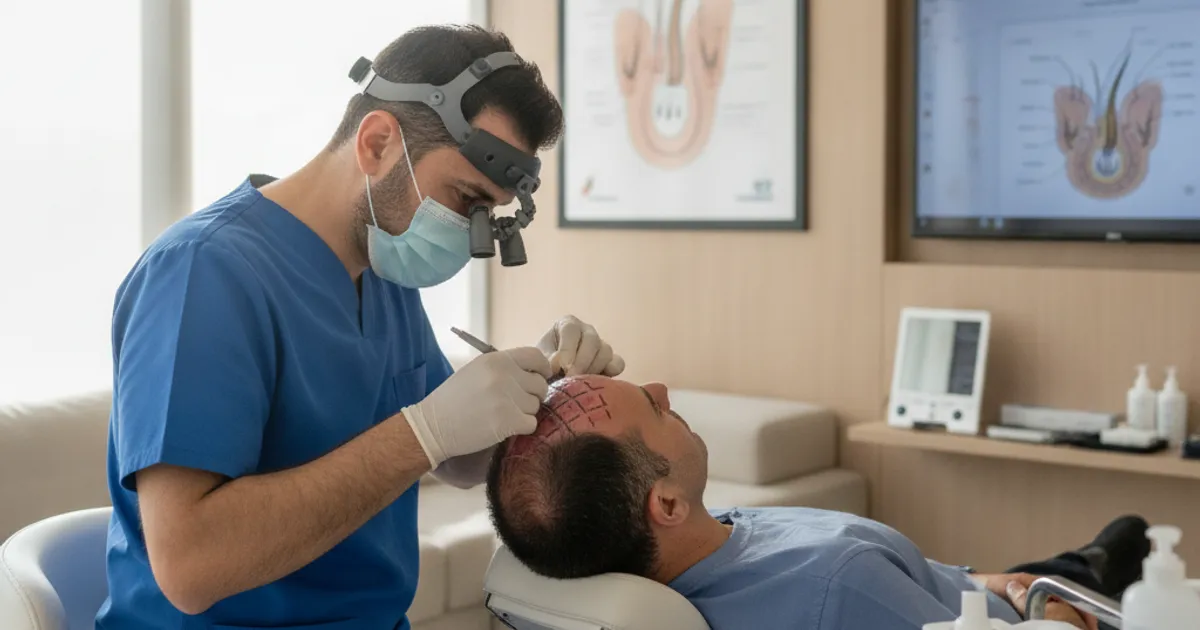
What Is a Sapphire Blade Hair Transplant?
A sapphire blade hair transplant is a follicular unit extraction (FUE) procedure where the surgeon uses sapphire-tipped blades to create the tiny recipient sites in the scalp. Instead of the traditional steel blade, the incisions are made with a blade made from synthetic sapphire crystal. The sapphire itself doesn't extract the grafts — it's used for the channel-opening step. The extraction of follicles is still done with a motorised or manual punch. The sapphire blade is the part that shapes the angle, depth, and density of the new hairline. Because sapphire is harder and smoother than surgical steel, the incisions tend to be more precise and the edges of the wound cleaner. That's the theory, and it's why clinics market it as a premium option. In practice, the skill of the surgeon matters far more than the blade material, but sapphire does offer some real advantages in the right hands.
How Sapphire Blade FUE Is Performed, Step by Step
The procedure follows the same broad steps as any FUE transplant, with the sapphire blade used at the channel-opening stage. Here's what a typical day looks like.
- Consultation and planning: the surgeon maps your hairline, assesses donor density, and calculates how many grafts are needed. This is usually done weeks before surgery.
- Local anaesthetic: the donor area (usually the back and sides of the scalp) is numbed with injections. Most patients stay awake throughout.
- Graft extraction: the surgeon uses a punch tool to remove individual follicular units. These are kept in a holding solution to stay hydrated.
- Sapphire blade channel creation: the surgeon makes thousands of tiny incisions in the recipient area using a sapphire-tipped blade. The angle and direction are set to match your natural hair growth.
- Graft implantation: the extracted follicles are placed into the sapphire-created channels one by one. This is the most time-consuming part.
- Clean-up and dressing: the scalp is cleaned, and a bandage or headband is applied. You go home the same day in most cases.
Sapphire vs. Steel Blades: Key Differences
The main difference between sapphire and steel blades comes down to the sharpness and smoothness of the incision. Sapphire blades are made from a single crystal, which means they can be sharpened to a finer edge and stay sharp longer during the procedure. Steel blades are cheaper and more widely available, but they can dull faster, which may lead to more trauma to the surrounding tissue. That said, the difference in final hair growth between the two is often marginal when the surgeon is experienced. The bigger factors are graft handling, storage time, and how densely the grafts are packed.
| Feature | Sapphire Blade | Steel Blade |
|---|---|---|
| Material | Synthetic sapphire crystal | Surgical-grade steel |
| Sharpness | Extremely sharp, holds edge longer | Sharp but dulls faster |
| Incisions per blade | Often more per blade | Often fewer per blade |
| Wound healing | May be slightly faster | Standard healing time |
| Cost to clinic | Higher | Lower |
| Availability | Less common | Widely available |
| Final result | Similar when surgeon is skilled | Similar when surgeon is skilled |
Recovery Timeline After a Sapphire Blade Transplant
Recovery from sapphire blade FUE is broadly the same as standard FUE. The sapphire incisions may cause slightly less crusting and redness in the first week, but you should still expect the usual healing milestones. Here's a realistic timeline.
- Days 1–3: swelling, tightness, and small scabs form. You'll need to sleep upright and avoid touching the grafts.
- Days 4–7: scabs begin to dry and flake. Most people can return to desk work by day 5–7.
- Weeks 2–3: scabs are gone. The transplanted hair sheds — this is normal and expected.
- Months 1–3: the scalp looks mostly normal, but the new hair is in a resting phase. Donor area may feel numb or itchy.
- Months 4–6: new growth starts. This is when you'll see fine hairs emerging.
- Months 9–12: the majority of growth is visible. Density continues to improve up to 18 months.
| Timeframe | What's Happening | Typical Appearance |
|---|---|---|
| Day 1–3 | Grafts are settling | Small scabs, redness, mild swelling |
| Week 1 | Scabs flaking | Crusty but manageable |
| Week 2–3 | Shock loss begins | Transplanted hair sheds |
| Month 3 | Resting phase | Scalp looks normal, little visible growth |
| Month 6 | Early growth | Fine hairs, uneven density |
| Month 12 | Mature result | Most density visible |
| Month 18 | Final result | Full maturation of grafts |
Results: What to Expect and When
Sapphire blade FUE produces natural-looking results when performed by a competent surgeon. The sapphire blade allows for very fine incisions, which can help create a softer hairline and denser packing in some cases. But the final result depends on how many grafts you have, your donor quality, and how well you heal. No blade can create hair where there are no follicles to transplant.
- Natural hairline: sapphire incisions can be made at very acute angles, mimicking natural growth direction.
- Density: packing density depends on graft count and scalp laxity, not the blade alone.
- Scarring: sapphire may produce slightly less visible scarring in the recipient area, but FUE scars are typically tiny dots regardless.
- Longevity: transplanted hair is permanent in most cases, but native hair can continue to thin over time.
- Realistic expectations: you won't see the final result for 12–18 months. Anyone promising faster results is overselling.
Who Is a Good Candidate for Sapphire Blade FUE?
Sapphire blade FUE suits most people who are good candidates for standard FUE. That means you have enough donor hair, your hair loss has stabilised, and you're in good general health. It's not a magic fix for active, aggressive hair loss — you'll still need medication like finasteride or minoxidil to preserve native hair. If you have a very tight scalp or poor donor density, you may not be a candidate for any FUE variant.
- You have a stable hair loss pattern (not rapidly progressing).
- Your donor area has enough density for the number of grafts needed.
- You're in good health with no uncontrolled bleeding disorders.
- You understand that a second procedure may be needed later.
- You're willing to take medication to protect existing hair.
- You have realistic expectations about density and timeline.
Sapphire Blade Hair Transplant Cost
Sapphire blade FUE usually costs more than standard FUE because the blades are more expensive and the procedure takes longer. The total price depends on the number of grafts, the clinic's location, and the surgeon's reputation. Below are average case prices by stage of hair loss. These are rough guides, not quotes.
| Stage of Hair Loss | Typical Grafts | Average Cost (USD) |
|---|---|---|
| Early (Norwood 2–3) | 1,000–1,500 | 2,500–4,000 |
| Moderate (Norwood 4–5) | 1,500–2,500 | 4,000–7,000 |
| Advanced (Norwood 6–7) | 2,500–4,000+ | 7,000–12,000 |
Sapphire Blade vs. Other Hair Transplant Techniques
Sapphire blade FUE is one of several FUE variants. The main alternatives are standard steel blade FUE, DHI (direct hair implantation), and FUT (strip surgery). Each has trade-offs. Sapphire sits in the middle: more expensive than steel FUE, less expensive than some DHI packages, and less invasive than FUT. If you're comparing techniques, focus on the surgeon's results, not the tool.
| Technique | How It Works | Typical Cost (USD) | Best For |
|---|---|---|---|
| Sapphire FUE | Sapphire blade creates channels, grafts implanted after | 2,500–12,000 | Patients wanting fine control and minimal scarring |
| Steel FUE | Steel blade creates channels | 2,000–10,000 | Budget-conscious patients with good donor hair |
| DHI | Grafts implanted directly with Choi pen | 3,000–15,000 | Precise hairline work, smaller sessions |
| FUT | Strip of scalp removed and dissected | 2,000–8,000 | Patients needing maximum grafts in one session |
How to Choose a Clinic for Sapphire Blade FUE
Choosing a clinic is more important than choosing a blade. Look for surgeons who perform sapphire FUE regularly, show consistent before-and-after photos, and are transparent about pricing and graft counts. Avoid clinics that promise unrealistic density or push you into surgery without a proper consultation. If you're travelling abroad, factor in aftercare and follow-up.
- Check how many sapphire FUE procedures the surgeon performs per month.
- Ask to see results at 12 months, not just immediate post-op photos.
- Confirm whether the price includes PRP, medication, and follow-up visits.
- Read independent reviews on multiple platforms, not just the clinic's website.
- Ask who performs the incisions — the surgeon or a technician.
- Make sure you have a clear plan for medication after surgery.
Frequently Asked Questions
Is sapphire blade FUE better than steel blade FUE?
Not automatically. Sapphire blades can create finer, cleaner incisions, which may help with healing and hairline precision. But the final result depends mostly on the surgeon's skill, graft handling, and your donor quality. A great surgeon using steel will outperform a mediocre surgeon using sapphire.
How long does sapphire blade FUE take?
Most sessions take several hours, depending on the number of grafts. Larger cases can take a full day or be split over two days. The sapphire channel step adds some time compared to steel because the surgeon often works more deliberately.
Does sapphire blade FUE leave scars?
Any FUE procedure leaves tiny dot scars in the donor area. Sapphire blades may produce slightly less visible scarring in the recipient area because the incisions are finer. But scarring depends on your skin type, healing ability, and how well you follow aftercare instructions.
How much does sapphire blade FUE cost?
Costs vary widely by clinic and location. As a rough guide, early-stage cases average 2,500–4,000 USD, moderate cases 4,000–7,000 USD, and advanced cases 7,000–12,000 USD. Always get a personalised quote based on your graft count.
More Guides
- Hair Transplant for Curly Hair: Graft and Technique Tips
A plain-English guide to hair transplants for curly hair: how surgeons adapt graft harvesting and placement, recovery, results, costs, and who it suits.
- How Long Does a Hair Transplant Last? Long-Term Durability
How long does a hair transplant last? We explain the procedure, recovery, durability, costs by stage of hair loss, and how it compares to alternatives.
- Hair Transplant Revision: When a Second Procedure Makes Sense
Considering a hair transplant revision? Learn how a second procedure works, who it suits, recovery, results, and costs. Expert explainer from Clinic Reccy.
- Hair Transplant for Norwood 6 and 7: What's Possible
A clear look at hair transplant options for Norwood 6 and 7 hair loss: graft limits, staging, recovery, costs, and realistic results.