
Why Hair Transplant Grafts Fail: Post-Surgery Mistakes
Hair transplant grafts can fail after surgery. Learn the post-op mistakes that damage grafts, how to protect them, and what proper aftercare involves.
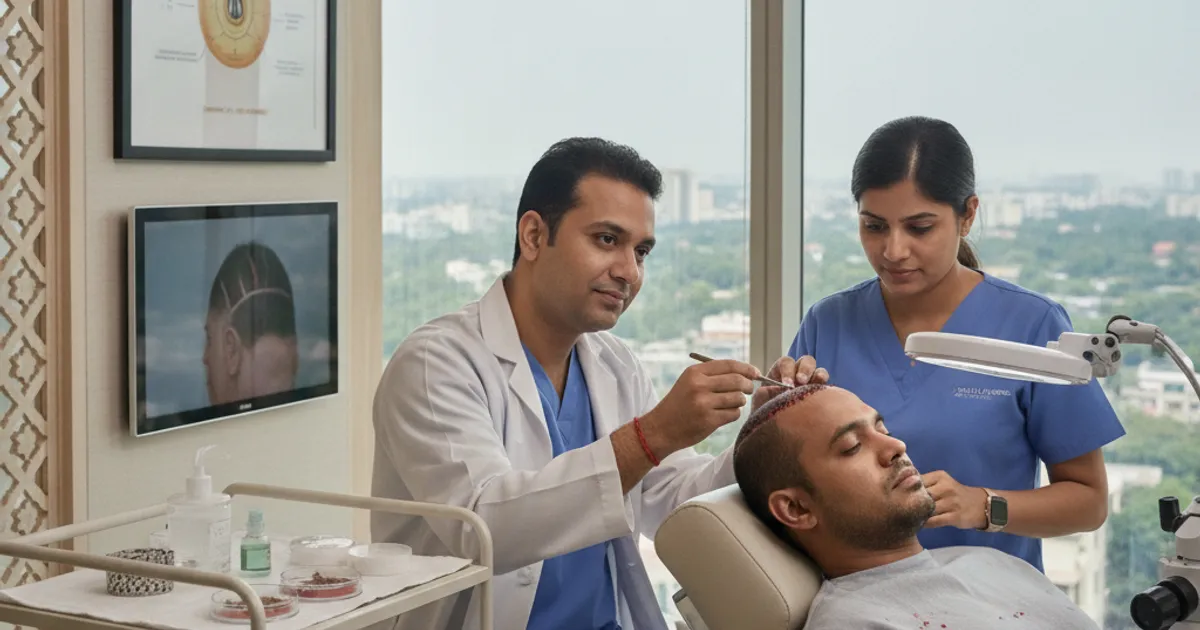
What Are Hair Transplant Grafts and Why Do They Fail?
A hair transplant graft is a tiny cluster of skin containing one to four hair follicles, moved from a donor area (usually the back or sides of the scalp) to a thinning or bald spot. The graft is the unit of survival. If it takes root and grows, you get hair. If it fails, that follicle is gone for good. Graft failure is not the same as normal post-op shedding. Shedding is expected and temporary. Failure means the follicle itself did not survive the transplant process.
How Hair Transplant Grafts Are Placed: The Surgical Process
The procedure usually follows a predictable sequence. The surgeon removes a strip of scalp (FUT) or extracts individual follicles with a punch tool (FUE). Each graft is then sorted, kept in a holding solution, and implanted into tiny incisions called recipient sites. The angle, depth, and density of those sites matter. So does the time the graft spends outside the body. The shorter the out-of-body time and the gentler the handling, the higher the survival rate.
- Donor harvesting: strip removal or individual follicle extraction.
- Graft sorting: technicians separate single-hair and multi-hair grafts under a microscope.
- Storage: grafts sit in a chilled saline or holding solution to stay hydrated.
- Recipient site creation: the surgeon makes tiny incisions in the balding area.
- Implantation: grafts are placed one by one, usually with forceps or an implanter pen.
- Bandaging and aftercare instructions: the scalp is covered and you leave with a written protocol.
The Critical Recovery Window: When Grafts Are Most Vulnerable
The first 10 days decide whether your grafts anchor. In the first 48 to 72 hours, grafts have no blood supply. They survive on plasma and nutrients from the surrounding tissue. Any friction, pressure, or trauma can dislodge them. From day 3 to day 10, new blood vessels start connecting. After day 10, the graft is usually secure, but the follicle can still be damaged by infection, inflammation, or scarring.
- Day 0–3: Grafts are fragile. No touching, no scratching, no hats that rub.
- Day 3–7: Crusts form. Wash gently with prescribed shampoo and lukewarm water.
- Day 7–10: Most crusts fall off. Grafts are anchoring but still sensitive.
- Week 2–4: Shock shedding begins. This is normal and not graft failure.
- Month 3–4: New growth starts. If nothing grows by month 6, graft failure is possible.
| Time After Surgery | What Is Happening | What You Should Do |
|---|---|---|
| First 72 hours | Grafts have no blood supply yet | Sleep upright, avoid touching, no exercise |
| Day 3–7 | Crusts form, blood supply starts | Gentle washing, no scratching, no swimming |
| Day 7–10 | Grafts anchor, crusts fall off | Keep scalp clean, avoid direct sun |
| Week 2–4 | Shock shedding | Do not panic, continue aftercare |
| Month 3–6 | New growth begins | Monitor growth, follow up with clinic |
Post-Surgery Mistakes That Cause Graft Failure
Most graft failure after surgery comes down to a handful of avoidable mistakes. The problem is that many of them feel harmless at the time. You bump your head getting into a car. You scratch an itch in your sleep. You go back to the gym too soon. Each one can cost you grafts.
- Touching or scratching the recipient area in the first 10 days.
- Sleeping flat or on your stomach instead of upright or on your back.
- Wearing tight hats, helmets, or headbands that rub the grafts.
- Washing too aggressively or using the wrong shampoo too early.
- Swimming in pools, lakes, or the ocean before the scalp heals.
- Heavy sweating from exercise or sauna use in the first two weeks.
- Drinking alcohol or smoking, which impairs circulation and healing.
- Missing prescribed antibiotics or anti-inflammatory medication.
- Exposing the scalp to direct sun without protection.
- Picking at crusts instead of letting them fall off naturally.
What Is Included in Proper Post-Operative Care
Good aftercare is not complicated, but it is specific. Your clinic should give you a written protocol with timelines. If they do not, ask for one. The basics cover cleaning, sleeping, medication, and activity restrictions.
- A gentle saline spray or prescribed solution for the first 48 hours.
- A mild, fragrance-free shampoo starting around day 3.
- Antibiotics or anti-inflammatory drugs if prescribed.
- Pain relief that does not thin the blood (avoid aspirin unless cleared).
- Instructions on sleeping position: usually elevated and on your back.
- A list of activities to avoid: gym, swimming, sauna, contact sports.
- Sun protection guidance for the first few months.
- A follow-up schedule: typically 1 week, 1 month, 3 months, 6 months, 12 months.
How Graft Survival Affects Results and Cost
Graft survival directly affects how your result looks and whether you need a second procedure. If most grafts survive, you get close to the planned density. If a significant portion fails, you may see patchy growth and need a repair session. That repair costs money and time. So protecting grafts is not just a medical issue. It is a financial one.
| Stage of Hair Loss | Typical Graft Range | What It Means for Graft Survival |
|---|---|---|
| Early (Norwood 2–3) | 1,000–1,500 grafts | Smaller session, easier to protect, lower risk of failure |
| Moderate (Norwood 4–5) | 1,500–2,500 grafts | Longer surgery, more grafts to manage, moderate risk |
| Advanced (Norwood 6–7) | 2,500–4,000+ grafts | Long session, higher risk of dehydration and trauma |
Who Is Most at Risk for Graft Failure?
Some people are more likely to lose grafts than others. It is not always about the surgeon. Your own habits and health play a big role. If you fall into one of these groups, be extra careful with aftercare.
- Smokers: nicotine restricts blood flow and slows healing.
- People with uncontrolled diabetes: poor circulation and higher infection risk.
- Anyone with a scalp condition like psoriasis or eczema.
- Patients who exercise heavily or sweat a lot in the first two weeks.
- People who cannot resist touching or scratching the recipient area.
- Those who do not follow the clinic's washing and medication instructions.
- Patients with a history of keloid scarring or poor wound healing.
- Anyone who returns to work in a dirty or dusty environment too soon.
How This Compares to Alternative Hair Restoration Methods
Hair transplant grafts are not the only option. Medications, laser therapy, and PRP can help, but they work differently. They do not move follicles. They try to keep the ones you have. If a follicle is already dead, no medication will bring it back. That is why transplants are still the only way to restore hair in bald areas.
| Method | How It Works | Graft Failure Risk | Best For |
|---|---|---|---|
| Hair transplant (FUE/FUT) | Moves follicles from donor to recipient | Yes, if aftercare is poor | Bald spots, receding hairline |
| Minoxidil | Topical vasodilator, improves blood flow | No grafts involved | Early thinning, crown |
| Finasteride | Oral DHT blocker | No grafts involved | Preventing further loss |
| Low-level laser therapy | Light energy to stimulate follicles | No grafts involved | Mild thinning |
| PRP injections | Platelet-rich plasma to stimulate growth | No grafts involved | Thinning, post-transplant support |
Choosing a Clinic to Minimize Graft Failure Risk
The clinic you choose affects graft survival as much as your own aftercare. A good clinic will not rush the surgery. They will keep grafts hydrated. They will give you clear written instructions. They will also follow up with you. If a clinic promises unrealistic density or pushes you into a mega-session without discussing risks, walk away.
- Ask how many grafts they typically place per session.
- Ask about their graft survival rate and how they track it.
- Request a written aftercare protocol before you book.
- Check if they offer follow-up appointments at 1, 3, 6, and 12 months.
- Look for clinics that use chilled holding solutions and implanter pens.
- Read reviews about aftercare, not just the surgery itself.
- Avoid clinics that do not mention graft failure or risks at all.
Frequently Asked Questions
Can a hair transplant graft fail after the first week?
Yes. While the first 72 hours are the most fragile, grafts can still be lost in the first 10 days from infection, scratching, or trauma. After day 10, the graft is usually anchored, but severe infection or scarring can still damage the follicle.
Is it normal to lose hair after a transplant?
Yes. Shock shedding is normal and happens around week 2 to 4. The hair shaft falls out, but the follicle stays in place. New hair usually starts growing around month 3 to 4. This is not graft failure.
What happens if I scratch my grafts?
Scratching can dislodge a graft if it has not anchored yet. If you scratch and see bleeding or a graft come out, contact your clinic. Do not try to put it back yourself. In many cases, a single scratch does not ruin the whole result, but it can affect density in that spot.
How can I tell if my grafts failed or if it is just slow growth?
If you see no growth by month 6, or if growth is patchy and uneven, some grafts may have failed. A follow-up with your clinic can assess density and determine if a repair session is needed. Slow growth alone is not failure.
More Guides
- Hair Transplant for Curly Hair: Graft and Technique Tips
A plain-English guide to hair transplants for curly hair: how surgeons adapt graft harvesting and placement, recovery, results, costs, and who it suits.
- How Long Does a Hair Transplant Last? Long-Term Durability
How long does a hair transplant last? We explain the procedure, recovery, durability, costs by stage of hair loss, and how it compares to alternatives.
- Hair Transplant Revision: When a Second Procedure Makes Sense
Considering a hair transplant revision? Learn how a second procedure works, who it suits, recovery, results, and costs. Expert explainer from Clinic Reccy.
- Hair Transplant for Norwood 6 and 7: What's Possible
A clear look at hair transplant options for Norwood 6 and 7 hair loss: graft limits, staging, recovery, costs, and realistic results.