
Crown Hair Transplant Results: What to Expect
Crown hair transplant results develop gradually over many months. Learn what affects growth, how many grafts you might need, and how to choose a clinic.
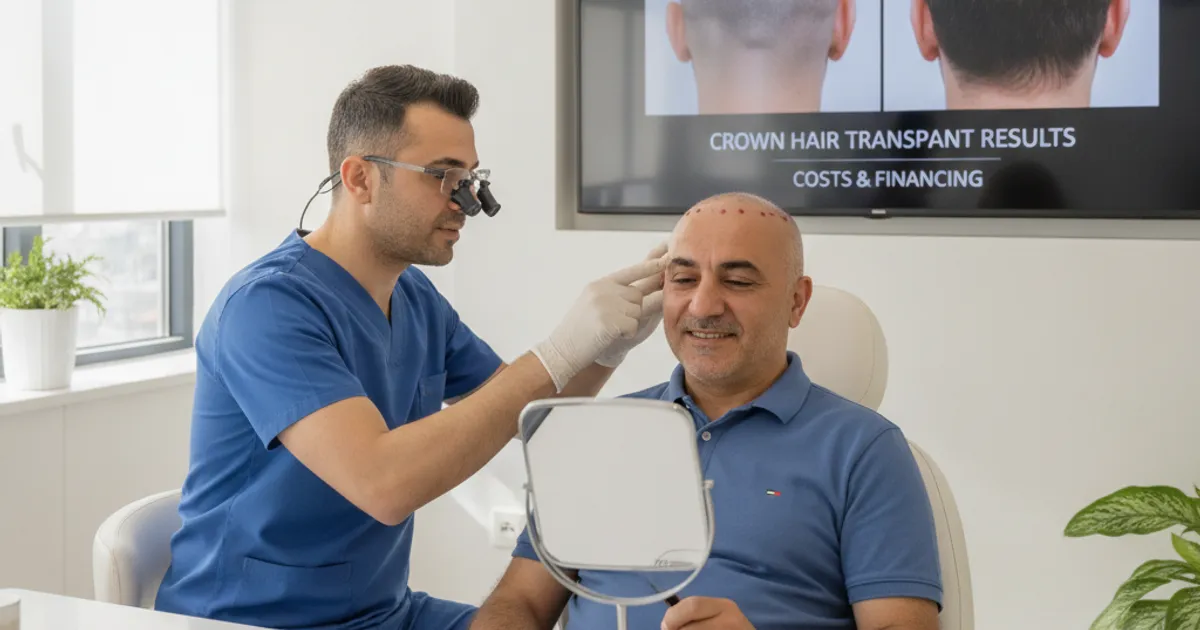
Crown hair transplant results are the visible hair regrowth you get after donor grafts are placed into the thinning or bald spot on the back of your scalp. Full results typically take many months to develop, with the most noticeable improvement happening between months 6 and 12. The exact timeline varies from person to person.
The crown — also called the vertex — is one of the trickiest areas to treat. It's a circular zone where hair grows in a swirl pattern, and the angles are different from the hairline. Because of that, results can look thinner than a hairline transplant even when the same number of grafts is used. Here's what actually matters if you're researching crown hair transplant results.
What Are Crown Hair Transplant Results?
Crown hair transplant results refer to the density, coverage, and natural appearance achieved after grafts are implanted into the crown area. Unlike the hairline, the crown is a focal point — people standing behind you see it directly. Good results blend seamlessly with existing hair and follow the natural whorl pattern.
- Improved density: grafts fill in thinning areas, but the crown often needs more grafts per square centimetre than the hairline.
- Natural swirl: the surgeon must match the direction and angle of your existing hair growth.
- Long-term stability: results depend partly on how much native hair you keep around the transplanted area.
- Scarring: FUE leaves tiny dot scars, FUT leaves a linear scar — both hidden by surrounding hair in most cases.
How Long Until You See Crown Hair Transplant Results?
You won't see final crown hair transplant results for at least a year. The timeline is predictable: shock loss first, then slow growth, then thickening. Most people notice real change around month 6, but the crown is often slower to fill in than the front because blood supply and graft take rates can differ.
| Timeframe | What's Happening |
|---|---|
| Weeks 1–2 | Transplanted hairs shed. This is normal — the follicles remain. |
| Months 2–3 | Dormant phase. The crown may look worse than before surgery. |
| Months 4–6 | New hairs start to emerge. Fine, thin, and patchy at first. |
| Months 6–9 | Visible density improves. You can style hair more normally. |
| Months 12–18 | Final results. Grafts thicken and mature. Crown fills in fully. |
- Don't judge results before month 6 — early growth is misleading.
- Take photos monthly under the same lighting to track progress objectively.
- The crown often lags behind the hairline in visible growth.
What Factors Affect Crown Hair Transplant Results?
Several variables determine how good your crown results will be. Some you can control, some you can't. The biggest ones are graft count, surgeon skill, your donor hair quality, and how much native hair you keep.
- Graft count: the crown needs a significant number of grafts depending on the size of the bald spot.
- Donor density: thicker, denser donor hair gives better coverage.
- Hair calibre: coarse hair covers more scalp than fine hair.
- Surgeon experience: angle, depth, and distribution matter more in the crown than anywhere else.
- Medical therapy: finasteride and minoxidil help maintain native hair around the grafts.
- Scalp laxity and healing: affects how well grafts take.
Good Candidate
- ✓ Stable hair loss or on medication
- ✓ Dense donor area
- ✓ Realistic expectations
- ✓ Willing to wait for results
Challenging Candidate
- ✓ Active, rapid hair loss
- ✓ Thin donor area
- ✓ Expecting immediate density
- ✓ Very large crown area
Crown vs. Hairline Transplant Results: What's the Difference?
Crown and hairline transplants are not the same. The hairline frames your face and needs precise, single-hair grafts for a natural look. The crown is about coverage and blending. Results differ in density, growth speed, and how many grafts are required.
| Factor | Crown Transplant | Hairline Transplant |
|---|---|---|
| Grafts needed | Varies by size | Varies by size |
| Growth speed | Slower | Faster |
| Visual impact | Coverage from behind | Frames the face |
| Technique | Swirl pattern, wider spacing | Single-hair grafts, tight spacing |
| Risk of thin look | Higher | Lower |
How Many Grafts Are Needed for Crown Hair Transplant Results?
Graft count depends on the size of the crown balding area and your hair characteristics. A small thinning spot might need fewer grafts, while a fully bald crown can require several thousand. Surgeons often stage crown transplants over two sessions to avoid overharvesting the donor area. The exact number should be determined by a qualified surgeon after examining your scalp.
- Small thinning: fewer grafts
- Moderate bald spot: moderate number of grafts
- Large bald crown: higher number of grafts, possibly multiple sessions
- Diffuse thinning: graft count varies; sometimes medical therapy is enough
| Crown Size | Typical Graft Range | Sessions Needed |
|---|---|---|
| Small | Fewer grafts | 1 |
| Moderate | Moderate number | 1–2 |
| Large | Higher number | 2–3 |
Can You Get Good Crown Hair Transplant Results with FUE or FUT?
Yes — both FUE and FUT can produce excellent crown results. The technique matters less than the surgeon's skill and your individual characteristics. FUE is more popular for crown work because it allows precise graft placement and leaves no linear scar. FUT may be recommended for larger sessions, but your surgeon will advise which is best for your case.
FUE
- ✓ No linear scar
- ✓ Precise graft placement
- ✓ Shorter recovery
- ✓ Better for smaller sessions
FUT
- ✓ May allow more grafts per session
- ✓ Linear scar hidden by hair
- ✓ Sometimes recommended for large crown cases
What Do Real Crown Hair Transplant Results Look Like?
Real crown results are not dramatic overnight transformations. They're gradual improvements in coverage and density. The best results look like you never lost hair in that area. The worst look pluggy, sparse, or like a patch of hair that doesn't match the surrounding texture.
- Natural results: hair blends with existing crown hair, follows the swirl, and looks dense under normal lighting.
- Mediocre results: visible gaps, unnatural angles, or a 'moth-eaten' look.
- Failed results: grafts don't grow, or the crown remains bald after 18 months.
- Realistic expectation: crown transplants improve coverage but rarely restore teenage density.
How to Choose a Clinic for Crown Hair Transplant Results
The clinic you choose has more impact on your crown results than any other factor. Look for surgeons who specialise in crown work, show real before-and-after photos of crown cases, and don't overpromise. Ask about graft counts, technique, and what happens if results fall short.
- Check for crown-specific before-and-after photos — not just hairlines.
- Ask how many crown cases the surgeon performs per month.
- Confirm whether the surgeon or technicians perform the incisions.
- Ask about a touch-up policy if growth is poor.
- Look for clinics that offer post-op follow-up for at least 12 months.
Frequently Asked Questions About Crown Hair Transplant Results
How long do crown hair transplant results last?
Transplanted crown hair is permanent because it's taken from the DHT-resistant donor zone. However, your native crown hair can continue to thin, which may make results look less full over time. Medication like finasteride helps maintain surrounding hair.
Why does the crown take longer to grow than the hairline?
The crown has a different blood supply and the grafts are placed at wider angles. This can slow initial growth. Most surgeons expect crown results to lag behind hairline results.
Can I get a crown hair transplant if I'm completely bald there?
Yes, but you'll need more grafts. A completely bald crown also means less native hair to blend with, so the final result may look less dense than a transplant into thinning hair.
What happens if my crown transplant doesn't grow?
Poor growth can happen in some cases. Most reputable clinics offer a touch-up at reduced or no cost if growth is clearly below expectations after 12–18 months. Always ask about this policy before booking.
Crown hair transplant results are predictable if you choose the right surgeon and understand the timeline. Expect many months for full growth, plan for a graft count determined by your surgeon, and stay on medication to protect your native hair. Compare clinics carefully, look at real crown cases, and don't rush the decision.
More Guides
- Hair Transplant and Blood Thinners: Safety and Timing
Can you have a hair transplant on blood thinners? Learn why they matter, which ones raise bleeding risk, how long to stop before surgery, and when to restart.
- Finasteride and PSA Testing: What You Need to Know
Finasteride lowers PSA levels, so your test results need careful interpretation. Learn how finasteride affects PSA, the adjustment factor, and what to tell your
- Can You Cure a Receding Hairline? What's Realistic
Can you cure a receding hairline? Learn what's realistic with medications, transplants, and lifestyle changes, plus expected results and costs.
- Minoxidil Hair Thinning Before Growth: Is It Normal?
Is minoxidil hair thinning before growth normal? Yes, it's a common sign the treatment is working. Learn why it happens, how long it lasts, and when to worry.