
Norwood 2 Crown Thinning: Is It Balding or Normal?
Norwood 2 crown thinning explained: causes, diagnosis, and treatment options. Learn when it's normal, when it's balding, and if a hair transplant helps.
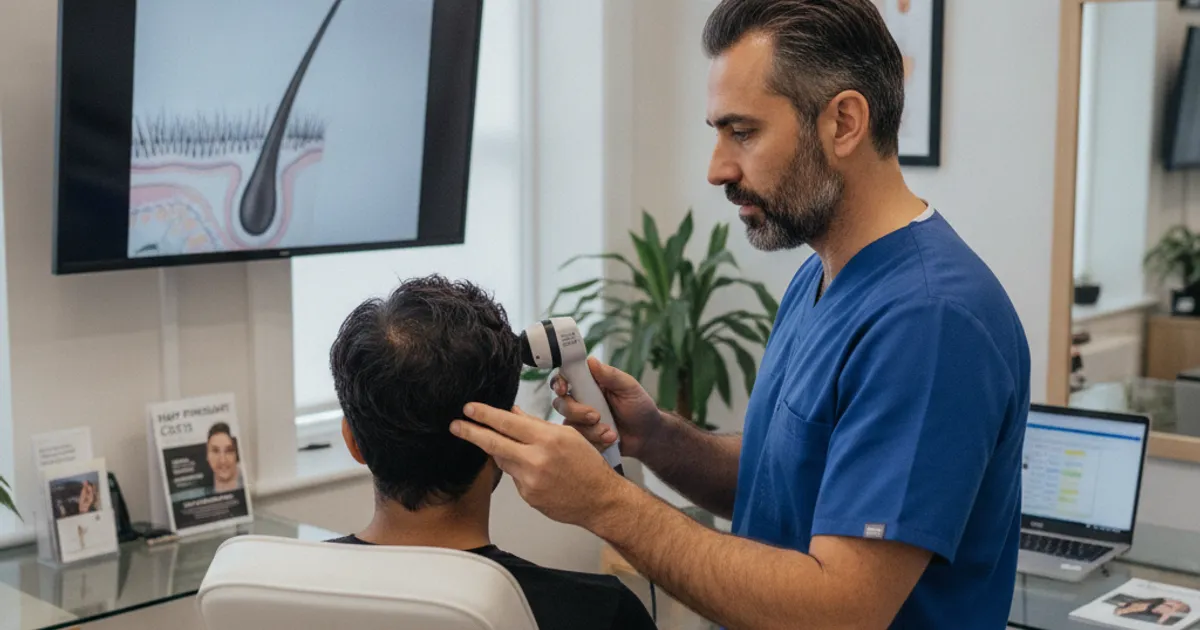
Norwood 2 crown thinning is early-stage hair loss where the hairline has receded slightly at the temples (Norwood 2) and the crown (vertex) is also starting to thin. It is not just a receding hairline — it is a combination pattern that can signal progressive male pattern baldness, especially if there is a family history.
What is Norwood 2 crown thinning?
The Norwood scale measures male pattern baldness from 1 (no loss) to 7 (extensive loss). Norwood 2 is the earliest visible stage: the hairline forms a subtle M shape with mild recession at the temples. Crown thinning means the hair on the top-back of the scalp is also losing density. When both happen together, it is called Norwood 2 crown thinning.
- Norwood 2: mild temple recession, hairline still relatively high.
- Crown thinning: reduced density at the vertex, often noticed under bright light or when styling.
- Combined pattern: two areas of loss at once, which can progress faster than hairline recession alone.
- Not the same as a maturing hairline, which is stable and does not involve crown density loss.
Is Norwood 2 crown thinning normal or a sign of balding?
A Norwood 2 hairline alone is often just a mature hairline and can be normal for many adult men. But when crown thinning is also present, it is more likely to be early male pattern baldness (androgenetic alopecia). The key difference is progression: a mature hairline stays put, while pattern baldness continues to thin and recede over time.
- Normal: hairline recedes slightly by late 20s and then stabilises for years.
- Balding: hairline recession plus crown thinning that worsens over time.
- Family history of crown loss increases the chance it is pattern baldness.
- Diffuse thinning all over (not just crown) may point to other causes like telogen effluvium.
What causes crown thinning at Norwood 2?
The main cause is genetics and hormones. Dihydrotestosterone (DHT) shrinks hair follicles in susceptible areas — typically the temples and crown. At Norwood 2, these follicles are miniaturising but not yet dead, which is why early treatment can still work.
- Genetics: inherited sensitivity to DHT in certain scalp zones.
- Hormones: DHT binds to follicles and shortens their growth phase.
- Age: risk rises with age, though it can start earlier.
- Other factors: stress, poor diet, thyroid issues, or medication can accelerate thinning.
- Lifestyle: smoking and high stress may worsen circulation to the scalp.
How is Norwood 2 crown thinning diagnosed?
Diagnosis is usually visual plus history. A doctor or trichologist will assess your hairline, crown density, and family history. They may use a dermatoscope to check for miniaturised hairs. Blood tests can rule out thyroid or iron issues if thinning is diffuse.
- Step 1: Visual exam of hairline and crown under good lighting.
- Step 2: Pull test or wash test to estimate daily shedding.
- Step 3: Dermoscopy to measure hair diameter diversity (miniaturisation).
- Step 4: Blood tests for ferritin, thyroid, vitamin D, and testosterone if needed.
- Step 5: Photographic tracking at regular intervals to confirm progression.
What are the treatment options for Norwood 2 crown thinning?
Treatment aims to slow loss and regrow hair. At Norwood 2, non-surgical options often work well because follicles are still alive. Options include medication, low-level laser therapy, and in some cases hair transplant. Below is a comparison of the main approaches.
| Treatment | How it works | Best for | Typical cost (USD) |
|---|---|---|---|
| Minoxidil (topical) | Increases blood flow, prolongs growth phase | Early thinning, crown | Varies by pharmacy and formulation |
| Finasteride (oral) | Blocks DHT conversion | Preventing progression | Varies by pharmacy and insurance |
| Low-level laser therapy | Stimulates follicle activity | Mild to moderate thinning | Device cost varies by brand |
| PRP injections | Growth factors to scalp | Crown thinning | Per-session cost varies by clinic |
| Hair transplant | Moves DHT-resistant follicles | Stable loss, defined bald spots | Varies by graft count and clinic |
- Start with medication if you want to preserve existing hair.
- Combine minoxidil and finasteride for better results than either alone.
- PRP can be added but evidence is mixed.
- Transplant is usually considered only after loss stabilises.
Is hair transplant suitable for Norwood 2 crown thinning?
Sometimes, but not always. A hair transplant at Norwood 2 crown thinning is risky if the crown loss is still progressing. Surgeons often prefer to wait until the pattern is stable, otherwise you may need multiple procedures as native hair continues to fall. For early crown thinning, medication is usually the first step.
- Good candidate: stable crown loss for an extended period, good donor density.
- Poor candidate: active, rapidly progressing thinning.
- Crown transplants need more grafts than hairline work — often a significant number of grafts.
- Without medication, transplanted hair may look isolated as surrounding hair thins.
- Always get a surgeon's assessment before booking.
When should you see a specialist for Norwood 2 crown thinning?
See a specialist if you notice crown thinning getting worse over time, if you are shedding more hair than usual, or if you want to start treatment early. Early intervention is the best way to keep your hair. A dermatologist or hair restoration surgeon can confirm the cause and discuss options.
- Thinning visible under bright light or when hair is wet.
- You can see more scalp at the crown than a year ago.
- Family history of early balding.
- You want to explore medication or transplant.
- You have other symptoms like fatigue or weight changes (possible thyroid issue).
Related guides
FAQ
Can Norwood 2 crown thinning reverse on its own?
No. Male pattern baldness is progressive. Without treatment, crown thinning usually worsens over time. Early medication can slow or partially reverse it.
Is Norwood 2 too early for a hair transplant?
Often yes. Most surgeons prefer to wait until loss stabilises. At Norwood 2, medication is usually the first-line treatment.
What is the best treatment for crown thinning at Norwood 2?
Finasteride and minoxidil are the most proven. Combining them gives the best chance of preserving and regrowing crown hair.
How fast does Norwood 2 crown thinning progress?
It varies. Some men stay at Norwood 2 for years; others progress to Norwood 3–4 more quickly. Genetics and treatment play a big role.
More Guides
- Hair Transplant and Blood Thinners: Safety and Timing
Can you have a hair transplant on blood thinners? Learn why they matter, which ones raise bleeding risk, how long to stop before surgery, and when to restart.
- Finasteride and PSA Testing: What You Need to Know
Finasteride lowers PSA levels, so your test results need careful interpretation. Learn how finasteride affects PSA, the adjustment factor, and what to tell your
- Can You Cure a Receding Hairline? What's Realistic
Can you cure a receding hairline? Learn what's realistic with medications, transplants, and lifestyle changes, plus expected results and costs.
- Minoxidil Hair Thinning Before Growth: Is It Normal?
Is minoxidil hair thinning before growth normal? Yes, it's a common sign the treatment is working. Learn why it happens, how long it lasts, and when to worry.