
Derma Pen for Hair: Microneedling Explained
What a derma pen does for hair loss, how microneedling works, recovery, results, cost and how it compares to other hair restoration options.
What Is a Derma Pen for Hair?
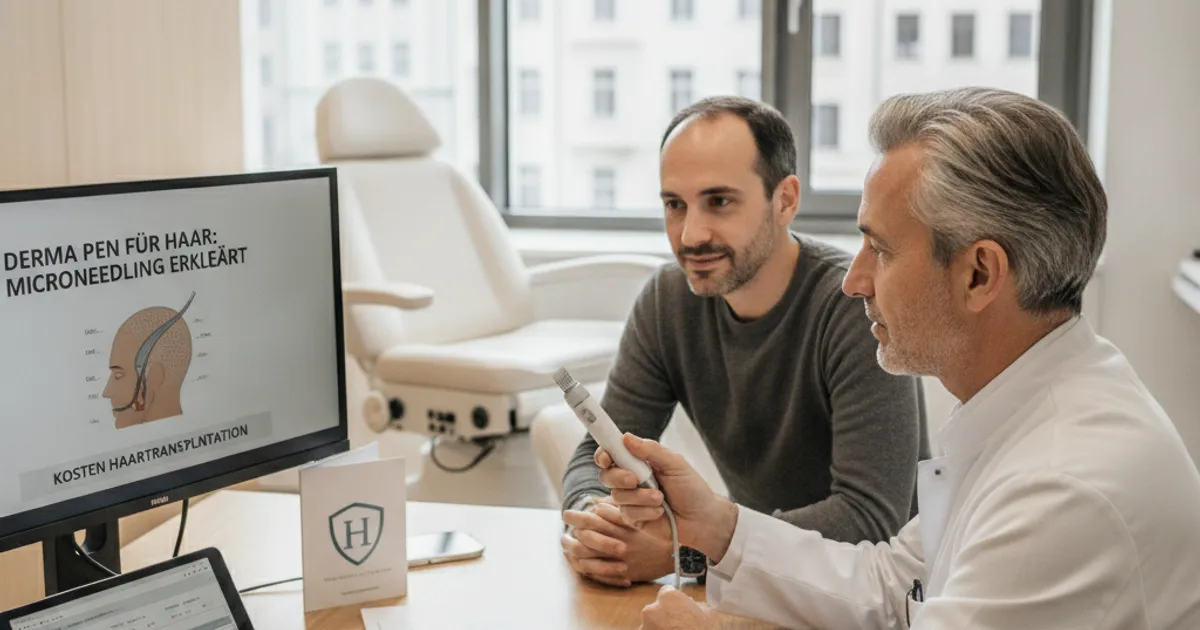
A derma pen is a handheld motorised device that pushes a cluster of fine needles in and out of the skin at high speed. When it's used on the scalp, the process is called microneedling, and the goal is to trigger your skin's repair response. That response does two useful things for hair: it increases blood flow to the follicle, and it opens tiny channels in the skin that let topical treatments absorb far better than they would on their own. It is not a hair transplant, and it does not move or replace follicles. It's a non-surgical treatment that's usually done in a series of sessions, often alongside minoxidil, finasteride or PRP.
- Non-surgical, no incisions, no stitches and no scarring expected when performed correctly
- Needle depth is adjustable, typically somewhere between 0.5mm and 2.5mm depending on the area and the provider's protocol (unverified — confirm with your provider)
- Often combined with minoxidil, platelet-rich plasma (PRP) or other topical serums to boost absorption
- Sessions are short — most scalp treatments take 15 to 30 minutes (unverified — varies by clinic and protocol)
- Can be done in a clinic by a professional, or at home with a consumer-grade device (with very different results and risks)
How Derma Pen Treatment Works: Step-by-Step
The exact protocol varies from clinic to clinic, but most professional sessions follow a similar structure. Here's what a typical appointment looks like.
Recovery and Aftercare: What to Expect
Recovery from a derma pen session is short compared to surgery. Most people go back to normal activities the same day, though the scalp will look red and feel warm for a few hours. You may notice mild pinpoint bleeding during the session itself, which is normal at deeper settings. Any redness usually fades within 24 to 48 hours (unverified — typical range reported anecdotally).
- Avoid washing your hair for the first 12 to 24 hours, or follow your clinic's specific instructions (unverified — follow provider advice)
- Skip strenuous exercise, saunas and swimming pools for about 24 hours to reduce irritation and infection risk (unverified — follow provider advice)
- Don't apply harsh products, dyes or strong chemicals to the scalp for several days
- If you use minoxidil, ask when to restart it — some clinics say 12 hours, others say 24
- Mild flaking or dryness in the days after treatment is common and usually settles on its own
- Contact your provider if you see spreading redness, pus, fever or pain that gets worse rather than better
Results and Timeline: When Will You See Changes?
This is the part most people want straight answers on, and the honest answer is: it takes time, and results vary a lot. Hair grows slowly, and any treatment that works on follicle health rather than replacing follicles needs months, not weeks, to show visible change. Most clinics schedule sessions every two to four weeks for the first few months, then taper to maintenance (unverified — typical protocol, confirm with your provider).
- Weeks 1–4: little visible change. Some people notice reduced shedding if microneedling is combined with minoxidil. (unverified timeline)
- Months 2–3: early signs may appear — finer hairs along the hairline or crown, or a general sense that the scalp looks denser. (unverified timeline)
- Months 4–6: this is when most reported improvement becomes noticeable, if it's going to happen at all. (unverified timeline)
- Months 6–12: results plateau. At this point you and your provider can judge whether to continue, adjust the protocol or consider other options. (unverified timeline)
- Maintenance: many people continue sessions every 4 to 8 weeks to hold onto gains. (unverified frequency)
Who Is a Good Candidate for Derma Pen?
Derma pen treatment suits people who still have active follicles in the thinning areas and who are looking for a low-risk, non-surgical option. It's often used as a first-line add-on for early androgenetic alopecia, or as a supporting treatment alongside medication. It's less useful for advanced baldness, where the follicles are gone.
- Early to moderate pattern hair loss with visible but not fully bald thinning
- People already using minoxidil or finasteride who want to improve absorption
- Those who want a non-surgical option before committing to a transplant
- People with healthy scalps and no active skin conditions in the treatment area
- Not ideal for active scalp infections, open wounds, severe acne, or a history of keloid scarring
- Not suitable during pregnancy or breastfeeding without medical clearance
- Not a replacement for a transplant in areas of complete baldness
| Stage of Hair Loss | Suitability | Typical Approach |
|---|---|---|
| Early thinning | Good candidate | Monthly sessions plus topical minoxidil |
| Moderate thinning | Reasonable candidate | Sessions combined with PRP or medication |
| Advanced baldness | Limited benefit | Consider surgical options instead |
| Patchy or scarring alopecia | Case-by-case | Requires diagnosis first — see a dermatologist |
Cost of Derma Pen for Hair
Derma pen pricing depends on where you are, whether a doctor or technician performs the session, and whether PRP or other add-ons are included. A single session is usually affordable, but because treatment is ongoing, the total cost over a year adds up. The figures below are illustrative examples only — they are not sourced from a live database and should not be treated as quotes. Always confirm pricing directly with the clinic.
| Cost Factor | What It Affects |
|---|---|
| Number of sessions | More sessions = higher total cost; most protocols start with 4–6 (unverified — typical range) |
| Add-ons (PRP, serums) | Can significantly increase per-session price |
| Provider type | Dermatologist-led sessions usually cost more than technician-led |
| Location | City and country pricing varies widely |
| Maintenance plan | Ongoing sessions every 4–8 weeks add to annual cost (unverified frequency) |
Derma Pen vs Other Hair Restoration Options
It helps to see microneedling in context. It's one of several non-surgical options, and it sits alongside — not above — proven treatments like medication and PRP. Surgery remains the only option that restores hair in areas that are already bald.
| Treatment | Invasiveness | Typical Cost Band (USD) | Best For |
|---|---|---|---|
| Derma pen (microneedling) | Non-invasive | Illustrative: 300–2,000 per course (not database-sourced) | Early to moderate thinning, add-on therapy |
| Minoxidil (topical) | Non-invasive | Low monthly cost | Ongoing maintenance, early thinning |
| Finasteride (oral) | Non-invasive | Low monthly cost | Slowing loss in men, prescription required |
| PRP injections | Minimally invasive | Moderate per session | Thinning with active follicles |
| Low-level laser therapy | Non-invasive | Moderate device or clinic cost | Adjunct to other treatments |
| Hair transplant (FUE/FUT) | Surgical | Varies widely by graft count | Advanced loss, bald areas |
- Derma pen is cheaper per session than PRP but usually needs more frequent sessions
- Medication is the cheapest ongoing option, but it's a commitment and can have side effects
- PRP and microneedling are often combined — many clinics consider them complementary
- A transplant is the only option that adds hair where follicles are gone, but it's surgical and priced per graft
- None of these treatments work for everyone; response depends on the cause and stage of your hair loss
Choosing a Clinic and Provider
Because derma pen treatment is simple to perform, it's offered in a lot of places — dermatology clinics, hair restoration clinics, med spas and even some salons. Quality varies enormously. The provider's training, the sterility of the equipment and whether they actually assess your scalp before treating matter more than the brand of pen.
- Check who performs the treatment — a dermatologist or trained clinician is preferable to an untrained operator
- Ask about needle depth protocols and whether they adjust for different scalp zones
- Confirm that cartridges are single-use and sterile
- Ask whether they combine microneedling with PRP or topical medication, and why
- Request a clear treatment plan with session frequency and a review point
- Be wary of anyone promising regrowth in weeks or guaranteeing results
- Look for before-and-after photos of real patients with similar hair loss patterns
Frequently Asked Questions
Does a derma pen actually regrow hair?
It can support regrowth in some people, particularly when combined with minoxidil or PRP. On its own, the evidence is weaker. It works best on early to moderate thinning where follicles are still active. It won't restore hair in areas that are already completely bald.
How often should you use a derma pen on your scalp?
Most clinical protocols start with sessions every two to four weeks for the first few months, then move to a maintenance schedule every four to eight weeks (unverified — typical protocol). At-home use is usually less frequent and at shallower depths. Follow the plan your provider gives you rather than guessing.
Is derma pen treatment painful?
Most people describe it as uncomfortable rather than painful — a scratching or prickling sensation. At deeper needle settings, a topical numbing cream is often used. Discomfort is short-lived and settles within minutes of finishing.
Can I do derma pen treatment at home instead of a clinic?
You can, but results and safety are not the same. Home devices are typically shallower and less powerful, and the main risk is infection from reused or unsterile cartridges. If you treat at home, use a personal device, fresh sterile cartridges and conservative depth settings.
More Guides
- Hair Transplant for Curly Hair: Graft and Technique Tips
A plain-English guide to hair transplants for curly hair: how surgeons adapt graft harvesting and placement, recovery, results, costs, and who it suits.
- How Long Does a Hair Transplant Last? Long-Term Durability
How long does a hair transplant last? We explain the procedure, recovery, durability, costs by stage of hair loss, and how it compares to alternatives.
- Hair Transplant Revision: When a Second Procedure Makes Sense
Considering a hair transplant revision? Learn how a second procedure works, who it suits, recovery, results, and costs. Expert explainer from Clinic Reccy.
- Hair Transplant for Norwood 6 and 7: What's Possible
A clear look at hair transplant options for Norwood 6 and 7 hair loss: graft limits, staging, recovery, costs, and realistic results.