
Does EMF Exposure Affect Hair Loss? A Complete Guide
Can electromagnetic fields cause hair loss? We break down the research, real causes, diagnosis, and treatment options including transplants.
Introduction: The Electromagnetic Field and Hair Loss Question
If you have been losing hair and also spend a lot of time around electronics, Wi-Fi routers, or power lines, you might have wondered whether electromagnetic field exposure is behind it. It is a fair question. EMF exposure hair loss is a topic that comes up often in forums and clinic waiting rooms, usually after someone has already tried the obvious fixes like changing shampoo or reducing stress. The short answer is that the evidence linking everyday EMF exposure to hair loss is weak, but it is not zero. Some laboratory studies suggest that certain frequencies and intensities could affect hair follicle behavior, while population-level research has not shown a clear connection. This guide walks through what EMF actually is, what the research says, how doctors tell the difference between EMF-related concerns and common hair loss conditions, and what treatment options actually work.
What Is Electromagnetic Field Exposure?
Electromagnetic fields are areas of energy produced by electrically charged objects. They exist on a spectrum from extremely low frequency (ELF) fields, like those from power lines and household wiring, to radiofrequency (RF) fields from cell phones, Wi-Fi, and Bluetooth devices, all the way up to ionizing radiation like X-rays. The fields most people encounter daily are non-ionizing, meaning they do not have enough energy to break chemical bonds or damage DNA directly. That distinction matters because it separates everyday EMF from the kind of radiation that is known to harm human tissue.
- Extremely low frequency (ELF): power lines, transformers, home wiring, and electrical appliances.
- Radiofrequency (RF): cell phones, Wi-Fi routers, Bluetooth headphones, smart meters, and microwave ovens.
- Intermediate frequency: some induction cooktops, anti-theft gates, and certain medical devices.
- Ionizing radiation: X-rays and gamma rays, which are a different category entirely and are not part of normal daily EMF exposure.
How EMF Exposure Might Affect Hair: Proposed Mechanisms
The theories about EMF and hair loss generally fall into a few categories. None of them are proven in humans at everyday exposure levels, but they are worth understanding because they explain why the question keeps coming up.
- Heat generation: RF fields can produce mild tissue heating. In theory, prolonged heating near the scalp could stress hair follicles, but everyday devices produce far too little heat to matter.
- Oxidative stress: some lab studies on cell cultures suggest EMF could increase reactive oxygen species, which might damage follicle cells over time. This has not been confirmed in living human scalps.
- Blood flow changes: a few small studies have looked at whether EMF affects scalp microcirculation. Results are mixed and not strong enough to draw conclusions.
- Hair cycle disruption: animal studies have occasionally shown changes in hair growth cycles after EMF exposure, but species differences and exposure levels make these hard to translate to people.
- Sleep and stress pathways: EMF exposure has been loosely linked to sleep disruption in some research, and poor sleep or chronic stress can contribute to hair shedding indirectly.
What the Evidence Says: EMF and Hair Loss
The honest summary is that high-quality human evidence connecting everyday EMF exposure to hair loss is thin. Most studies are small, done in labs rather than on real people, or focused on occupational exposure rather than typical home and office environments. Reviews by health agencies have generally concluded that no consistent link has been established between non-ionizing EMF and hair loss at levels the public encounters. That does not mean the door is closed forever, but it does mean EMF should not be your first suspect if you are shedding hair.
| Evidence Type | What It Suggests | Strength of Evidence |
|---|---|---|
| Cell culture studies | Some changes in follicle cell behavior at certain frequencies | Weak, not directly applicable to people |
| Animal studies | Occasional hair cycle changes at high exposure levels | Weak to moderate, species differences |
| Human observational studies | No consistent link between everyday EMF and hair loss | Moderate, but limited by exposure measurement |
| Occupational exposure studies | Mixed results, no clear pattern | Weak, confounded by other factors |
| Reviews by health agencies | No established causal link at public exposure levels | Strong consensus position |
Common Hair Loss Conditions That May Be Confused With EMF Effects
When someone notices thinning hair and also happens to live near a cell tower or use a laptop daily, it is easy to connect the two. But in practice, most hair loss has a well-known cause. These are the conditions doctors see most often when patients come in worried about EMF.
- Androgenetic alopecia: the most common cause of hair loss in both men and women, driven by genetics and hormones. It follows a predictable pattern and has nothing to do with EMF.
- Telogen effluvium: a temporary shedding condition triggered by stress, illness, surgery, childbirth, or nutritional deficiencies. It usually resolves within months once the trigger is removed.
- Alopecia areata: an autoimmune condition that causes patchy hair loss. It can appear suddenly and is unrelated to environmental fields.
- Traction alopecia: hair loss from tight hairstyles, braids, or extensions that pull on the follicles over time.
- Scalp conditions: seborrheic dermatitis, fungal infections, or psoriasis can cause shedding and thinning that may be mistaken for something environmental.
- Nutritional deficiencies: low iron, low vitamin D, or inadequate protein intake can all contribute to hair loss.
Diagnosing Hair Loss: Is EMF the Real Cause?
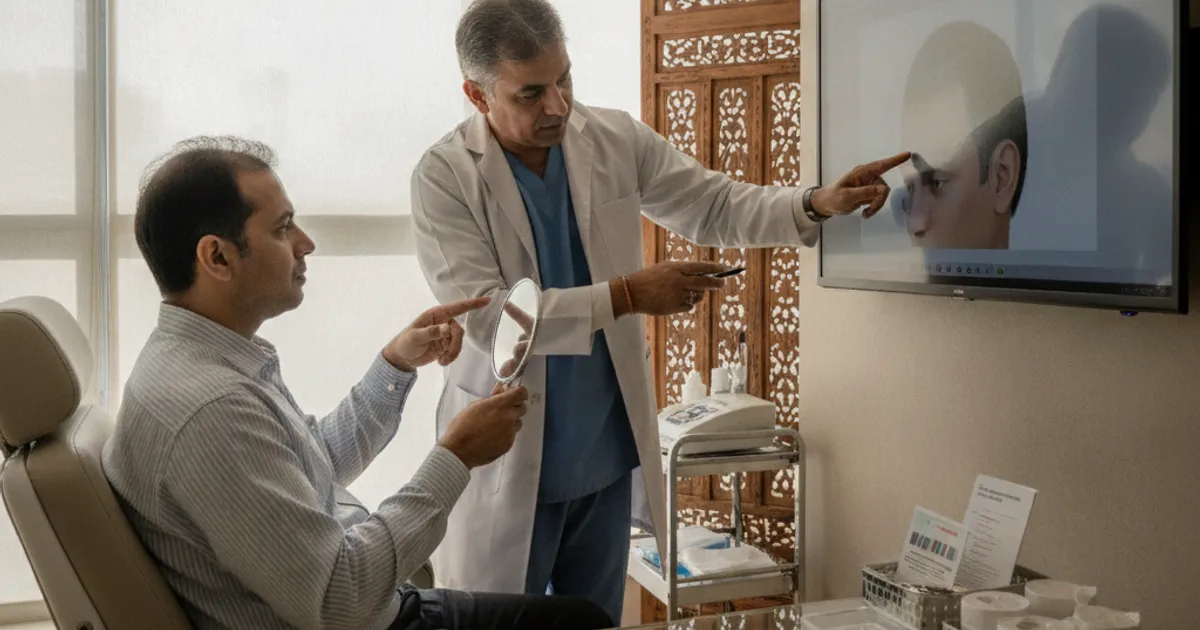
A proper diagnosis starts with a detailed history and a physical exam of the scalp. Dermatologists look at the pattern of loss, check for inflammation or scarring, and ask about recent illnesses, medications, stress, and family history. If EMF exposure is a concern, it is worth mentioning, but it will usually be one small part of a much larger picture. In most cases, the real cause shows up in the history or the scalp exam.
- Pull test: a doctor gently pulls a small group of hairs to see how many come out, which can indicate active shedding.
- Trichoscopy: a magnified view of the scalp and hair follicles that helps distinguish different types of hair loss.
- Blood tests: checking for iron deficiency, thyroid issues, vitamin D, and hormone imbalances.
- Scalp biopsy: rarely needed, but useful when scarring alopecia or another unusual condition is suspected.
- Exposure history: a detailed account of work environment, hobbies, and daily device use if EMF is a specific concern.
Treatment Options for Hair Loss (Including EMF-Related Concerns)
Treatment depends on the underlying cause, not on whether EMF is involved. If you have androgenetic alopecia, the standard options are finasteride and minoxidil, often combined with platelet-rich plasma (PRP) therapy. If you have telogen effluvium, the focus is on correcting the trigger. If you have a scarring condition, early treatment is important to prevent permanent damage. Reducing EMF exposure is not a recognized treatment for hair loss, but some people choose to do it anyway for peace of mind.
- Finasteride: an oral prescription medication that blocks DHT, the hormone responsible for androgenetic hair loss. It is effective for many men and some women.
- Minoxidil: a topical treatment that improves blood flow to the scalp and prolongs the growth phase of hair follicles. Available over the counter.
- PRP therapy: injections of concentrated platelets from your own blood, which may stimulate follicle activity. Often used alongside other treatments.
- Low-level laser therapy: a device-based treatment that some studies suggest can improve hair density in androgenetic alopecia.
- Lifestyle and nutrition: correcting deficiencies, managing stress, and treating underlying health conditions can resolve some types of shedding.
- Hair transplant surgery: for permanent hair loss where follicles no longer grow, surgery can restore density in specific areas.
| Treatment | Best For | Typical Approach |
|---|---|---|
| Finasteride | Androgenetic alopecia in men | Daily oral medication, prescription required |
| Minoxidil | Androgenetic alopecia in men and women | Topical application once or twice daily |
| PRP therapy | Early to moderate hair thinning | Series of injections, often monthly at first |
| Low-level laser therapy | Mild to moderate androgenetic alopecia | At-home device or in-clinic sessions |
| Hair transplant | Permanent hair loss with stable donor area | Surgical procedure, results are permanent |
Is a Hair Transplant Suitable for EMF-Related Hair Loss?
If your hair loss is genuinely caused by EMF exposure, which is unlikely, a hair transplant would not address the root cause. Surgery moves healthy follicles from one part of the scalp to another, but it does not change how your body responds to environmental factors. That said, if you have androgenetic alopecia and are also concerned about EMF, a transplant can still be a good option as long as your hair loss has stabilized. The key is to get a proper diagnosis first and make sure the underlying condition is being managed.
- Stable hair loss: surgeons generally want to see that your loss has plateaued before operating, so the results look natural long-term.
- Good donor area: you need enough healthy hair at the back and sides of the scalp to move to thinning areas.
- Realistic expectations: a transplant restores density but does not give you the hairline you had at 18.
- Ongoing treatment: many patients continue finasteride or minoxidil after surgery to protect the remaining hair.
- Underlying causes addressed: if a medical condition is causing your loss, it should be treated before or alongside surgery.
Reducing EMF Exposure: Practical Steps and Limitations
If you want to reduce your EMF exposure, there are simple steps you can take. Just keep in mind that no study has shown these steps will regrow hair or stop hair loss. Think of them as general wellness measures rather than hair treatments.
- Keep your phone away from your head when possible, and use speakerphone or wired headphones for long calls.
- Turn off Wi-Fi at night if it helps you sleep better, though the evidence for health effects is weak.
- Avoid standing directly in front of microwave ovens while they are running.
- Move your bed away from walls that have smart meters or electrical panels on the other side.
- Take breaks from screens and devices, which can also reduce eye strain and improve sleep quality.
- Focus on proven hair loss treatments rather than spending money on EMF-blocking products with no evidence behind them.
FAQ: Electromagnetic Fields and Hair Loss
Can Wi-Fi routers cause hair loss?
There is no solid evidence that Wi-Fi routers cause hair loss. The radiofrequency levels they emit are far below what is considered harmful, and studies have not shown a link to hair shedding or thinning.
Does using a cell phone lead to baldness?
No consistent link has been found between cell phone use and baldness. If you are losing hair, genetics, hormones, stress, or nutritional issues are far more likely explanations.
Are there any studies proving EMF causes hair loss?
Some laboratory and animal studies have shown changes in hair follicle behavior under certain EMF conditions, but human studies have not confirmed a causal link at everyday exposure levels.
Should I get a hair transplant if I think EMF caused my hair loss?
Get a proper diagnosis first. If you have a permanent condition like androgenetic alopecia, a transplant may be suitable. If your loss is temporary or caused by something treatable, surgery is usually not the answer.
What actually works for hair loss?
Finasteride, minoxidil, PRP therapy, low-level laser therapy, and hair transplant surgery are the main evidence-based options. The right choice depends on your specific diagnosis.
Can reducing EMF exposure regrow hair?
There is no evidence that reducing EMF exposure regrows hair. If you have a diagnosed hair loss condition, focus on proven treatments rather than environmental changes.
More Guides
- Hair Loss After Weight Loss Surgery: Timeline & Fixes
Hair loss after weight loss surgery is common. Learn the timeline, causes, treatments like minoxidil and PRP, and whether a hair transplant is right for you.
- Stress-Related Hair Loss: Recovery Time and Treatment
How long does stress-induced hair loss take to recover? Learn about telogen effluvium, diagnosis, treatments, and when a transplant may help.
- Female Hair Loss at the Back of the Head: Causes & Fixes
Learn why women lose hair at the back of the head, how it's diagnosed, and the best treatment options including minoxidil, PRP, and hair transplant suitability.
- Wellbutrin and Hair Loss: What You Need to Know
Learn how Wellbutrin may cause hair loss, how it's diagnosed, and what treatments—including hair transplant—can help you regrow hair.