
Female Hair Loss at the Back of the Head: Causes & Fixes
Learn why women lose hair at the back of the head, how it's diagnosed, and the best treatment options including minoxidil, PRP, and hair transplant suitability.
What Is Hair Loss at the Back of the Head?
Hair loss at the back of the head in women is less common than thinning at the crown or hairline, but it does happen. The back of the scalp — the occipital region — is usually considered a "safe zone" for donor hair because it's resistant to the hormones that drive pattern baldness. So when women start noticing thinning or bald patches back there, it often points to a different set of causes. It could be traction alopecia from tight hairstyles, an inflammatory scalp condition, telogen effluvium triggered by stress or illness, or even a localized autoimmune issue like alopecia areata. Because the back of the head is an unusual spot for female pattern hair loss, it's worth paying attention to early.
Common Causes of Hair Loss at the Back of the Head
There's no single cause. In practice, dermatologists see a mix of mechanical, inflammatory, hormonal, and systemic factors. Here are the ones that come up most often:
- Traction alopecia — from tight ponytails, buns, braids, or extensions that pull constantly on the back of the scalp.
- Telogen effluvium — diffuse shedding after physical or emotional stress, illness, surgery, or rapid weight loss.
- Alopecia areata — an autoimmune condition that causes round, smooth patches of hair loss, sometimes at the back of the head.
- Folliculitis or scalp infections — inflammation of the hair follicles that can lead to localized shedding.
- Female pattern hair loss (androgenetic alopecia) — usually affects the crown and part line, but can occasionally involve the back.
- Thyroid disorders, iron deficiency, or other systemic issues — these can cause diffuse thinning that includes the back.
- Medications — certain drugs (e.g., some antidepressants, blood thinners, or chemotherapy) list hair loss as a side effect.
Symptoms and Patterns to Watch For
The way hair loss looks at the back of the head can give clues about the cause. Pay attention to whether the shedding is diffuse, patchy, or concentrated in one spot, and whether the scalp itself looks inflamed or normal.
- Diffuse thinning across the whole back of the scalp — often points to telogen effluvium or a systemic issue.
- Well-defined round or oval patches — classic for alopecia areata.
- Thinning along the hairline at the nape of the neck — common with traction alopecia.
- Redness, scaling, or bumps — suggests folliculitis or another inflammatory condition.
- Itching or tenderness — may accompany inflammatory scalp disorders.
| Pattern | Likely Cause | Key Feature |
|---|---|---|
| Diffuse thinning | Telogen effluvium, thyroid, iron deficiency | Widespread shedding, no bare patches |
| Round patches | Alopecia areata | Smooth, well-defined bald spots |
| Nape thinning | Traction alopecia | Hair loss along the lower back hairline |
| Red, bumpy scalp | Folliculitis | Inflammation around follicles |
| Gradual thinning at crown extending back | Female pattern hair loss | Widening part, thinning crown |
How Is It Diagnosed?
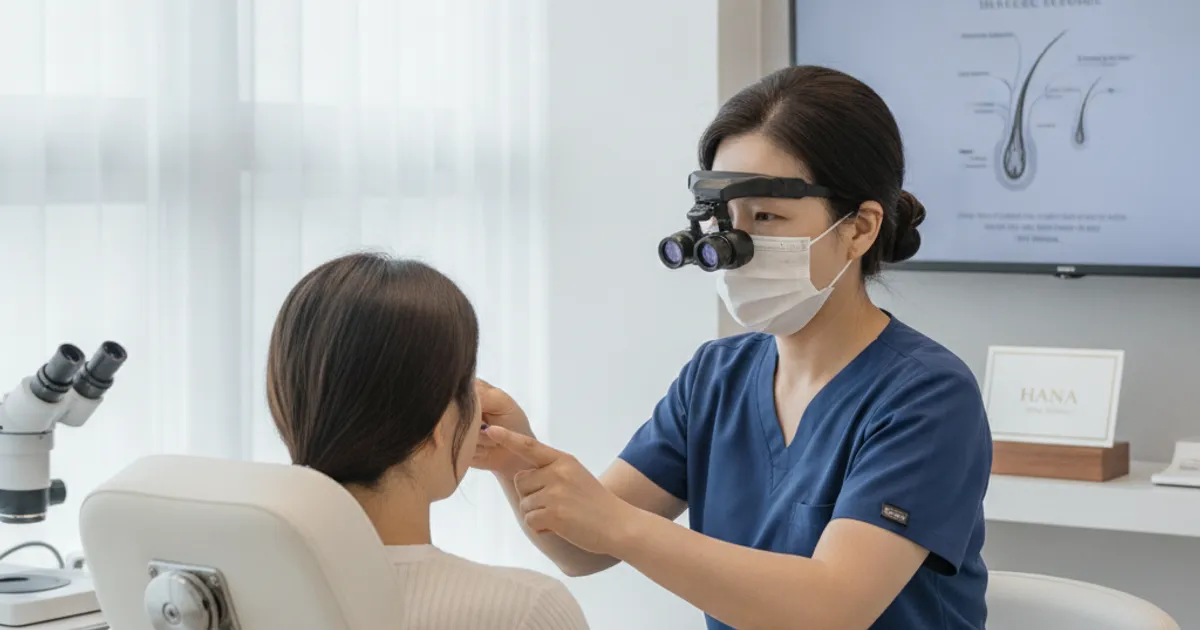
A proper diagnosis starts with a dermatologist or trichologist. They'll ask about your hair care habits, medical history, medications, and stress levels. Then they'll examine your scalp closely — sometimes with a dermoscope to look at follicle health and hair shaft variability.
- Medical history and hair care routine review.
- Scalp examination with a dermatoscope (handheld magnifier).
- Pull test — gently pulling a small bunch of hair to see how many come out.
- Blood tests — ferritin, thyroid function, vitamin D, and hormone levels.
- Scalp biopsy — rarely needed, but can confirm inflammatory or autoimmune conditions.
Treatment Options for Female Hair Loss at the Back
Treatment depends entirely on the cause. If it's traction alopecia, stopping the tight hairstyle is the first step. For telogen effluvium, addressing the underlying trigger (stress, iron deficiency, thyroid) usually leads to regrowth. For inflammatory conditions, topical or oral anti-inflammatories may be prescribed. When the cause is androgenetic alopecia or you need to stimulate regrowth, the following treatments are commonly used:
- Minoxidil (topical or oral) — FDA-approved for female pattern hair loss; helps stimulate follicles and prolong the growth phase.
- Finasteride — not FDA-approved for women of childbearing age, but sometimes prescribed off-label for postmenopausal women with androgenetic alopecia.
- PRP (platelet-rich plasma) — injections of your own platelet-rich plasma to stimulate follicle activity; evidence is growing but results vary.
- Low-level laser therapy (LLLT) — devices like caps or combs that use red light to improve follicle health.
- Corticosteroid injections — for alopecia areata patches.
- Nutritional correction — iron, vitamin D, zinc, and protein if deficiencies are found.
| Treatment | Best For | Typical Frequency | Notes |
|---|---|---|---|
| Minoxidil | Female pattern hair loss | Twice daily (topical) | Requires ongoing use; shedding may occur initially |
| Finasteride | Postmenopausal women with androgenetic alopecia | Daily oral | Off-label; not for women who may become pregnant |
| PRP | Early to moderate hair loss | Multiple sessions, then maintenance | Uses your own blood; minimal downtime |
| LLLT | Mild to moderate thinning | Several times per week | At-home devices available; takes months to see results |
| Corticosteroids | Alopecia areata | Periodic injections | Targets inflammation; not for pattern baldness |
Is a Hair Transplant Suitable for This Condition?
A hair transplant can be an option for women with permanent hair loss at the back of the head — but only if the cause is stable and the donor area is healthy. The back of the scalp is usually the donor zone, so if that area itself is thinning, a transplant becomes more complex. Surgeons typically avoid transplanting women with active alopecia areata, telogen effluvium, or traction alopecia until the condition is under control. For female pattern hair loss that has stabilized, transplanting hair from the back to thinning areas can work well. But candidacy is highly individual.
- Good candidates: women with stable, permanent hair loss (e.g., well-controlled androgenetic alopecia) and a healthy donor area at the back.
- Poor candidates: active alopecia areata, diffuse unpatterned alopecia, or ongoing traction alopecia.
- Donor area matters: if the back of the head is the thinning area, there may not be enough safe donor hair to transplant.
- Realistic expectations: a transplant won't stop future loss; medication may still be needed to maintain results.
What to Expect from a Consultation
A consultation with a hair restoration surgeon or dermatologist is usually a low-pressure conversation. They'll review your history, examine your scalp, and discuss whether you're a candidate for surgery or whether medical treatment makes more sense first.
- Detailed medical and hair loss history.
- Scalp and donor area assessment (density, miniaturization).
- Review of previous treatments and their results.
- Discussion of surgical vs. non-surgical options.
- Realistic expectations about outcomes and recovery.
- Cost estimate and financing options if available.
Frequently Asked Questions
Can hair loss at the back of the head be reversed?
It depends on the cause. Traction alopecia and telogen effluvium often improve once the trigger is removed. Alopecia areata may regrow spontaneously or with treatment. Female pattern hair loss is progressive but can be managed with medication.
Is minoxidil effective for hair loss at the back of the head?
Minoxidil is most effective for androgenetic alopecia. If the back-of-head loss is due to traction or inflammation, minoxidil alone won't fix it — you need to address the root cause.
Can I have a hair transplant if my donor area is thinning?
It's riskier. Surgeons need a stable donor supply. If the back of your head is thinning, you may not be a candidate, or you may need a smaller session. A consultation will clarify.
How do I know if my hair loss is serious?
If you notice sudden patches, redness, itching, or rapid shedding, see a dermatologist. Gradual thinning over years is less urgent but still worth checking.
Are there any side effects from PRP for hair loss?
PRP uses your own blood, so allergic reactions are rare. Common side effects are mild: temporary redness, swelling, or tenderness at injection sites.
More Guides
- Hair Loss After Weight Loss Surgery: Timeline & Fixes
Hair loss after weight loss surgery is common. Learn the timeline, causes, treatments like minoxidil and PRP, and whether a hair transplant is right for you.
- Stress-Related Hair Loss: Recovery Time and Treatment
How long does stress-induced hair loss take to recover? Learn about telogen effluvium, diagnosis, treatments, and when a transplant may help.
- Wellbutrin and Hair Loss: What You Need to Know
Learn how Wellbutrin may cause hair loss, how it's diagnosed, and what treatments—including hair transplant—can help you regrow hair.
- Hair Transplant for Men With Psoriasis or Eczema
Can you get a hair transplant with scalp psoriasis or eczema? Learn causes, symptoms, treatments, and how to prepare safely. Expert guide.