
FUE Extraction Devices: How They Work and What to Expect
A plain-English guide to FUE extraction devices, how they work, recovery, results, costs, and how they compare to other hair transplant methods.
What Are FUE Extraction Devices?
FUE extraction devices are the surgical tools used to remove individual hair follicles from the back and sides of the scalp during a follicular unit extraction (FUE) hair transplant. Instead of cutting out a strip of skin like older strip methods, FUE relies on small punches and motors to isolate and lift out one follicular unit at a time. The device you choose matters because it affects how fast the procedure goes, how much trauma the scalp experiences, and how well the grafts survive once they are re-implanted.
- Manual punches: hand-held circular blades rotated by the surgeon with no motor. Slower, but gives very fine control.
- Motorised punches: a powered handpiece rotates or oscillates the punch at controlled speed. Faster and more consistent.
- Robotic systems: computer-assisted arms that identify and extract follicles with minimal human input.
- Suction-assisted devices: use gentle vacuum pressure to help lift the graft out once the punch has separated it.
How FUE Extraction Devices Work: Step-by-Step
The basic principle is the same across all FUE devices: separate a single follicular unit from the surrounding tissue, then remove it without damaging the root. The differences come down to how the punch is driven and how the graft is pulled free. Here is the typical sequence during a device-assisted FUE session.
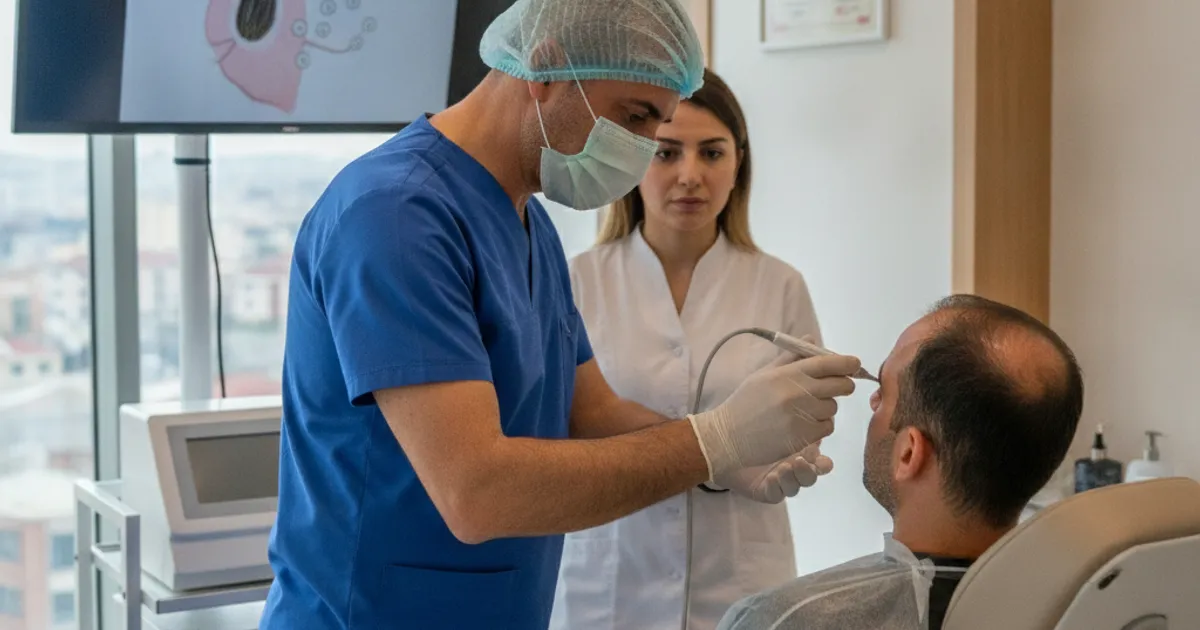
Close-up of an FUE punch handpiece being aligned with a follicular unit in the donor area.
Types of FUE Extraction Devices Compared
There is no single best device. Each type has trade-offs between speed, cost, and the level of control the surgeon has. The table below gives a general comparison based on how these devices are typically described in surgical literature and clinic practice.
| Device Type | Speed | Graft Control | Typical Use Case |
|---|---|---|---|
| Manual punch | Slow | Very high | Small sessions, curly or fine hair, scar revision |
| Motorised rotary punch | Fast | High | Large sessions, straight hair, most common choice |
| Motorised oscillating punch | Medium | Very high | Sensitive scalps, tighter skin, reduced trauma |
| Robotic system | Medium | High | Uniform donor zones, patients wanting minimal human variability |
| Suction-assisted | Fast | Medium | High graft counts where speed matters |
- Manual punches are often chosen for patients with curly hair because the surgeon can adjust angle in real time.
- Rotary punches are the workhorse of most high-volume FUE clinics.
- Oscillating punches tend to cause less friction and heat, which may help graft survival in tighter scalps.
- Robotic systems can be consistent but are not suitable for every hair type or donor pattern.
- Suction-assisted devices speed things up but require careful pressure control to avoid graft damage.
Recovery After FUE with Different Devices
Recovery after FUE is generally quicker than strip surgery regardless of the device used, but the type of punch can influence how the donor area feels and heals in the first couple of weeks. Smaller punches tend to leave less visible scarring, while larger punches may speed up extraction but leave slightly more noticeable dot scars.
- The first few days: donor area feels tight and tender. Small scabs form around each extraction point.
- The first week: scabs begin to loosen. Most patients can return to desk work within a few days.
- The second and third weeks: donor area looks pink but is usually covered by surrounding hair.
- The first two months: shock loss may occur in both donor and recipient areas. This is temporary.
- Months three to six: new growth starts to appear in the recipient zone.
- Months nine to twelve: final density becomes visible. Donor area should look fully healed.
Results and Graft Survival: What to Expect
Graft survival is the percentage of extracted follicles that grow hair after transplantation. Modern FUE devices are designed to minimise trauma and support good survival, but the device is only one factor. How the grafts are handled after extraction, how long they are out of the body, and how carefully the recipient sites are made all play a role.
- Smaller punch sizes generally mean less trauma to the follicle and surrounding tissue.
- Cooling and hydrating solutions during the procedure help maintain graft viability.
- Shorter time between extraction and implantation improves survival odds.
- Surgeon experience with a specific device often matters more than the device itself.
- Dense packing in the recipient area can compromise survival if blood supply is limited.
Who Is a Good Candidate for Device-Assisted FUE?
FUE with modern extraction devices suits a wide range of patients, but it is not right for everyone. The best candidates have a healthy donor area with enough density to support the number of grafts needed, and they understand that results take up to a year to fully develop.
- People with early to moderate hair loss who want to avoid a linear scar.
- Patients who wear their hair short and want minimal donor scarring.
- Those with curly or wavy hair, where manual punches often work best.
- People needing a smaller session for temple recession or scar revision.
- Patients with realistic expectations about density and timeline.
Cost of FUE Extraction Devices: What Influences Price
The device itself is rarely billed separately. What you pay for is the surgeon's time, the number of grafts, and the technology used during the procedure. Clinics that use robotic systems or advanced motorised punches often charge more per graft because of equipment costs and the additional training required.
| Cost Factor | Impact on Price |
|---|---|
| Number of grafts | More grafts means longer surgery and higher cost. |
| Device type | Robotic and advanced motorised systems typically cost more. |
| Surgeon experience | Senior surgeons often charge a premium per graft. |
| Clinic location | Prices vary widely between countries and cities. |
| Additional services | PRP, medication, and aftercare packages can add to the total. |
FUE vs. Other Extraction Methods: A Comparison
FUE is not the only way to harvest hair. Strip surgery (FUT) and newer hybrid techniques are still used, and each has advantages depending on the patient. The table below compares the main extraction methods.
| Method | Scarring | Recovery | Graft Count | Best For |
|---|---|---|---|---|
| FUE (manual punch) | Tiny dot scars | Fast | Lower | Short hair, small sessions |
| FUE (motorised) | Tiny dot scars | Fast | Higher | Most patients, larger sessions |
| FUE (robotic) | Tiny dot scars | Fast | Moderate | Uniform donor zones |
| FUT (strip) | Linear scar | Slower | High | Very large sessions, longer hair |
| Hybrid FUE/FUT | Mixed | Moderate | High | Complex cases needing maximum grafts |
- FUE generally heals faster and leaves less visible scarring than FUT.
- FUT can yield more grafts in a single session but leaves a linear scar.
- Robotic FUE is consistent but not always suitable for curly or very fine hair.
- Hybrid approaches combine methods to maximise graft numbers in advanced cases.
Related Guides and Clinic Listings
If you are comparing FUE with other techniques or trying to understand costs in different countries, the guides below go into more detail. You can also browse clinic listings to see which providers offer specific extraction devices and what their packages include.
Frequently Asked Questions
Does the type of FUE extraction device affect my results?
It can, but it is not the only factor. Smaller punches and gentler extraction methods may reduce trauma and improve graft survival, but surgeon skill and graft handling usually have a bigger impact on the final result.
Is motorised FUE better than manual FUE?
Not necessarily. Motorised devices are faster and more consistent for large sessions, while manual punches give the surgeon finer control for curly hair or smaller cases. The best choice depends on your hair type and the size of the procedure.
How long does the donor area take to heal after FUE?
Most patients see the donor area heal within a couple of weeks. Small scabs fall off naturally, and any pinkness usually fades over a few weeks. Full healing and maturation can take several months.
Can I choose which extraction device my clinic uses?
You can ask, but not all clinics offer every device type. It is worth discussing your hair type and goals with the surgeon to see which device they recommend for your case.
More Guides
- Hair Transplant for Curly Hair: Graft and Technique Tips
A plain-English guide to hair transplants for curly hair: how surgeons adapt graft harvesting and placement, recovery, results, costs, and who it suits.
- How Long Does a Hair Transplant Last? Long-Term Durability
How long does a hair transplant last? We explain the procedure, recovery, durability, costs by stage of hair loss, and how it compares to alternatives.
- Hair Transplant Revision: When a Second Procedure Makes Sense
Considering a hair transplant revision? Learn how a second procedure works, who it suits, recovery, results, and costs. Expert explainer from Clinic Reccy.
- Hair Transplant for Norwood 6 and 7: What's Possible
A clear look at hair transplant options for Norwood 6 and 7 hair loss: graft limits, staging, recovery, costs, and realistic results.