
Hair Transplant Donor Area Recovery: Timeline & Healing
Hair transplant donor area recovery takes 7–14 days for scabs to heal, with full sensation and density returning over 6–12 months. Here's the timeline.
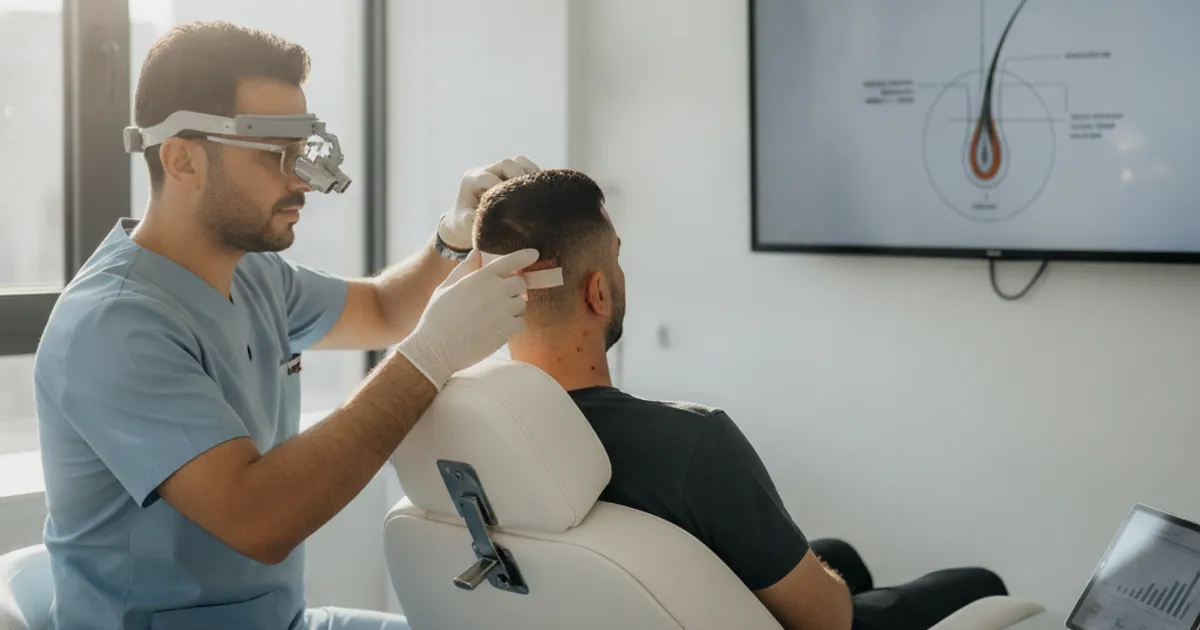
Hair transplant donor area recovery usually takes 7 to 14 days for the surface to heal, with redness fading over 2 to 4 weeks and full sensation and density returning over 6 to 12 months. The donor area is the back and sides of your scalp where follicles are harvested, and it heals faster than the recipient area because the incisions are smaller and the skin is thicker.
What Is the Donor Area and Why Does It Need to Recover?
The donor area is the strip of scalp at the back and sides of your head that is genetically resistant to DHT, the hormone that causes male pattern baldness. Surgeons harvest follicles from here because these hairs tend to keep growing for life, even when transplanted to the top of the scalp.
- FUE (follicular unit extraction): individual follicles are punched out with a tiny circular tool, leaving small dot-like wounds.
- FUT (follicular unit transplantation): a strip of skin is removed and stitched closed, leaving a linear scar.
- Both methods create hundreds or thousands of micro-wounds that need to clot, scab, and re-epithelialise.
- The donor area has a richer blood supply than the recipient area, which is why it typically heals faster.
- Recovery matters because visible scarring, infection, or over-harvesting can limit future transplants.
Hair Transplant Donor Area Recovery Timeline: Week by Week
| Timeframe | What's Happening | What You'll See |
|---|---|---|
| Day 1–3 | Clotting and scab formation | Small red dots or a linear incision; mild swelling and tightness |
| Day 4–7 | Scabs begin to dry and lift | Itchy, flaky scabs; some crusting along the suture line (FUT) |
| Day 8–14 | Scabs fall off naturally | Pink or slightly red skin underneath; no open wounds |
| Week 3–4 | Skin surface heals | Redness fades to a faint pink; numbness may persist |
| Month 2–3 | Sensation returns | Tightness eases; tiny white dots (FUE) or a thin line (FUT) visible |
| Month 6–12 | Full healing and density | Scars mature and fade; donor area looks normal in most cases |
Most people can return to work within 3 to 5 days if they can hide the scabs, and to exercise within 7 to 10 days. The timeline above assumes you follow your clinic's aftercare instructions and don't pick at the scabs.
What Does Donor Area Recovery Look and Feel Like at Each Stage?
- Days 1–3: The donor area feels tight, sore, and numb. You may see dried blood or tiny crusts. Sleeping on your back with a travel pillow helps.
- Days 4–7: Itching kicks in as scabs dry. This is normal. Do not scratch — use the saline spray or lotion your clinic gave you.
- Days 8–14: Scabs flake off in the shower. The skin underneath is pink and sensitive. Some people notice mild shock loss around the donor area.
- Weeks 3–6: Redness fades but numbness or tingling can remain. FUE dot scars may look like tiny white specks.
- Months 2–6: Sensation gradually returns. The donor area may feel lumpy or uneven for a few weeks as tissue remodels.
- Months 6–12: Scars mature and flatten. FUE dots usually fade to near-invisible; FUT lines become a thin, pale scar.
Shock loss — temporary shedding of nearby hairs — can happen in the donor area too, but it's usually mild and reverses within 3 to 4 months. If you see more shedding than expected, mention it to your clinic.
FUE vs FUT: How Does Donor Area Recovery Differ?
FUE Donor Recovery
Typically faster surface healing
- ✓ No stitches or staples
- ✓ Scabs fall off in 7–10 days
- ✓ Tiny dot scars that fade over 6–12 months
- ✓ Less initial pain, more itching
- ✓ Can shave the donor area immediately
FUT Donor Recovery
Slower surface healing, linear scar
- ✓ Stitches or staples removed at 10–14 days
- ✓ Suture line can feel tight for weeks
- ✓ Leaves a linear scar that may widen over time
- ✓ More discomfort in the first week
- ✓ Must keep the strip area covered and clean
FUE generally heals faster on the surface because there's no long incision to close. FUT can be a better option for very large sessions, but the trade-off is a linear scar and a slightly longer donor recovery. Your surgeon should explain which method suits your scalp laxity and hair type.
How Can You Speed Up Donor Area Healing?
- Don't wear tight hats or helmets for the first 2 weeks.
- Avoid strenuous exercise for 7–10 days to prevent bleeding and swelling.
- Use a clean pillowcase every night for the first week.
- If your clinic offers PRP or low-level laser therapy, ask whether it can help donor healing.
When Should You Worry About Donor Area Recovery?
- Spreading redness, warmth, or swelling after day 5 — possible infection.
- Yellow or green pus, or a foul smell from the donor area.
- Fever above 38°C (100.4°F).
- Severe pain that doesn't improve with over-the-counter painkillers.
- Bleeding that won't stop after 10 minutes of gentle pressure.
- A suture line that splits open or widens noticeably (FUT).
- Numbness that hasn't improved at all after 6 months.
- Obvious over-harvesting — a moth-eaten or patchy look in the donor area.
Most donor area issues are minor and resolve on their own. But if you notice any of the signs above, contact your clinic the same day. Infections are rare but easy to treat with antibiotics when caught early. Over-harvesting is harder to fix and usually means choosing a more conservative surgeon for any future session.
How Do You Choose a Clinic That Protects Your Donor Area?
The single biggest factor in donor area recovery is the surgeon's technique. A skilled surgeon extracts follicles evenly, avoids over-harvesting, and uses small punches that heal with minimal scarring. Before booking, ask how many grafts they plan to take, what punch size they use, and whether they'll show you healed donor area photos from past patients. You can browse verified clinics and compare their donor area results on Clinic Reccy's hair transplant directory.
Frequently Asked Questions About Donor Area Recovery
How long does the donor area take to heal completely?
Surface healing takes 7–14 days. Redness fades by week 3–4. Full healing, including sensation and scar maturation, takes 6–12 months.
Can I sleep on my donor area after a hair transplant?
No. Sleep on your back with your head elevated on a travel pillow for the first 3–5 nights to avoid rubbing the donor area.
Will the donor area grow back after FUE?
The extracted follicles do not grow back. However, surrounding hairs continue to grow, so the donor area usually looks full once it heals.
Is it normal for the donor area to be numb?
Yes. Numbness or tingling is common for weeks to months after surgery as nerves regenerate. It usually resolves within 6–12 months.
More Guides
- Hair Transplant and Blood Thinners: Safety and Timing
Can you have a hair transplant on blood thinners? Learn why they matter, which ones raise bleeding risk, how long to stop before surgery, and when to restart.
- Finasteride and PSA Testing: What You Need to Know
Finasteride lowers PSA levels, so your test results need careful interpretation. Learn how finasteride affects PSA, the adjustment factor, and what to tell your
- Can You Cure a Receding Hairline? What's Realistic
Can you cure a receding hairline? Learn what's realistic with medications, transplants, and lifestyle changes, plus expected results and costs.
- Minoxidil Hair Thinning Before Growth: Is It Normal?
Is minoxidil hair thinning before growth normal? Yes, it's a common sign the treatment is working. Learn why it happens, how long it lasts, and when to worry.