
Hair Follicle Miniaturization: When Is It Too Late for a Transplant?
Hair follicle miniaturization explained: causes, symptoms, diagnosis, treatment, and when it's too late for a hair transplant. Read the full guide.
What Is Hair Follicle Miniaturization?
Hair follicle miniaturization is the process where individual hair follicles gradually shrink and produce thinner, shorter, and weaker hairs over time. It is the underlying mechanism behind androgenetic alopecia, commonly known as male or female pattern hair loss. Instead of a hair falling out and being replaced by a healthy terminal hair, the follicle enters a cycle of producing progressively finer hairs — often called vellus or miniaturized hairs — until it may stop producing visible hair altogether. Understanding miniaturization matters because it determines whether a follicle can still be saved with medication or whether it has permanently lost the ability to grow a normal hair. This distinction is central to the question of when it is too late for a hair transplant.
Causes of Hair Follicle Miniaturization
The primary driver of follicle miniaturization is genetics combined with the hormone dihydrotestosterone (DHT). In people who are genetically predisposed, DHT binds to receptors in susceptible hair follicles and gradually shortens the growth phase (anagen) while lengthening the resting phase (telogen). Over successive cycles, the follicle produces thinner hairs until it may become dormant. Other factors can accelerate or mimic this process, which is why a proper diagnosis matters before assuming a transplant is the answer.
- Genetics and family history of pattern hair loss
- DHT sensitivity in susceptible follicles
- Hormonal changes (thyroid disorders, menopause, PCOS)
- Nutritional deficiencies (iron, vitamin D, zinc, protein)
- Chronic stress and telogen effluvium
- Traction from tight hairstyles or repeated tension
- Certain medications and medical treatments
- Age-related follicle decline
Symptoms and Stages: How to Recognize Miniaturization
Miniaturization rarely happens overnight. It progresses through recognizable stages, and the earlier you identify it, the more options you have. The most common early sign is a widening part or a thinning crown that looks less dense than before. Hairs may feel softer and finer when you run your fingers through them. Over time, the frontal hairline may recede, and the scalp becomes increasingly visible under light. The table below outlines typical stages and what they mean for follicle health.
| Stage | What You See | Follicle Status | Reversibility |
|---|---|---|---|
| Early (Norwood 1–2) | Slight thinning at temples or part | Miniaturization beginning, follicles still active | Often responsive to medication |
| Moderate (Norwood 3–4) | Visible recession, thinning crown | Significant miniaturization, some dormant follicles | Partially responsive, transplant may help |
| Advanced (Norwood 5–6) | Large bald areas, sparse remaining hair | Many follicles dormant or scarred | Limited medical response, transplant depends on donor supply |
| Severe (Norwood 7) | Extensive baldness, donor area thinning | Most affected follicles non-viable | Transplant often not suitable |
How Is Hair Follicle Miniaturization Diagnosed?
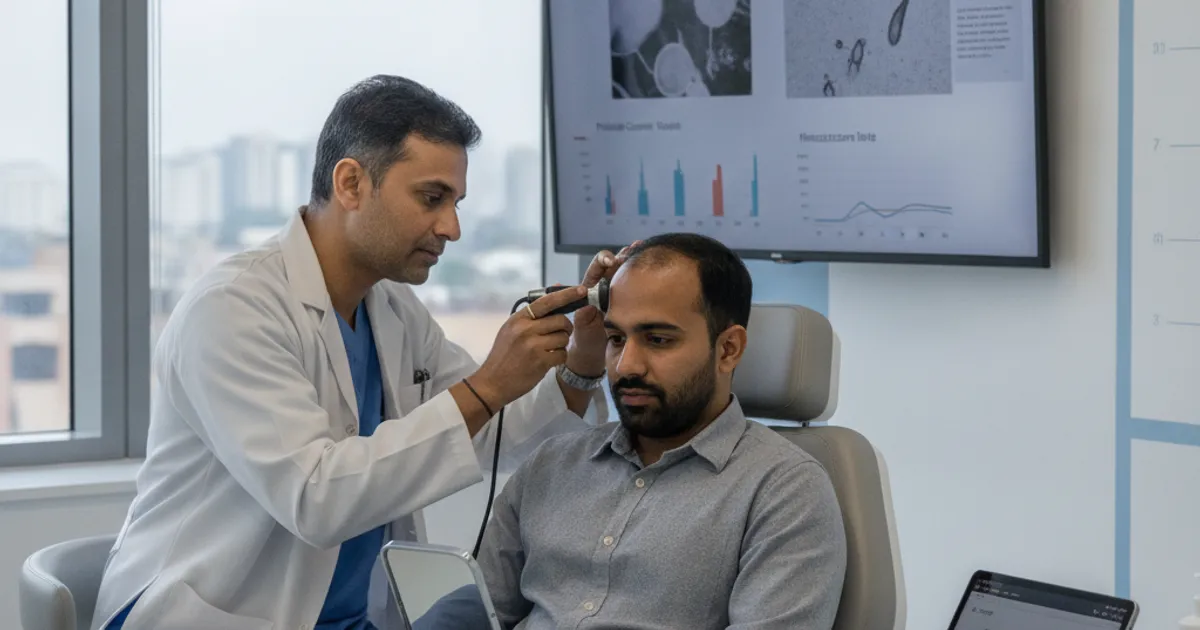
A proper diagnosis goes beyond looking at your hairline. Dermatologists and hair restoration surgeons use several tools to measure miniaturization and determine whether follicles are still viable. The most common is trichoscopy, a magnified examination of the scalp and hair shafts. Some clinics also use digital hair counting or phototrichograms to track density and hair diameter over time. Blood tests may be ordered to rule out thyroid issues, iron deficiency, or hormonal imbalances that can mimic pattern hair loss.
- Trichoscopy (dermoscopy of the scalp) to measure hair diameter diversity
- Pull test to assess active shedding
- Phototrichogram or digital imaging to track density changes
- Blood tests for ferritin, thyroid function, vitamin D, and hormones
- Family history and pattern assessment using the Norwood or Ludwig scales
- Donor area density evaluation to estimate transplant supply
Treatment Options for Miniaturized Hair
Treatment depends on how much of the follicle is still functioning. If miniaturization is caught early, medications can slow or partially reverse it. Once a follicle has been dormant for a long time, medication is unlikely to bring it back, and surgical restoration may be the only option — if the donor area is strong enough. Here are the main treatment categories.
- Finasteride: oral prescription that lowers DHT and can slow or reverse miniaturization in early stages
- Minoxidil: topical or oral treatment that extends the growth phase and improves hair density
- PRP (platelet-rich plasma): injections that may stimulate follicle activity and improve hair caliber
- Low-level laser therapy: device-based treatment that may support follicle health
- Ketoconazole shampoo: adjunct therapy that may reduce scalp inflammation
- Hair transplant: surgical relocation of healthy follicles from the donor area to thinning or bald zones
When Is It Too Late for a Hair Transplant?
There is no single cutoff point, but there are clear situations where a hair transplant is unlikely to produce a good result. The key factors are donor hair supply, the extent of miniaturization in the recipient area, and whether the hair loss is still progressing. If the donor area itself is thinning, there may not be enough healthy follicles to transplant. If the bald area is too large relative to the donor supply, the result may look sparse. And if the hair loss is still active, a transplant without medication can look unnatural as native hair continues to fall out around the grafts.
- Donor area has significant miniaturization or low density
- Bald area is too large for the available donor supply
- Hair loss is still progressing rapidly and not stabilized
- Follicles in the recipient area are completely dormant or scarred
- Realistic expectations cannot be met with the available donor hair
- Underlying medical conditions are not controlled
Hair Transplant Suitability by Stage of Hair Loss
The table below summarizes how suitability typically changes with the stage of hair loss. It is a general guide, not a substitute for an in-person evaluation. Costs vary by clinic, technique, and case complexity, so the figures below are averaged case pricing medians for early, moderate, and advanced stages.
| Stage | Typical Suitability | Average Case Price (USD) |
|---|---|---|
| Early (Norwood 1–2) | Usually not recommended unless stabilized; medication first | $3,500 |
| Moderate (Norwood 3–4) | Often suitable if donor area is strong | $6,000 |
| Advanced (Norwood 5–6) | May be suitable with careful planning and realistic goals | $9,000 |
What to Expect During a Consultation
A consultation for hair loss should be thorough. A good clinic will assess your donor area, measure miniaturization, review your medical history, and discuss both surgical and non-surgical options. You should leave with a clear understanding of what is realistic for your stage of hair loss. If a clinic promises a full head of hair regardless of your donor supply, that is a red flag.
- Scalp examination with trichoscopy or digital imaging
- Donor area density and miniaturization assessment
- Discussion of medical history and current medications
- Review of treatment options including finasteride, minoxidil, and PRP
- Realistic graft count estimate and expected coverage
- Cost breakdown and financing options if available
- Before-and-after photos of similar cases
Frequently Asked Questions
Can miniaturized hair become healthy again?
Yes, if the follicle is still alive and producing some hair. Treatments like finasteride, minoxidil, and PRP can improve hair caliber and density in early to moderate stages. Once a follicle has been dormant for years, it is unlikely to recover.
How do I know if it's too late for a transplant?
The main indicators are poor donor area density, extensive baldness relative to donor supply, and ongoing active hair loss. A consultation with trichoscopy and donor assessment is the only reliable way to know.
Does a hair transplant stop miniaturization?
No. A transplant moves healthy follicles from the donor area, but it does not stop the miniaturization of native hair. Most surgeons recommend medication after surgery to protect the remaining hair.
What is the average cost of a hair transplant by stage?
Averaged case pricing medians are approximately $3,500 for early-stage cases, $6,000 for moderate cases, and $9,000 for advanced cases. Actual costs vary by clinic, technique, and graft count.
Can I have a transplant if I'm Norwood 7?
In many cases, no. Norwood 7 typically means extensive baldness and limited donor supply. Some clinics may offer a limited procedure to restore the hairline, but full coverage is usually not realistic.
Is PRP effective for miniaturized hair?
PRP may improve hair density and caliber in some people, especially in early stages. Results vary, and it is often used alongside finasteride or minoxidil rather than as a standalone treatment.
What to Expect During a Suitability Assessment
If you are being evaluated for a transplant, the consultation is usually less about whether you have hair loss and more about mapping what you have left. A surgeon will typically examine the donor zone at the back and sides of the scalp, because that hair is genetically resistant to DHT in most people. The goal is to estimate how many viable follicular units can be harvested over your lifetime without leaving the donor area visibly thin. This is sometimes called donor reserve or donor capacity, and it is the single biggest constraint on what a transplant can achieve.
Expect the assessment to include a review of your medical history, medications, and family pattern of hair loss. Surgeons often ask about how fast your loss has progressed and whether you have tried medication, because a transplant planned around active, untreated loss tends to age poorly. Some clinics will ask you to stabilize your loss with medication for a period before scheduling surgery, and some will photograph and measure your scalp so future comparisons are possible. Bring old photos if you have them; they help establish how quickly things have changed.
- A donor density check, often with magnification, to estimate harvestable grafts
- A recipient area map showing where grafts would go and at what density
- A discussion of your hair caliber and color contrast, which affect how full a result looks
- An honest conversation about how many sessions may be needed and how future loss could change the plan
- A review of medications and whether you are willing and able to use them long term
Why a Transplant Does Not Stop Miniaturization
A common misunderstanding is that surgery halts the balding process. It does not. A transplant relocates DHT-resistant follicles from the donor area into thinning zones, but it leaves your native follicles where they are, still subject to the same hormonal and genetic influences. That means the hair around and between the grafts can continue to miniaturize after surgery. If your loss is still active and untreated, the transplanted hair may remain while the surrounding hair recedes, which can create gaps or an unnatural pattern over time.
This is why surgeons generally recommend continuing medical therapy after a transplant when it is appropriate for you. Medication helps protect the native hair that frames the grafts and supports a more cohesive long-term result. It also explains why timing matters: operating on someone whose loss has stabilized, or who is committed to stabilization, tends to produce more durable outcomes than operating during rapid active loss.
Alternatives and What Comes Next When a Transplant Is Not Advised
Being told you are not a good candidate is not the end of your options. It usually means the timing or approach needs to change rather than that nothing can be done. If your loss is still progressing, the priority is often stabilization with medication and monitoring over several months to a year. If your donor supply is limited, a surgeon may recommend a more conservative hairline design, focusing on framing the face rather than restoring full density. In some cases, scalp micropigmentation, hair fibers, or a well-chosen hair system can provide cosmetic coverage while you decide on a longer-term plan.
If miniaturization in the recipient area is advanced but not complete, medication may still improve hair caliber and density enough to change your candidacy later. Reassessment after a period of treatment is common and reasonable. For people whose loss has genuinely stabilized and whose donor area is healthy, surgery remains a strong option. The key is matching the treatment to your stage and to what your donor supply can realistically support, rather than forcing a surgical solution onto a scalp that is not ready for it.
- Stabilize first: give medication and monitoring time to show whether your loss is controlled
- Consider conservative surgical planning if donor supply is limited
- Explore non-surgical coverage options while you weigh a longer-term plan
- Get reassessed periodically, since candidacy can change with treatment and time
- Seek a second opinion if a clinic promises results without discussing donor limits or future loss
Can miniaturized hair become healthy again on its own?
Generally no. Miniaturization driven by pattern hair loss tends to progress without treatment. Some follicles that are miniaturized but still active can improve in caliber with medication, but follicles that have been dormant for a long time usually do not recover on their own.
How long should I be on medication before considering a transplant?
There is no universal timeline, and it depends on your rate of loss and how you respond. Many surgeons prefer to see that loss has stabilized, often assessed over several months to a year, before planning surgery. Your clinician can advise based on your specific pattern.
Does a transplant work on completely bald, shiny scalp?
Transplanted follicles can grow in areas that are bald, provided the scalp tissue is healthy and has adequate blood supply. The bigger limiting factor is usually how much donor hair is available to cover the area at a density that looks natural.
Will I need more than one session?
Possibly. Large areas of loss relative to donor supply often require staged sessions, and future native hair loss can create a need for touch-up work. A surgeon should discuss this openly during planning.
What happens if I stop medication after a transplant?
Transplanted donor hair is generally resistant to DHT and tends to persist, but your native hair can resume thinning. Stopping medication may lead to further loss around the grafts, which can affect how full the overall result looks.
More Guides
- Hair Loss After Weight Loss Surgery: Timeline & Fixes
Hair loss after weight loss surgery is common. Learn the timeline, causes, treatments like minoxidil and PRP, and whether a hair transplant is right for you.
- Stress-Related Hair Loss: Recovery Time and Treatment
How long does stress-induced hair loss take to recover? Learn about telogen effluvium, diagnosis, treatments, and when a transplant may help.
- Female Hair Loss at the Back of the Head: Causes & Fixes
Learn why women lose hair at the back of the head, how it's diagnosed, and the best treatment options including minoxidil, PRP, and hair transplant suitability.
- Wellbutrin and Hair Loss: What You Need to Know
Learn how Wellbutrin may cause hair loss, how it's diagnosed, and what treatments—including hair transplant—can help you regrow hair.