
Hair Transplant Graft Quality vs Quantity: What Matters
Graft quality vs quantity in hair transplants: learn why survival and technique beat raw counts, plus planning and aftercare tips for better results.
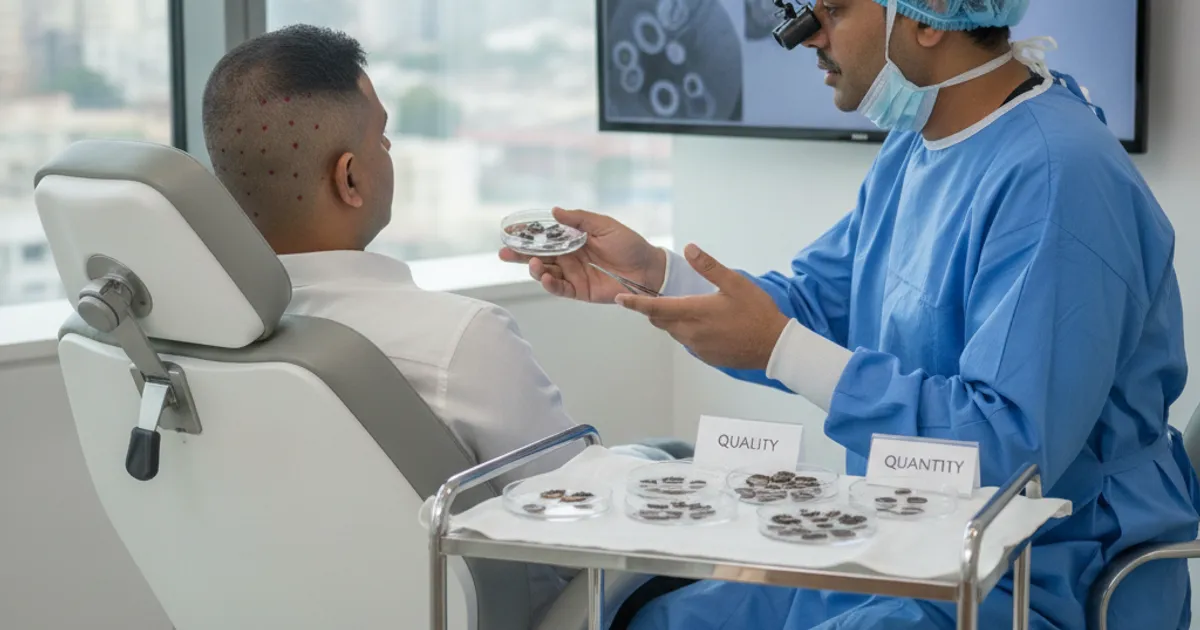
Graft Quality vs Quantity: The Core Question
When you start researching hair transplants, the conversation quickly turns to numbers. Clinics quote graft counts that sound impressive, and it's easy to assume more is better. But the real measure of a successful transplant isn't how many grafts go in — it's how many grow and how natural they look. Graft quality vs quantity is the balance that actually determines your result, and understanding it will help you ask better questions and avoid costly mistakes.
What Graft Quantity Really Means (And Why More Isn't Always Better)
A graft is a tiny bundle of hair follicles — typically containing a small number of hairs — removed from the donor area at the back and sides of your scalp. Quantity refers to the total number of these bundles transplanted in a single session. It's tempting to think a higher count guarantees denser hair, but the donor area is a finite resource. Overharvesting can thin the back of your head, leave visible scarring, and actually reduce the number of viable grafts for future sessions. Quantity should be a reflection of what your donor area can safely support, not a marketing headline.
- Donor supply is limited — once you overharvest, you can't get those follicles back.
- High counts spread over a large bald area can mean lower density per square centimetre.
- Aggressive sessions may increase shock loss and prolong recovery.
- A realistic graft count should be based on your donor density, scalp elasticity, and balding pattern.
What Graft Quality Really Means: Survival, Diameter, and Technique
Quality is harder to see in a quote, but it's what makes the difference between a full result and a patchy one. It comes down to three things: how many grafts survive the procedure, how thick the individual hairs are, and how skilfully they're handled. Grafts are fragile. If they're dehydrated, crushed, or left out too long, they won't grow — no matter how many you paid for. Technique matters just as much: dense packing, correct angle and direction, and minimal trauma to the scalp all protect the final look.
- Survival rate: the percentage of transplanted grafts that actually grow — top clinics aim for consistently high survival.
- Hair diameter: thicker hairs give more visual coverage per graft, so quality can beat raw numbers.
- Handling and storage: grafts kept in a chilled, hydrated solution suffer less stress.
- Implantation technique: correct depth, angle, and direction create a natural hairline and avoid pitting.
How Hair-Loss Stage Changes the Quality vs Quantity Balance
Your stage of hair loss shifts the balance. Early on, you may need fewer grafts, so quality and precision matter most — especially at the hairline where every graft is visible. With moderate loss, you need a careful plan that preserves donor hair for the future while adding meaningful density. In advanced cases, quantity becomes more relevant, but only if quality is maintained; a large session with poor survival is wasted money and donor supply. The table below gives a rough guide to how priorities shift.
| Hair-Loss Stage | Typical Priority | What to Watch For |
|---|---|---|
| Early (minor thinning, receding hairline) | Quality and precision | Natural hairline design, conservative graft counts, donor preservation |
| Moderate (visible thinning, defined bald areas) | Balance of quality and quantity | Strategic density, planning for future loss, healthy donor management |
| Advanced (extensive baldness) | Quantity with quality control | Realistic expectations, staged sessions, avoiding overharvesting |
The Hidden Risks of Chasing High Graft Counts
A big number on a quote can feel reassuring, but it can also signal trouble. Some clinics compete on graft counts to win patients, and that pressure can lead to overharvesting, rushed surgery, or grafts that are damaged before they're implanted. The result is often a thinner look than expected, a depleted donor area, and limited options later. It's worth being sceptical of any quote that promises an unusually high count without a thorough assessment of your donor area.
- Donor depletion: taking too much from the back and sides can leave permanent thinning.
- Poor survival: speed-focused sessions may compromise graft handling and storage.
- Unnatural results: dense packing without attention to angle and direction looks pluggy.
- Lost future options: if you need a second procedure, you may not have enough donor hair left.
What a Good Clinic Should Assess Before Quoting Grafts
A trustworthy clinic won't quote a graft number in the first five minutes. They'll examine your scalp, measure donor density, and talk through your goals and future hair-loss risk. This assessment is what separates a tailored plan from a sales pitch. If a clinic skips these steps, treat it as a red flag.
- Donor density and scalp laxity measurements.
- Hair calibre and colour contrast between donor and recipient areas.
- Family history and likelihood of future hair loss.
- Realistic goals for density and hairline placement.
- A clear explanation of how many grafts are needed and why.
Planning Your Procedure: Questions to Ask About Graft Quality
Before you book, ask direct questions about how the clinic protects graft quality. The answers will tell you more about the likely outcome than any graft count. A clinic that can explain its process clearly and without hype is usually the safer bet.
- What is your typical graft survival rate, and how do you measure it?
- Who performs the extraction and implantation — the surgeon or technicians?
- How are grafts stored and kept hydrated during the procedure?
- How do you decide the graft count for my case?
- What happens if I need a second session later — how do you preserve donor hair?
Aftercare That Protects Graft Quality and Quantity
Your job doesn't end when you leave the clinic. The early healing phase is critical for graft survival. Following aftercare instructions carefully protects the investment you've made in both quality and quantity. Most clinics provide a detailed protocol — follow it closely and ask if anything is unclear.
- Sleep with your head elevated in the initial period to reduce swelling.
- Avoid touching, scratching, or picking at the grafts.
- Wash your scalp gently as instructed, using the recommended shampoo.
- Stay out of direct sun and avoid strenuous exercise while healing.
- Don't smoke or drink alcohol during the early healing phase — both can impair blood flow.
- Attend follow-up appointments so the clinic can check healing and graft survival.
FAQ: Graft Quality vs Quantity
Is a higher graft count always better?
No. A higher count only helps if the grafts survive and are placed well. Overharvesting can damage your donor area and limit future options. Quality and a realistic plan matter more than the biggest number.
How can I tell if a clinic prioritises graft quality?
Ask about their survival rates, how grafts are stored, who performs each step, and how they assess your donor area. A clinic that answers clearly and conservatively is usually more trustworthy than one that promises huge counts.
What affects graft survival after surgery?
Handling during surgery, storage conditions, and your aftercare all play a role. Following instructions on sleeping position, washing, sun exposure, and avoiding smoking gives your grafts the best chance.
Can I get more grafts later if I need them?
Often yes, but only if your donor area hasn't been overharvested. That's why a conservative first session that preserves donor hair is often smarter than chasing a high count upfront.
How Graft Quality Is Measured in Practice
Patients often hear the word quality without being told how it is actually judged. In practice, clinics and researchers assess it through a few observable factors, and knowing them helps you interpret what a clinic tells you. None of these are things you can verify from a quote alone, which is why the consultation and the clinic's willingness to explain its process matter more than the number printed on the estimate.
- Follicular unit composition: grafts differ in how many hairs they contain. A clinic that reports hair counts as well as graft counts gives you a more honest picture of coverage, because two grafts can carry very different amounts of hair.
- Transection rate: the proportion of follicles accidentally cut or damaged during extraction. Lower transection preserves more usable hair from the same donor strip or area.
- Survival rate: the share of implanted grafts that produce visible growth months later. This is usually assessed by the clinic through follow-up photography rather than measured live during surgery.
- Graft handling time: how long grafts sit outside the body and under what conditions. Shorter handling time and proper storage reduce stress on the follicles.
- Recipient site quality: whether the tiny incisions are made at the correct depth, angle, and direction so grafts sit naturally and are not traumatised on insertion.
FUE vs FUT: How the Technique Affects the Quality-Quantity Trade-off
The two main donor-harvesting methods, follicular unit extraction (FUE) and follicular unit transplantation (FUT, sometimes called strip surgery), influence the quality-versus-quantity balance in different ways. Neither is universally better; the right choice depends on your donor characteristics, your goals, and how much future loss you are likely to face.
FUE removes individual grafts one at a time with a small punch tool. It leaves tiny dot-like scars rather than a linear scar and allows shorter hairstyles, but it is more time-consuming, and the skill of the operator strongly affects transection rates. Because grafts are handled individually, storage and hydration discipline matter a great deal.
FUT removes a strip of scalp from the donor area, which is then dissected into grafts under magnification. This can allow a very high yield of intact grafts from a single session and is often favoured when a large number of grafts is needed, but it leaves a linear scar and requires the surgeon to close the donor area carefully to preserve scalp laxity for any future session.
- FUE suits patients who wear their hair very short or who want to avoid a linear scar, and it allows grafts to be taken from a wider area of the donor zone.
- FUT can be efficient for very large sessions and may preserve certain donor hair that FUE punches might otherwise damage, but it commits you to a scar and to careful closure technique.
- Some clinics combine both methods in a single session to maximise yield while managing scarring.
- Whichever method is proposed, ask how the clinic minimises transection and how it stores grafts during the procedure.
What to Expect Over the First Year: A Realistic Timeline
Understanding the normal healing timeline prevents panic in the early months, when the result can look worse before it looks better. Graft quality and quantity are decided at surgery, but how they translate into visible hair unfolds over many months, and the schedule below reflects typical general guidance rather than a promise for any individual.
- First days to two weeks: small scabs form around each graft. Grafts are fragile and must not be disturbed. Follow the clinic's washing and sleeping instructions closely.
- Two to eight weeks: many transplanted hairs shed as part of the normal cycle. This is expected and does not mean the grafts have failed; the follicles usually remain and begin a new growth phase.
- Three to four months: early new growth typically starts to appear. Results at this stage are patchy and uneven, which is normal.
- Six months: meaningful density is usually visible, and you can begin to judge the direction and placement of the hairline.
- Nine to twelve months: most patients see the bulk of their final result, with further maturation of hair calibre and coverage continuing for some months beyond that.
Does a higher graft count always mean a better result?
No. The result depends on how many grafts survive and how well they are placed. A large session with poor survival or unnatural placement can look worse than a smaller, carefully executed one, and overharvesting can permanently thin your donor area and limit future options.
Can I have a second procedure if I need more density later?
Often yes, but only if enough healthy donor hair remains. This is why a good clinic plans conservatively, preserves donor supply, and discusses your likely future hair loss before committing to an aggressive first session. Ask how the clinic protects donor hair for the long term.
Why do some clinics quote very different graft numbers for the same head?
Graft estimates depend on donor density, scalp laxity, the size of the area to be covered, the desired density, and the clinic's assessment of future loss. Some clinics also inflate counts for marketing. A trustworthy estimate is explained step by step rather than presented as a headline number.
Is a graft with more hairs always better than one with fewer?
Not necessarily. Multi-hair grafts give more coverage per graft, but the hairline is usually built with finer, single-hair grafts to look natural. The right mix depends on where the graft is placed, so placement strategy matters as much as graft composition.
How soon after surgery can I tell whether the grafts survived?
Not for several months. Early shedding is normal, and new growth typically becomes visible around three to four months, with meaningful density by around six months and a mature result closer to a year. Judging survival before then is unreliable.
More Guides
- How Long After Finasteride Before a Hair Transplant?
Planning a hair transplant while on finasteride? Learn the typical waiting period, why timing matters, and how to coordinate with your surgeon for best results.
- Early Symptoms of Hair Loss: What to Watch For First
Learn the early symptoms of hair loss, how to track them, and when to see a specialist. Plan ahead with treatment options and costs.
- Alopecia Treatment: A Comprehensive Guide
A practical guide to alopecia treatment: types, diagnosis, medications, surgery, recovery timeline, and aftercare. Plan your hair restoration with confidence.
- Hair Loss Causes: What You Can and Can't Control
Understand hair loss causes, what's controllable, and how to plan a transplant. Practical guide to factors, aftercare, and when to see a specialist.