
Hard Water and Hair Loss: Does It Cause Balding?
Does hard water cause hair loss or just breakage? Learn the difference, how it's diagnosed, treatment options, and when a hair transplant may help.
What Is Hard Water and How Does It Affect Hair?
Hard water is water with a high concentration of dissolved minerals, mainly calcium and magnesium. It picks these up as it moves through rock and soil. You can't see them, but they change how water behaves. It lathers less with soap, leaves a chalky film on taps and shower screens, and leaves that same film on your hair and scalp. If you live in a hard water area, you've probably noticed the residue without knowing what caused it. The question people actually care about is whether hard water and hair loss are linked, and the honest answer is more specific than a simple yes or no.
- Hardness is measured by the amount of calcium carbonate per litre of water. Higher numbers mean harder water.
- Hard water doesn't penetrate the hair shaft deeply, but it does leave mineral deposits on the outer layer, the cuticle.
- Those deposits make hair feel rougher, look duller, and tangle more easily.
- The scalp can also be affected, with residue building up around the follicle opening and causing irritation in some people.
- Hard water is extremely common. Many major cities in Europe, North America, and parts of Asia have moderately to very hard water.
Hard Water vs. Hair Loss: Does It Cause Balding?
This is where most articles get sloppy. Hard water does not cause androgenetic alopecia, the genetic condition behind male and female pattern balding. Balding is driven by hormones, genetics, and time. Hard water can't change your DNA or your hormone levels. What hard water can do is damage the hair you have, making it break, thin at the ends, and look sparser than it is. That's a cosmetic and structural issue, not a balding issue. The confusion happens because both problems look similar in the mirror, especially when they overlap.
| Factor | Hard Water Damage | Genetic Balding (Androgenetic Alopecia) |
|---|---|---|
| Root cause | Mineral buildup on hair shaft and scalp | Genetics and hormone sensitivity (DHT) |
| Where it starts | Along the hair shaft, mid-length to ends | At the follicle, often at the temples or crown |
| Hair shed or broken? | Mostly breakage, not shedding from the root | True shedding and follicle miniaturisation |
| Reversibility | Often improves with water treatment and hair care | Progressive without treatment; managed, not cured |
| Pattern | Diffuse roughness, dryness, split ends | Patterned thinning, receding hairline, crown thinning |
| Scalp involvement | Irritation, flaking, residue | Usually normal scalp, sometimes itching or inflammation |
Symptoms: Breakage, Dryness, and Scalp Irritation
Hard water damage has a recognisable set of symptoms. They tend to build up gradually, so many people don't connect them to their water supply until someone points it out. If you've moved to a new city and your hair changed within a few months, that's a strong clue.
- Hair feels dry, straw-like, or rough even after conditioning.
- Increased tangling and snapping when you brush or comb.
- Split ends appear faster than usual, sometimes within weeks of a trim.
- Hair looks dull and lacks shine, with a coated or filmy feel.
- Scalp feels itchy, tight, or flaky, and shampoo doesn't seem to rinse clean.
- Colour-treated or highlighted hair fades faster and feels brittle.
- More hair in the shower drain, but on close inspection it's short broken pieces rather than full-length strands with a white root bulb.
How Hard Water Damage Is Diagnosed
There's no single test for hard water hair damage. Diagnosis is a process of elimination. A dermatologist or trichologist will look at your hair and scalp, ask about your water supply, your hair routine, and your family history, and then rule out other causes. The goal is to separate hard water breakage from genuine hair loss conditions like androgenetic alopecia, telogen effluvium, or alopecia areata.
- Check your local water hardness. Your water supplier publishes this, or you can test it with a home kit.
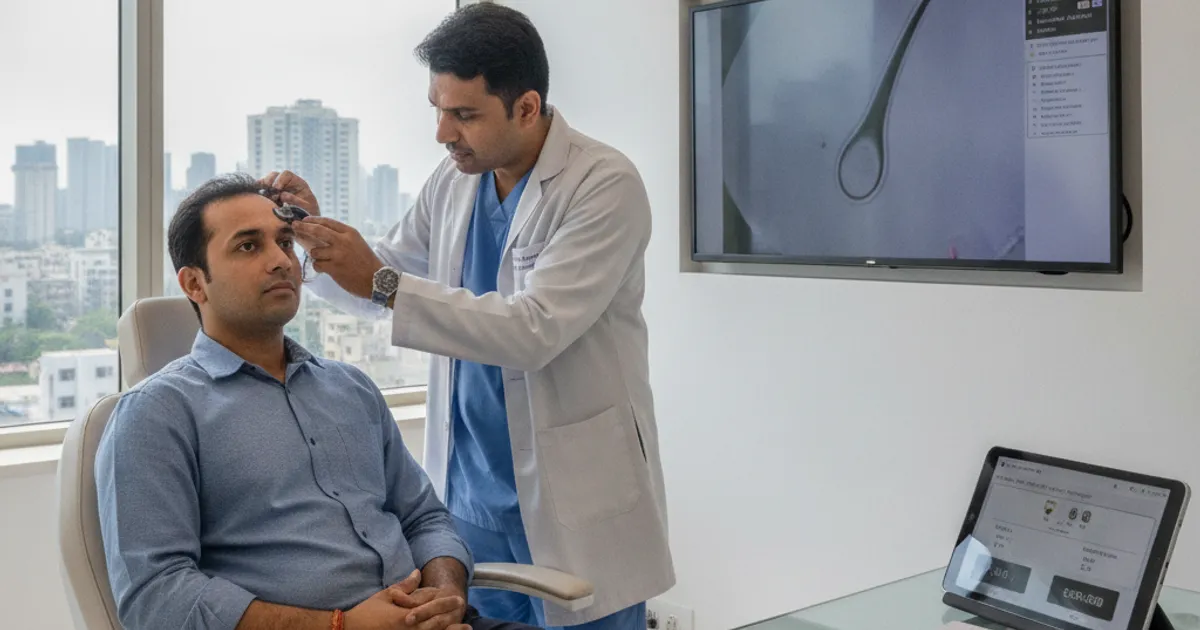
- Hair pull test and trichoscopy (dermatoscope examination of the scalp and follicles) to look for miniaturisation or inflammation.
- Blood tests to rule out thyroid issues, iron deficiency, and vitamin D deficiency, all of which cause shedding.
- Review of medications, recent illness, stress, and diet, since these commonly trigger temporary hair loss.
- Hair shaft examination under magnification to confirm breakage rather than shedding from the root.
| Sign or Test | Points to Hard Water Damage | Points to Genetic Hair Loss |
|---|---|---|
| Hair pull test | Normal or minimal shedding | Increased shedding in affected areas |
| Trichoscopy | Normal follicles, rough hair shaft | Miniaturised follicles, varied shaft thickness |
| Hair shaft exam | Split ends, cuticle damage, breakage | Intact shafts, thinner but not broken |
| Scalp condition | Residue, flaking, irritation | Often normal or mildly inflamed |
| Family history | Not relevant | Often positive on one or both sides |
Treatment Options for Hard Water Hair Damage
Treatment splits into two tracks: fixing the water and repairing the hair. You need both. If you only treat the hair and keep washing it in hard water, the damage returns. If you only fix the water but your hair is already badly damaged, you'll need to grow out or cut off the worst sections. For genuine hair loss alongside hard water damage, medical treatment is a separate conversation.
- Install a shower filter or water softener. Filters reduce minerals; softeners replace calcium and magnesium with sodium. Softeners are more effective but cost more.
- Use a chelating or clarifying shampoo once a week to strip mineral buildup. Don't overdo it, as these can be drying.
- Switch to a moisturising, sulphate-free shampoo and a rich conditioner to rebuild the hair's feel and reduce breakage.
- Apply a leave-in conditioner or hair oil to seal the cuticle and reduce friction.
- Reduce heat styling and harsh chemical treatments while your hair recovers.
- For scalp irritation, use a gentle anti-inflammatory shampoo and avoid scratching.
- For confirmed genetic hair loss, discuss finasteride (oral, prescription) or minoxidil (topical or oral, prescription in some regions) with a doctor.
- Platelet-rich plasma (PRP) injections can be considered for certain types of hair thinning, but evidence is strongest for androgenetic alopecia, not hard water damage.
| Treatment | What It Does | Best For | Notes |
|---|---|---|---|
| Shower filter | Reduces minerals in shower water | Mild to moderate hard water | Cheap, easy to install, needs regular cartridge changes |
| Water softener | Removes hardness minerals at the source | Very hard water areas | Higher upfront cost, whole-home solution |
| Chelating shampoo | Removes mineral buildup from hair | Existing residue and dullness | Use weekly, follow with a deep conditioner |
| Finasteride | Blocks DHT, slows genetic hair loss | Confirmed androgenetic alopecia | Prescription only, takes months to show results |
| Minoxidil | Stimulates follicle growth, prolongs growth phase | Androgenetic alopecia, some thinning types | Topical or oral, prescription needed in some countries |
| PRP | Growth factors injected into the scalp | Selected thinning cases | Multiple sessions, results vary, not a hard water fix |
When Hair Transplant May Be Suitable
A hair transplant moves healthy, genetically stable follicles from the back of the scalp to thinning or bald areas. It's a permanent solution for pattern baldness, not for hard water breakage. If your hair is breaking mid-shaft because of minerals, a transplant won't help, because the problem isn't the follicle. The transplanted hair would be just as exposed to the same water. A transplant becomes worth discussing when you have confirmed genetic hair loss that's stabilised, a good donor supply at the back of the scalp, and realistic expectations.
- You have patterned hair loss confirmed by a doctor, not just diffuse breakage.
- Your hair loss has been stable for at least a year, often with medication.
- You have enough healthy donor hair at the back and sides of the scalp.
- You've addressed other causes, including hard water damage, thyroid issues, and nutritional deficiencies.
- You understand that a transplant doesn't stop future loss in non-transplanted areas, so ongoing medical treatment is usually needed.
Preventing and Managing Hard Water Effects
Prevention is mostly about reducing mineral exposure and keeping the hair shaft in good condition. You don't need to move house. Small changes make a real difference over time, especially if you start before the damage gets severe.
- Rinse with filtered or softened water if you can. Even a final rinse with bottled or filtered water helps.
- Wash your hair less often if your scalp allows it, to reduce mineral exposure.
- Use a chelating shampoo every one to two weeks, and a moisturising shampoo in between.
- Always condition after shampooing, and use a deep conditioning mask weekly.
- Pat hair dry instead of rubbing, and detangle with a wide-tooth comb starting from the ends.
- Limit heat tools and chemical treatments, which compound cuticle damage.
- Keep up with regular trims to remove split ends before they travel up the shaft.
- If you colour your hair, ask your stylist about treatments that protect against mineral buildup.
FAQ: Hard Water and Hair Loss
Does hard water actually cause balding?
No. Hard water does not cause androgenetic alopecia, the genetic condition behind pattern balding. It can damage the hair shaft, causing breakage, dryness, and a thinner appearance, but it doesn't stop follicles from growing hair. If you're balding in a pattern, genetics and hormones are the likely cause.
Can hard water make hair fall out from the root?
Hard water doesn't typically cause shedding from the root. What looks like hair loss is usually breakage along the shaft. If you're seeing full-length strands with a white bulb at the end, that's shedding, and you should get it investigated for other causes.
Will a shower filter stop hair loss?
A shower filter can reduce mineral exposure and improve how your hair feels, but it won't stop genetic hair loss. It's a useful part of managing hard water damage, not a treatment for balding.
How long does it take for hair to recover from hard water damage?
It depends on how much damage there is. With a filter, chelating shampoo, and good conditioning, many people notice softer, less brittle hair within a few weeks. Badly damaged sections may need to be trimmed off before the hair looks healthy again.
Is a hair transplant worth it if I have hard water damage?
Only if you also have confirmed genetic hair loss that's stable. A transplant won't fix breakage. If your hair is breaking because of minerals, treat the water and the hair first. If you have pattern baldness on top of that, a transplant may be an option after a proper assessment.
Can I use finasteride or minoxidil for hard water hair damage?
Finasteride and minoxidil treat genetic hair loss, not hard water damage. They won't repair broken hair shafts. If you have both conditions, a doctor may recommend them for the genetic component while you manage the water issue separately.
Does hard water affect hair colour or texture?
Yes. Mineral buildup can make colour fade faster and leave hair feeling rough and coated. It can also make textured or curly hair harder to manage because the cuticle doesn't lie flat.
More Guides
- Hair Loss After Weight Loss Surgery: Timeline & Fixes
Hair loss after weight loss surgery is common. Learn the timeline, causes, treatments like minoxidil and PRP, and whether a hair transplant is right for you.
- Stress-Related Hair Loss: Recovery Time and Treatment
How long does stress-induced hair loss take to recover? Learn about telogen effluvium, diagnosis, treatments, and when a transplant may help.
- Female Hair Loss at the Back of the Head: Causes & Fixes
Learn why women lose hair at the back of the head, how it's diagnosed, and the best treatment options including minoxidil, PRP, and hair transplant suitability.
- Wellbutrin and Hair Loss: What You Need to Know
Learn how Wellbutrin may cause hair loss, how it's diagnosed, and what treatments—including hair transplant—can help you regrow hair.