
Mesotherapy for Hair Loss: What It Is, Results, Cost
Mesotherapy for hair loss: how it works, evidence, dosage, results timeline, side effects, cost, and how it compares to minoxidil and other treatments.
What Is Mesotherapy for Hair Loss?
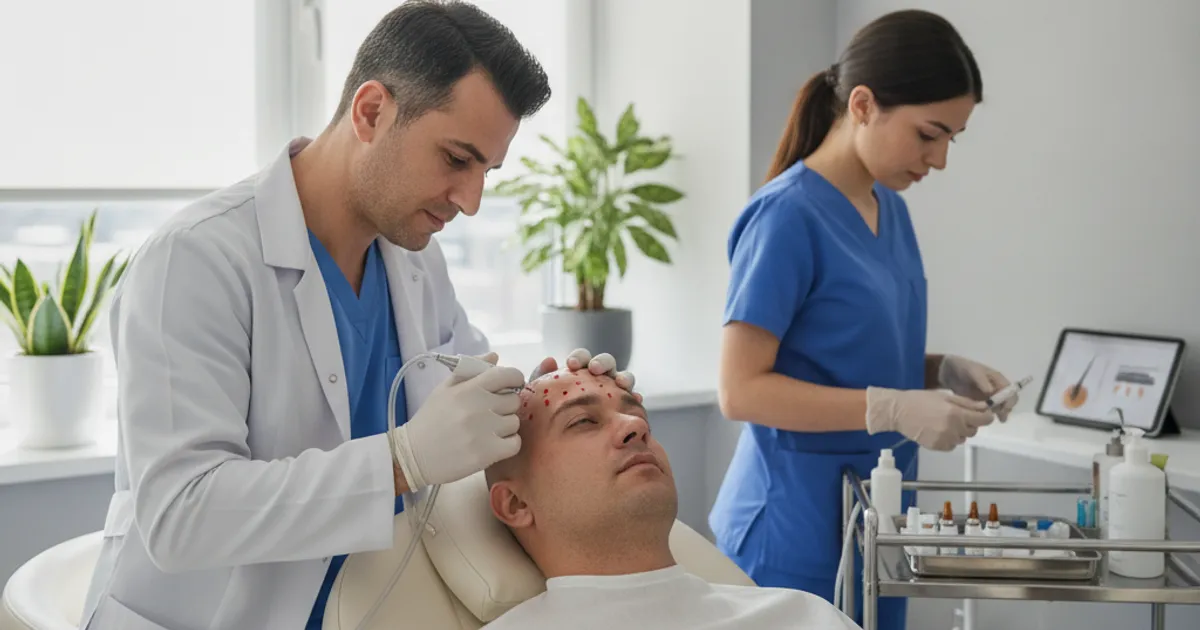
Mesotherapy for hair loss is a series of shallow injections into the scalp. The idea is simple: instead of applying a topical product to the surface of your skin and hoping it absorbs, you deliver a cocktail of vitamins, minerals, amino acids, and sometimes prescription drugs directly into the dermis, a few millimetres below the surface. The technique is widely credited to Dr Michel Pistor in France in the 1950s, originally for pain management, and was later adapted for cosmetic and hair purposes. Today it sits somewhere between a medical treatment and a salon add-on, which is exactly why the quality varies so much from clinic to clinic.
It is worth being clear about what mesotherapy is not. It is not a hair transplant. It does not create new follicles. It is not a permanent fix for androgenetic alopecia. What it can do, in the right candidate, is improve the environment around existing follicles so that thinning hair looks thicker and sheds less. Think of it as a supporting treatment rather than a standalone cure.
- A course of micro-injections delivered into the upper layers of the scalp
- The injected solution usually contains a mix of vitamins, minerals, amino acids, and sometimes vasodilators
- Typically sold as a package of sessions rather than a one-off appointment
- Often combined with PRP, minoxidil, or finasteride rather than used alone
- Available at dermatology clinics, trichology clinics, and some hair transplant centres
How Mesotherapy Works: Mechanism and Ingredients
The mechanism is partly mechanical and partly chemical. The tiny needles cause micro-trauma to the scalp, which triggers a mild healing response and a temporary increase in blood flow to the area. The injected substances are then meant to nourish the hair follicle, reduce inflammation, and in some formulas improve circulation around the dermal papilla, the structure at the base of the follicle that controls hair growth.
The problem is that there is no single agreed formula. Two clinics can both advertise mesotherapy and inject completely different things. Some use a simple vitamin blend. Others add prescription drugs such as minoxidil or finasteride directly into the solution, which raises both the potential benefit and the potential risk. Some add biotin, zinc, copper peptides, or hyaluronic acid. A few add vasodilators like buflomedil, though this is less common now due to safety concerns.
| Ingredient Type | Common Examples | Claimed Purpose |
|---|---|---|
| Vitamins | B-complex, biotin, vitamin C, vitamin E | Support follicle metabolism and reduce oxidative stress |
| Minerals | Zinc, copper, magnesium | Enzyme cofactors involved in hair growth cycles |
| Amino acids | Cysteine, methionine, arginine | Building blocks of keratin, the protein in hair |
| Vasodilators | Minoxidil, buflomedil | Increase blood flow to the scalp |
| Hyaluronic acid | Cross-linked or plain HA | Hydration and volume in the scalp tissue |
| Prescription drugs | Finasteride, dutasteride (rare) | Hormonal suppression of DHT |
The Evidence: Does Mesotherapy Actually Grow Hair?
This is where the honest answer gets uncomfortable. The evidence base for mesotherapy in hair loss is weak compared to treatments like minoxidil or finasteride. There are some small studies, mostly from Europe and Asia, that show improvements in hair count and hair diameter after a course of injections. But many of these studies are small, short, not blinded, and often combine mesotherapy with other treatments, which makes it impossible to say how much of the benefit came from the injections themselves.
- Several small trials report increased hair density and reduced shedding after a course of injections
- Most studies are low quality: small sample sizes, no control group, or combined with PRP or minoxidil
- There is no large, long-term, randomised controlled trial that isolates mesotherapy as a standalone treatment
- Results are generally described as modest, not dramatic
- The treatment is more convincing as an add-on than as a primary therapy
How to Use Mesotherapy: Dosage, Frequency, and Treatment Protocol
There is no universal protocol. What you are offered depends on the clinic, the formula, and your pattern of hair loss. That said, most providers follow a similar structure: an initial loading phase of frequent sessions, followed by a maintenance phase with sessions spaced further apart. The injections are usually given with a very fine needle or a mesotherapy gun, and a session typically takes around 15 to 30 minutes. Most people describe it as mildly uncomfortable rather than painful, though the scalp can feel tender afterwards.
| Phase | Typical Frequency | Typical Duration |
|---|---|---|
| Loading phase | Every 1 to 2 weeks | 4 to 8 sessions |
| Transition phase | Every 3 to 4 weeks | 2 to 3 sessions |
| Maintenance phase | Every 1 to 3 months | Ongoing, indefinite |
| Top-up after a break | As needed | Varies by individual |
- Sessions are usually 15 to 30 minutes, done in-clinic
- No downtime is required, but the scalp may be red or tender for a day
- Many clinics advise avoiding washing your hair for 12 to 24 hours after a session
- Do not expect a single session to do anything meaningful
- If you stop entirely, any benefit is likely to fade over months
Expected Results and Timeline: What to Realistically Expect
If mesotherapy works for you, the first thing you will usually notice is less shedding, often within the first month or two. Visible changes in thickness or density tend to take longer, typically three to six months. This is not a fast treatment. Hair grows slowly, and any intervention that affects the growth cycle takes time to show up in the mirror. Anyone promising visible regrowth in two weeks is selling you something.
- Weeks 1 to 4: possible reduction in shedding, little visible change
- Months 2 to 3: early improvements in hair texture and scalp condition may appear
- Months 4 to 6: modest improvements in density or thickness, if the treatment is working for you
- Months 6 to 12: best results usually seen in this window with continued sessions
- If you stop: benefits typically fade over several months
Timeline at a Glance
- Month 0: first session, baseline photos taken
- Month 1: loading phase underway, shedding may reduce
- Month 3: first realistic checkpoint for visible change
- Month 6: decision point, continue or stop based on results
- Month 12: maintenance phase, reassess with your clinician
Side Effects and Risks of Hair Mesotherapy
For most people, mesotherapy is well tolerated. The most common issues are local and temporary: redness, swelling, tenderness, and occasional bruising at the injection sites. More serious problems are rare but real, and they usually come from either the technique or the formula. Infection is possible if sterile technique is not followed. Allergic reactions can happen to any ingredient. And if prescription drugs like finasteride are added to the cocktail, you inherit the systemic risks of those drugs, including sexual side effects in men and fetal risk in women of childbearing age.
- Redness, swelling, and tenderness at injection sites, often resolving within 24 to 48 hours
- Bruising, especially in people on blood thinners
- Small risk of infection if sterile technique is poor
- Allergic reaction to any component of the injected solution
- Systemic side effects if prescription drugs are included in the formula
- Scalp nodules or granulomas, rare but reported with some filler-type ingredients
Who Is a Suitable Candidate for Mesotherapy?
Mesotherapy is best suited to people in the early stages of hair thinning who still have a reasonable number of active follicles. It is not a rescue treatment for advanced baldness, and it will not regrow hair on a slick bald patch where the follicles have already died. It can be used alongside other treatments, and some clinics offer it as a pre- or post-transplant support therapy, though the evidence for that specific use is thin.
| Candidate Profile | Suitability | Notes |
|---|---|---|
| Early-stage thinning with active follicles | Good | Best chance of seeing a modest benefit |
| Moderate thinning, combined with other treatments | Reasonable | Works better as part of a plan than alone |
| Advanced baldness with dormant follicles | Poor | Unlikely to produce meaningful regrowth |
| Recent hair transplant patient | Variable | Some clinics offer it, evidence is limited |
| Pregnant or breastfeeding women | Not suitable | Risk from formula ingredients, especially prescription drugs |
| People with scalp infections or skin conditions | Not suitable until resolved | Wait until the scalp is healthy |
Cost of Mesotherapy for Hair Loss
Mesotherapy pricing is all over the place. It depends on the country, the clinic, the formula, and whether you buy sessions individually or as a package. In many markets, a single session sits in the low-to-mid hundreds, and a package of six to ten sessions is the standard way it is sold. Because it is usually an ongoing treatment, the real cost is the cumulative spend over a year or more, not the price of one appointment. Always ask for the full package price and what happens if you need maintenance sessions indefinitely.
| Cost Factor | What Affects It |
|---|---|
| Number of sessions | More sessions means higher total cost |
| Formula complexity | Prescription drugs and premium ingredients raise the price |
| Clinic location | City-centre dermatology clinics charge more than suburban ones |
| Provider type | Dermatologists typically charge more than aestheticians |
| Package vs single session | Packages are cheaper per session but a bigger upfront commitment |
| Maintenance | Ongoing sessions add up over years |
Mesotherapy vs Other Hair Loss Treatments
Mesotherapy does not exist in a vacuum. If you are losing hair, you have several options, and mesotherapy is rarely the strongest one on its own. Minoxidil and finasteride have far better evidence. PRP has a similar evidence profile to mesotherapy, with some studies suggesting it may be slightly better. Low-level laser therapy is another option with modest evidence. A hair transplant is the only option that physically restores hair in bald areas, but it is a surgical procedure with a very different cost and commitment profile. The sensible approach for most people is to start with the treatments that have the best evidence, and consider mesotherapy as a supporting add-on if you want to try it.
| Treatment | Evidence Strength | Typical Role | Ongoing? |
|---|---|---|---|
| Minoxidil (topical) | Strong | First-line for many patients | Yes, indefinite |
| Finasteride (oral) | Strong | First-line for men with pattern loss | Yes, indefinite |
| PRP injections | Moderate | Add-on or alternative | Yes, maintenance needed |
| Mesotherapy | Weak to moderate | Add-on, rarely standalone | Yes, maintenance needed |
| Low-level laser therapy | Moderate | Add-on | Yes, regular use needed |
| Hair transplant | Strong for restoration | Surgical restoration of bald areas | No, but may need top-ups |
Frequently Asked Questions About Hair Mesotherapy
Is mesotherapy for hair loss safe?
For most people, yes, when it is performed by a qualified provider using sterile technique and a clearly disclosed formula. The main risks are local reactions like redness, swelling, and bruising. More serious risks come from poor technique or from prescription drugs added to the injection. Always ask what is in the syringe before you start.
How many mesotherapy sessions do I need before I see results?
Most protocols start with four to eight sessions spaced one to two weeks apart. Reduced shedding may show up within the first month, but visible changes in thickness or density usually take three to six months. If you see nothing by month six, it is reasonable to stop and reassess.
Can mesotherapy replace a hair transplant?
No. Mesotherapy cannot create new follicles or restore hair on areas that are already bald. A hair transplant is the only treatment that physically restores hair in bald areas. Mesotherapy may be used alongside a transplant as a support treatment, but it is not a substitute.
Does mesotherapy work for female pattern hair loss?
Some small studies suggest it may help, particularly in early-stage thinning. However, the evidence is weak, and results vary. Women who are pregnant or breastfeeding should avoid mesotherapy, especially if the formula contains prescription drugs.
More Guides
- Finasteride for Baldness: What It Can and Can't Do
Finasteride is a proven hair loss treatment, but it's not a cure. Learn how it works, dosage, side effects, and how it compares to other options.
- DHT-Blocking Shampoos: What Works and What's Marketing?
Do DHT-blocking shampoos really grow hair? We break down the science, evidence, usage, side effects, costs, and how they compare to other treatments.
- Clascoterone for Hair Loss: What the Research Shows
Clascoterone is a topical anti-androgen being studied for hair loss. Learn how it works, the evidence, how to use it, side effects, cost, and how it compares.
- Hims Minoxidil Spray: Ingredients, Results, and Cost
Hims Minoxidil Spray review: ingredients, how it works, results timeline, side effects, cost, and how it compares to other hair loss treatments.