
Androgenetic Alopecia: Causes, Treatments & Hair Transplant
Androgenetic alopecia explained: causes, symptoms, diagnosis, and treatments like finasteride, minoxidil, PRP, plus when a hair transplant makes sense.
What Is Androgenetic Alopecia?
Androgenetic alopecia is the medical term for what most people call male pattern baldness or female pattern hair loss. It's a genetic condition driven by hormones, specifically androgens like dihydrotestosterone (DHT). If you have it, your hair follicles gradually shrink over time — a process called miniaturization — until they stop producing visible hair altogether. It's the most common form of hair loss worldwide, affecting both men and women, though it tends to show up differently in each. In men, it usually starts with a receding hairline or thinning crown. In women, it's typically a widening part and overall diffuse thinning on top, while the frontal hairline stays largely intact.
Causes and Risk Factors
The root cause is a combination of genetics and hormones. You inherit a sensitivity to DHT from either side of your family — not just your mother's father, as the old myth goes. When DHT binds to receptors in susceptible hair follicles, it shortens the growth phase (anagen) and lengthens the resting phase (telogen), causing hairs to become thinner and shorter with each cycle. Several factors influence how early and how severely this happens:
- Genetics: a family history of pattern hair loss on either side increases your risk.
- Hormones: androgens, particularly DHT, drive the miniaturization process.
- Age: risk rises with age, though it can start in your late teens or early twenties.
- Ethnicity: patterns and prevalence vary across different populations.
- Medical conditions: polycystic ovary syndrome (PCOS) can accelerate hair loss in women.
- Medications: some drugs, including certain steroids and hormone treatments, can worsen thinning.
- Stress and lifestyle: severe stress or nutritional deficiencies can unmask or speed up genetic hair loss.
Symptoms and Patterns of Hair Loss
The symptoms of androgenetic alopecia are usually gradual and follow predictable patterns. Men often notice a receding hairline first, then thinning at the crown, which can eventually meet. Women typically see a widening part and a decrease in overall density on the top of the scalp, while the frontal hairline remains. Unlike some other hair loss conditions, androgenetic alopecia doesn't usually cause itching, redness, or scaling. The scalp looks normal — the hair just gets thinner. Here's a quick breakdown of how it typically presents:
| Pattern | Who It Affects | Typical Signs |
|---|---|---|
| Receding hairline | Men | Hairline moves back at the temples, forming an M or V shape. |
| Crown thinning | Men | A bald spot develops at the top of the head, often expanding over time. |
| Diffuse thinning on top | Women | Overall density decreases on the crown and mid-scalp; part widens. |
| Frontal hairline preservation | Women | The hairline usually stays put, unlike in male pattern loss. |
| Miniaturized hairs | Both | Hairs become finer, shorter, and less pigmented before disappearing. |
How Androgenetic Alopecia Is Diagnosed
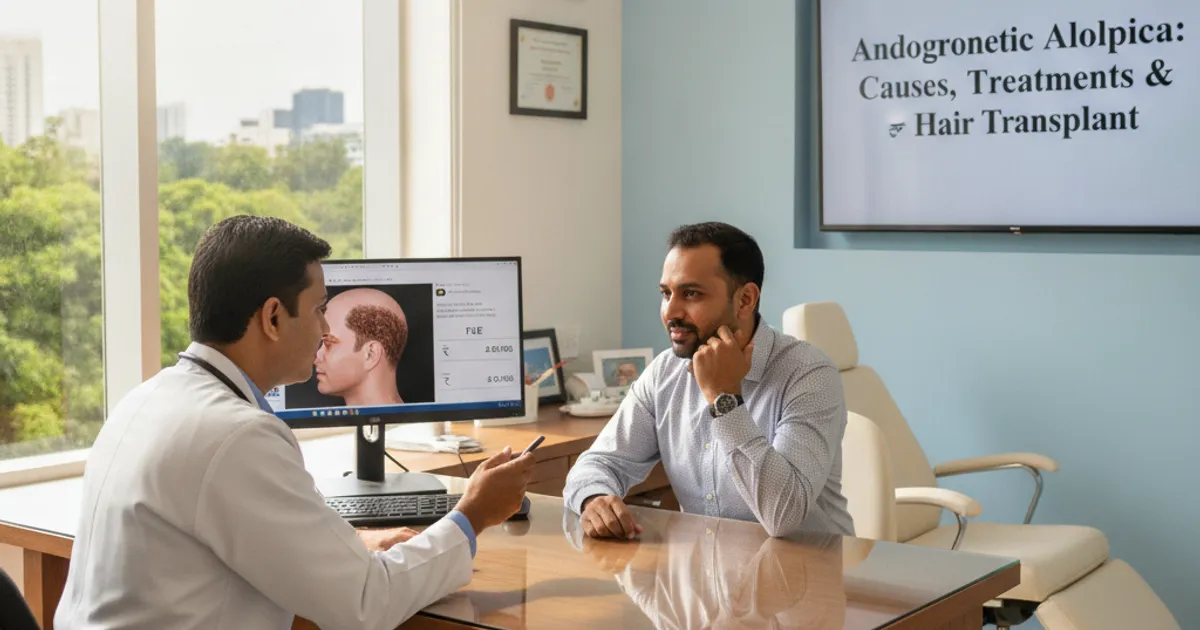
Diagnosis is usually straightforward and can be done by a dermatologist or a hair restoration specialist. There's no single blood test for androgenetic alopecia, but your doctor will take a history and examine your scalp. They may use a dermoscope to look at the hair follicles up close, checking for miniaturization and hair diameter diversity. In some cases, they might order blood tests to rule out other causes like thyroid issues, iron deficiency, or hormonal imbalances. A pull test or scalp biopsy is rarely needed but can help if the diagnosis is unclear. Here's what the process typically involves:
- Medical history: your doctor asks about hair loss patterns in your family, when yours started, and any medications or health conditions.
- Scalp examination: visual inspection of the pattern and extent of thinning.
- Dermoscopy: a handheld magnifier that shows hair shaft variability and follicle miniaturization.
- Blood tests: to check for thyroid function, iron levels, and hormones if other causes are suspected.
- Hair pull test: a gentle tug to see how many hairs come out, which can indicate active shedding.
- Scalp biopsy: rarely used, but can confirm the diagnosis when other conditions are possible.
Treatment Options for Androgenetic Alopecia
Treatment aims to slow or stop hair loss and, in some cases, regrow hair. The earlier you start, the more hair you're likely to keep. Options range from medications to in-office procedures and surgery. Finasteride (oral) and minoxidil (topical) are the two most common medications. Finasteride is for men and works by blocking DHT production; minoxidil is available for both men and women and helps prolong the growth phase. Platelet-rich plasma (PRP) injections are another option — they use your own blood plasma to stimulate follicles. Low-level laser therapy and ketoconazole shampoo are sometimes used as adjuncts. Here's a rundown of the main treatments:
- Finasteride: oral prescription for men; reduces DHT and can slow loss and regrow some hair.
- Minoxidil: topical solution or foam for men and women; increases blood flow to follicles.
- Platelet-rich plasma (PRP): injections of concentrated platelets to stimulate hair growth.
- Low-level laser therapy: devices that emit red light to improve follicle activity.
- Ketoconazole shampoo: an antifungal that may have mild anti-androgenic effects.
- Hair transplant surgery: moves healthy follicles from the back of the scalp to thinning areas.
Is a Hair Transplant Suitable for You?
A hair transplant can be a good option if you have stable hair loss and a healthy donor area — usually the back and sides of the scalp. But it's not a cure for androgenetic alopecia. The transplanted hair is typically resistant to DHT, so it should last, but your existing hair may continue to thin. That's why most surgeons recommend continuing medication like finasteride or minoxidil after surgery to protect the rest of your hair. Ideal candidates are usually those with early to moderate loss, realistic expectations, and enough donor hair. If you're still actively shedding or have advanced loss, you may need to stabilize the condition first. Here are some factors to consider:
- Stable hair loss: your pattern should be relatively stable, not rapidly progressing.
- Good donor density: enough healthy hair at the back and sides to move.
- Realistic expectations: a transplant won't give you a full head of hair, but it can restore density.
- Commitment to aftercare: medication and follow-up are often needed to maintain results.
- Overall health: you should be in good health and not have contraindications to surgery.
Related Hair Loss Conditions
Androgenetic alopecia isn't the only reason people lose hair. Other conditions can look similar but have different causes and treatments. Telogen effluvium is a temporary shedding condition often triggered by stress, illness, or nutritional deficiencies. Alopecia areata is an autoimmune condition that causes patchy hair loss. Traction alopecia results from hairstyles that pull on the hair. Scarring alopecia involves inflammation that destroys follicles permanently. Diffuse thinning is a general term for widespread hair loss that can have multiple causes. If you're not sure which condition you have, it's worth getting a proper diagnosis before starting treatment.
Frequently Asked Questions
Can androgenetic alopecia be reversed?
It can't be cured, but it can often be slowed or partially reversed with treatments like finasteride, minoxidil, and PRP. The earlier you start, the better the results. Hair transplants can restore hair in bald areas, but you'll likely need ongoing treatment to maintain the rest.
Is androgenetic alopecia the same as male pattern baldness?
Yes, male pattern baldness is the common name for androgenetic alopecia in men. In women, it's called female pattern hair loss. The underlying mechanism is similar, but the patterns differ.
At what age does androgenetic alopecia usually start?
It can start as early as your late teens or early twenties, but most people notice it in their 30s or 40s. The timing and speed vary widely based on genetics.
Does a hair transplant work for androgenetic alopecia?
Yes, for many people. The transplanted follicles are usually resistant to DHT, so they continue to grow. However, you need a stable donor area and realistic expectations. Most surgeons recommend continuing medication after surgery.
Can women get hair transplants for androgenetic alopecia?
Yes, women can be candidates, but they need to be evaluated carefully. Diffuse thinning can make it harder to find a good donor area. A specialist can assess whether you're suitable.
Are there any side effects from finasteride or minoxidil?
Both can have side effects. Finasteride may cause sexual side effects in a small percentage of men — clinical trials report that around 2-4% of men experience them, though some studies show lower rates. Minoxidil can cause scalp irritation or unwanted facial hair growth. Talk to your doctor about risks and benefits.
More Guides
- Minoxidil Contact Dermatitis: Signs and Alternatives
Learn the signs of minoxidil contact dermatitis, how it's diagnosed, treatment options, and alternatives like finasteride, PRP, and hair transplant surgery.
- Can Radiotherapy Cause Hair Loss? What to Expect
Radiotherapy can cause temporary or permanent hair loss. Learn the causes, symptoms, diagnosis, treatment options, and whether a hair transplant is suitable.
- Hair Loss After Illness or High Fever: When Does It Stop?
Hair loss after illness or high fever is usually temporary telogen effluvium. Learn causes, symptoms, diagnosis, treatment, and when a hair transplant may help.
- Can Dandruff Cause Hair Loss? Facts vs Folklore
Does dandruff cause hair loss? We separate fact from folklore, explain the real connection, diagnosis, treatments, and when a hair transplant makes sense.