
SmartGraft Hair Transplant: How It Works, Cost & Results
SmartGraft hair transplant explained: how the system works, recovery timeline, results, candidacy, cost by hair loss stage, and how it compares to other techniq
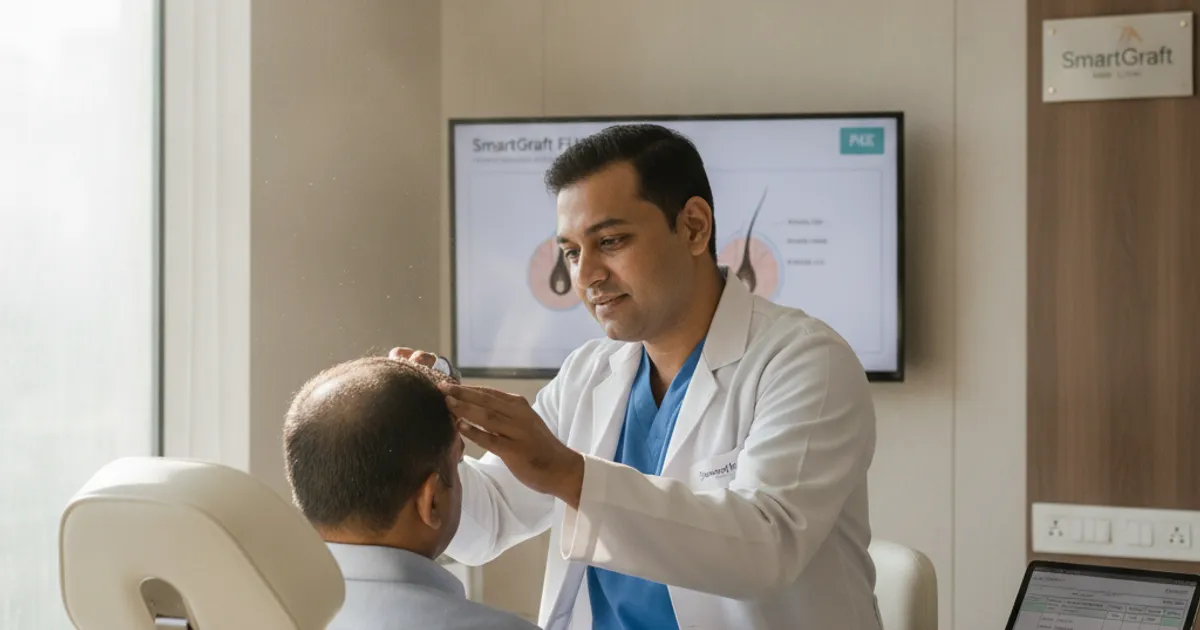
What Is the SmartGraft System?
SmartGraft is a US-made, FDA-cleared device used to perform follicular unit extraction (FUE) hair transplants. Instead of a surgeon manually punching and pulling individual grafts, the SmartGraft system uses a handheld tool that harvests, sorts, and stores grafts in a single closed process. It's essentially an all-in-one FUE workstation: one part extracts the follicles, another keeps them hydrated and chilled in a sterile canister until they're ready to be implanted. The idea is to reduce the time grafts spend outside the body and cut down on the handling that can damage them.
The system is most commonly marketed as a faster, more consistent alternative to manual FUE, and some clinics also use it for beard or body hair harvesting. It is not the same as a robotic system like ARTAS — SmartGraft is handheld and surgeon-controlled, not automated.
- FDA-cleared handheld FUE device with a built-in graft storage canister
- Harvests, sorts, and stores grafts in one closed, temperature-controlled process
- Designed to reduce graft handling time and dehydration
- Used for scalp, beard, and body hair harvesting at some clinics
- Surgeon-controlled — not a robot, not automated
How SmartGraft Hair Restoration Works: Step by Step
The procedure itself follows the same broad arc as any FUE transplant. The difference is in the tools and the workflow. Here's how a typical SmartGraft session runs, from consultation to final graft placement.
Diagram showing the SmartGraft handpiece extracting a follicular unit and depositing it into the closed canister system.
SmartGraft Recovery Timeline: What to Expect Week by Week
Recovery from SmartGraft is broadly similar to standard FUE. Because the extraction is done with small punches, there's no linear scar, and most people can return to desk work within a few days. That said, the first two weeks are the most delicate. Here's a realistic week-by-week picture.
| Timeframe | What's Happening | What You Can Do |
|---|---|---|
| Days 1–3 | Donor and recipient areas are tender, scabby, and swollen. Grafts are still anchoring. | Rest, sleep upright, avoid touching the scalp. No exercise. |
| Days 4–7 | Scabs start to form and tighten. Swelling usually peaks around day 3–4 and subsides. | Light walking is fine. Gentle washing per clinic instructions. |
| Week 2 | Scabs loosen and flake off. Some grafts may shed — this is normal. | Most people return to work. Still no heavy sweating or swimming. |
| Weeks 3–6 | Shock loss can kick in. The transplanted hairs fall out and the scalp may look patchy. | Back to normal activity. Resist the urge to panic — this is expected. |
| Months 2–4 | Dormant phase. Little visible change. New hairs begin to sprout near the end of this window. | Nothing to do but wait. Take progress photos. |
| Months 5–8 | Visible growth. Density improves month by month. | Hair can be styled normally. Avoid harsh chemicals if possible. |
| Months 9–12 | Final maturation. Grafts thicken and the result settles. | This is when you can fairly judge the outcome. |
SmartGraft Results: When Will You See Growth?
The honest answer is: not for a while. Hair transplants are a patience game, and SmartGraft doesn't change the biology of how follicles grow. What it may change is graft survival rate — the percentage of transplanted follicles that actually take root and grow. Clinics that use SmartGraft often claim better graft survival because of the closed storage system, but independent head-to-head studies comparing SmartGraft to manual FUE are limited. Treat manufacturer and clinic claims with appropriate skepticism and ask for before-and-after photos of real patients.
- Months 1–3: transplanted hairs shed, then go dormant. Little visible change.
- Months 4–6: new growth starts. Fine, wispy hairs appear.
- Months 6–9: density becomes noticeable. You can start styling.
- Months 12–18: final result. Grafts thicken and mature.
- Graft survival: varies by surgeon and patient, not just by device.
Who Is a Good Candidate for SmartGraft?
SmartGraft suits many of the same people who are good candidates for FUE generally. The device works best when the surgeon needs to harvest a large number of grafts efficiently, or when the donor area has finer or curlier hair that's trickier to extract manually. It's not a solution for everyone, though.
- You have a stable donor area with good density at the back and sides of the scalp
- Your hair loss pattern has stabilized — you're not losing hair rapidly
- You want to avoid a linear strip scar (as with FUT)
- You have realistic expectations about density and timeline
- You're in good general health and can tolerate a long procedure day
| Candidate Profile | Good Fit? | Why |
|---|---|---|
| Early hair loss, thick donor hair | Yes | Small session, high graft quality, minimal risk |
| Moderate loss, stable pattern | Yes | SmartGraft's efficiency helps with larger sessions |
| Advanced loss, limited donor | Maybe | Graft supply may be the limiting factor, not the device |
| Active, rapid hair loss | No | Transplanting into unstable areas can look odd as loss progresses |
| Very fine or curly donor hair | Often yes | The device can help with tricky extraction |
| Realistic expectations, patient | Yes | Results take time regardless of technique |
SmartGraft Cost: What Affects the Price?
SmartGraft pricing is set by the clinic, not by the device manufacturer. There's no standard SmartGraft price, and costs vary widely by country, city, surgeon reputation, and the number of grafts you need. Most clinics price per graft, though some quote a flat fee for a session. The biggest driver is graft count — a small hairline touch-up costs far less than a full restoration. Below are averaged case prices by stage of hair loss, based on typical clinic pricing. These are medians, not quotes — your actual price will depend on your specific case.
- Graft count — the single biggest factor. More grafts, higher cost.
- Surgeon experience — senior surgeons charge more per graft.
- Location — major cities and high-cost countries cost more.
- Clinic overhead — SmartGraft devices are expensive, and that cost is passed on.
- Additional services — PRP, sedation, aftercare kits, and follow-up visits may be extra.
- Whether the price is all-inclusive or itemized — always ask what's included.
SmartGraft vs. Other Hair Transplant Techniques
SmartGraft is one option among several. The main alternatives are manual FUE, motorized FUE (like the WAW or Devroye systems), FUT (strip surgery), and robotic FUE (ARTAS). Each has trade-offs in cost, scarring, speed, and graft handling. Here's a plain comparison.
| Technique | How It Works | Scarring | Typical Cost Level | Best For |
|---|---|---|---|---|
| SmartGraft FUE | Handheld device extracts and stores grafts in a closed canister | Small dot scars | Mid to high | Larger sessions, tricky donor hair |
| Manual FUE | Surgeon uses a manual punch and forceps | Small dot scars | Mid | Smaller sessions, precise control |
| Motorized FUE | Powered punch speeds up extraction | Small dot scars | Mid | High-volume sessions |
| FUT (strip) | A strip of scalp is removed and dissected | Linear scar | Lower per graft | Very large sessions, tight budgets |
| Robotic FUE (ARTAS) | Robot assists with extraction | Small dot scars | High | Clinics with the robot, patients wanting automation |
Choosing a SmartGraft Clinic: What to Look For
Not every clinic offers SmartGraft, and not every clinic that claims to use it actually does. Some advertise the device but use it only for part of the procedure, or use it rarely. If SmartGraft is important to you, verify it directly. Ask how many SmartGraft procedures they perform per month, who operates the device, and whether the surgeon or a technician does the extraction. Also ask to see before-and-after photos of SmartGraft patients specifically — not just generic FUE results.
- Confirm the clinic actually owns and uses a SmartGraft device — ask for a demo or photo
- Ask who performs the extraction: the surgeon or a technician
- Request before-and-after photos of SmartGraft cases, not just any FUE
- Check whether the price is all-inclusive or itemized
- Ask about graft survival rates and how they track them
- Look for clinics with transparent pricing and realistic timelines
- Read reviews from patients who specifically mention SmartGraft
Related Guides
If you're still weighing up techniques, the FUE guide covers the broader category SmartGraft sits within. The cost guide breaks down pricing by country and clinic, and the recovery guide goes deeper on what the first few months actually feel like. When you're ready to compare clinics, the directory lets you filter by procedure, location, and price range.
Frequently Asked Questions About SmartGraft
Is SmartGraft better than regular FUE?
Not necessarily. SmartGraft is a tool that may improve graft handling and speed up extraction, but the outcome depends mostly on the surgeon's skill and your individual case. Some clinics report better graft survival with SmartGraft, but independent comparisons are limited. It's worth considering, but not a guaranteed upgrade over well-performed manual FUE.
How much does a SmartGraft hair transplant cost?
There's no fixed price. Costs depend on graft count, clinic location, surgeon experience, and what's included. Early-stage cases need fewer grafts and cost less; advanced cases need more and cost more. Contact clinics directly for a quote based on your specific hair loss pattern.
How long does SmartGraft recovery take?
Most people return to desk work within a week. Scabs flake off by week two, and shock loss may occur around weeks three to six. Visible growth starts around month four, with final results typically taking many months. The recovery is similar to standard FUE.
Does SmartGraft leave a scar?
It leaves small dot scars in the donor area, similar to other FUE techniques. There's no linear strip scar like FUT. The dots are usually tiny and fade over time, and they're easily hidden by surrounding hair.
SmartGraft is a tool in the hair transplant world, but it's not a shortcut. It won't change the biology of how hair grows, and it won't make a bad surgeon good. What it can do is help a skilled surgeon work more efficiently and potentially handle grafts more gently. If you're considering it, focus on the clinic's results, ask hard questions about who does what, and go in with a realistic timeline. The best transplant is the one matched to your hair loss pattern, your donor supply, and your budget — not the one with the most advanced device.
More Guides
- Hair Transplant for Curly Hair: Graft and Technique Tips
A plain-English guide to hair transplants for curly hair: how surgeons adapt graft harvesting and placement, recovery, results, costs, and who it suits.
- How Long Does a Hair Transplant Last? Long-Term Durability
How long does a hair transplant last? We explain the procedure, recovery, durability, costs by stage of hair loss, and how it compares to alternatives.
- Hair Transplant Revision: When a Second Procedure Makes Sense
Considering a hair transplant revision? Learn how a second procedure works, who it suits, recovery, results, and costs. Expert explainer from Clinic Reccy.
- Hair Transplant for Norwood 6 and 7: What's Possible
A clear look at hair transplant options for Norwood 6 and 7 hair loss: graft limits, staging, recovery, costs, and realistic results.