
Temporal Recession vs Normal Hairline Maturation
Learn how to tell temporal recession from normal hairline maturation. Causes, symptoms, diagnosis, and treatment options explained clearly.
Why the Hairline Question Matters
If you have noticed your hairline changing shape, you are probably wondering whether it is just a normal part of growing up or the early signs of male pattern baldness. This is one of the most common questions people bring to hair restoration clinics, and the answer is not always obvious. The difference between temporal recession and normal hairline maturation can be subtle, especially in the early stages. Getting it right matters because it affects whether you should consider treatments like finasteride or minoxidil, or whether you can simply relax and accept a natural change in your hairline.
What Is Normal Hairline Maturation?
Normal hairline maturation is the gradual, natural change in the shape and position of the hairline that happens to most men during early adulthood. It is not caused by disease or hormonal imbalance. Instead, it reflects the transition from a juvenile hairline to an adult hairline. The juvenile hairline is typically lower, straighter, and more rounded. The adult hairline tends to sit slightly higher, with a more mature shape and often a slight recession at the temples.
- Happens gradually over several years, not months.
- Usually symmetrical on both sides of the forehead.
- Stops progressing once the adult hairline is established.
- Does not involve thinning or miniaturisation of the hair shaft.
- The hairline remains relatively stable after the mid-to-late twenties.
| Feature | Normal Hairline Maturation |
|---|---|
| Age of onset | Late teens to mid-twenties |
| Speed of change | Slow, over years |
| Symmetry | Usually symmetrical |
| Hair density | Remains normal |
| Progression | Stabilises by late twenties |
| Family history | Not strongly linked |
What Is Temporal Recession?
Temporal recession is the loss of hair at the temples, often forming the classic M-shaped hairline associated with male pattern baldness. Unlike normal maturation, temporal recession is driven by the effects of dihydrotestosterone (DHT) on genetically susceptible hair follicles. It can start at any age after puberty, but it most commonly begins in the late teens or early twenties. The key difference is that temporal recession is progressive. Without treatment, it tends to continue, eventually merging with other areas of thinning to create a larger bald patch.
- Hair loss is concentrated at the temples, often asymmetrical at first.
- The hairline moves back further over time.
- Hair in the affected area becomes thinner and shorter before disappearing.
- May be accompanied by thinning on the crown or mid-scalp.
- Often runs in families, though it can skip generations.
Key Differences: Normal Maturation vs. Temporal Recession
The table below summarises the main differences. Keep in mind that some men can have both normal maturation and early temporal recession at the same time, which makes diagnosis tricky. A dermatologist or hair restoration specialist can help distinguish between the two.
| Factor | Normal Hairline Maturation | Temporal Recession |
|---|---|---|
| Cause | Natural ageing of the hairline | Genetic sensitivity to DHT |
| Onset | Late teens to mid-twenties | Can start any time after puberty |
| Pattern | Symmetrical, slight recession | Often asymmetrical, deeper recession |
| Progression | Stops after a few years | Continues without treatment |
| Hair quality | Normal thickness | Thinning and miniaturisation |
| Family history | Weak link | Strong link |
| Treatment needed | Usually none | Often yes, to slow or stop loss |
- Normal maturation: hairline moves back by a few millimetres and then stabilises.
- Temporal recession: hairline continues to recede, often forming a deep M shape.
- Normal maturation: no change in hair density behind the hairline.
- Temporal recession: thinning may spread to the mid-scalp and crown.
Causes of Temporal Recession
Temporal recession is primarily caused by a combination of genetics and hormones. The hormone dihydrotestosterone (DHT) binds to receptors in susceptible hair follicles, causing them to shrink over time. This process is known as androgenetic alopecia or male pattern baldness. While genetics play the biggest role, other factors can influence how quickly it progresses.
- Genetics: a family history of male pattern baldness increases your risk.
- Hormones: DHT is the main driver of follicle miniaturisation.
- Age: risk increases with age, but it can start in your teens.
- Stress: severe or chronic stress may accelerate hair loss.
- Medical conditions: thyroid problems, anaemia, or scalp infections can contribute.
- Medications: some drugs can cause hair thinning as a side effect.
Symptoms and Signs to Watch For
The early signs of temporal recession can be easy to miss. You might notice a few extra hairs on your pillow or in the shower, or your hairline might look slightly different in photos. Here are the most common symptoms to look out for.
- Receding hairline at the temples, often more on one side.
- Thinning or miniaturised hairs along the front of the hairline.
- A widening forehead or a change in the shape of your hairline.
- Increased shedding when washing or brushing your hair.
- Thinning on the crown or top of the head.
- A family history of hair loss.
How Is Temporal Recession Diagnosed?
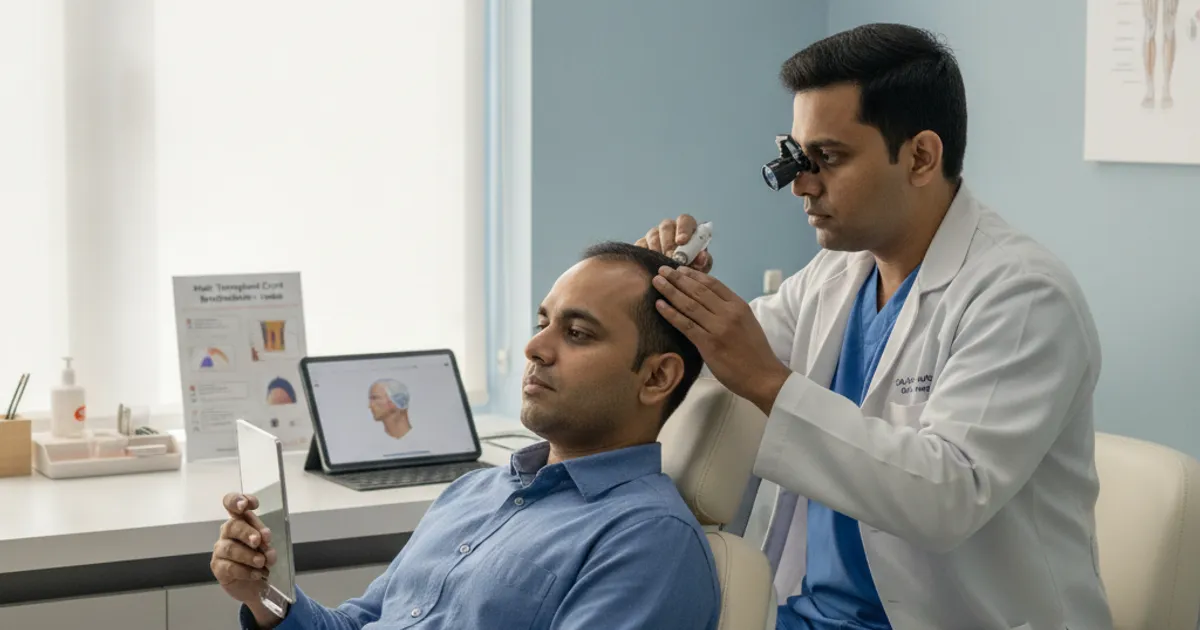
Diagnosis usually starts with a consultation with a dermatologist or hair restoration specialist. They will ask about your medical history, family history, and when you first noticed changes. They will also examine your scalp and hair under magnification to look for miniaturised hairs. In some cases, blood tests may be ordered to rule out other causes like thyroid disorders or nutritional deficiencies.
- Medical and family history review.
- Visual examination of the scalp and hairline.
- Dermoscopy or trichoscopy to assess hair shaft variability.
- Pull test to evaluate shedding.
- Blood tests for thyroid, iron, and hormone levels if needed.
- Photographic documentation to track progression over time.
| Diagnostic Tool | What It Shows |
|---|---|
| Dermoscopy | Miniaturised hairs, perifollicular signs |
| Pull test | Active shedding or telogen effluvium |
| Blood tests | Thyroid, iron, vitamin D, hormones |
| Photography | Changes in hairline over time |
| Family history | Genetic predisposition |
Treatment Options for Temporal Recession
If you are diagnosed with temporal recession, there are several treatment options. The best approach depends on your age, how advanced the loss is, and your goals. The earlier you start, the more hair you are likely to keep. Treatments fall into three main categories: medications, procedural treatments, and surgery.
- Finasteride: an oral prescription drug that lowers DHT levels and can slow or stop hair loss.
- Minoxidil: a topical solution or foam that stimulates hair growth and can be used alongside finasteride.
- PRP (platelet-rich plasma): injections of your own plasma to stimulate hair follicles.
- Low-level laser therapy: devices that use light energy to promote hair growth.
- Hair transplant surgery: moving healthy hair follicles to thinning areas.
| Treatment | How It Works | Best For |
|---|---|---|
| Finasteride | Reduces DHT production | Early to moderate loss |
| Minoxidil | Increases blood flow to follicles | Early loss, crown thinning |
| PRP | Growth factors stimulate follicles | Early to moderate loss |
| Laser therapy | Light energy stimulates cells | Early loss, maintenance |
| Hair transplant | Relocates DHT-resistant follicles | Moderate to advanced loss |
Is a Hair Transplant Suitable for Temporal Recession?
A hair transplant can be an excellent option for temporal recession, but it is not right for everyone. The ideal candidate has stable hair loss, good donor hair density, and realistic expectations. If your hair loss is still progressing rapidly, a transplant may not be the best first step because you could continue to lose hair around the transplanted area. In that case, medications like finasteride or minoxidil are often recommended first to stabilise the loss.
- Good candidates: stable hair loss, healthy donor area, realistic goals.
- Less ideal: active, rapidly progressing loss without medication.
- Not suitable: diffuse thinning without a stable donor area.
- Age: most surgeons prefer patients over 25 to ensure the pattern is clear.
- Combination approach: transplant plus medication often gives the best long-term result.
FAQ: Temporal Recession vs. Normal Hairline Maturation
Can normal hairline maturation turn into temporal recession?
Yes. Some men have a normal mature hairline that later begins to recede due to male pattern baldness. The key difference is that normal maturation stabilises, while temporal recession continues to progress.
At what age does temporal recession usually start?
It can start anytime after puberty, but most commonly begins in the late teens to early twenties. By age 50, many men have some degree of temporal recession.
Is temporal recession always caused by genetics?
Genetics is the main cause, but other factors like stress, medical conditions, and medications can contribute or accelerate it.
Can I stop temporal recession without medication?
No. Once temporal recession starts, it will usually continue without treatment. Medications like finasteride and minoxidil are the most effective ways to slow or stop it.
Does a hair transplant work for temporal recession?
Yes, for suitable candidates. A transplant can restore hair at the temples, but it is usually combined with medication to prevent further loss.
How can I tell if my hairline is maturing or receding?
Look for symmetry, speed of change, and whether the hairline stabilises. If it keeps moving back or you notice thinning, it is more likely recession. A dermatologist can give you a definitive answer.
More Guides
- Hair Loss After Weight Loss Surgery: Timeline & Fixes
Hair loss after weight loss surgery is common. Learn the timeline, causes, treatments like minoxidil and PRP, and whether a hair transplant is right for you.
- Stress-Related Hair Loss: Recovery Time and Treatment
How long does stress-induced hair loss take to recover? Learn about telogen effluvium, diagnosis, treatments, and when a transplant may help.
- Female Hair Loss at the Back of the Head: Causes & Fixes
Learn why women lose hair at the back of the head, how it's diagnosed, and the best treatment options including minoxidil, PRP, and hair transplant suitability.
- Wellbutrin and Hair Loss: What You Need to Know
Learn how Wellbutrin may cause hair loss, how it's diagnosed, and what treatments—including hair transplant—can help you regrow hair.