
What Is a Follicular Unit? Graft Anatomy Explained
Understand follicular unit anatomy, how grafts are harvested in FUE and FUT, and what it means for planning, density, and aftercare. A clear guide.
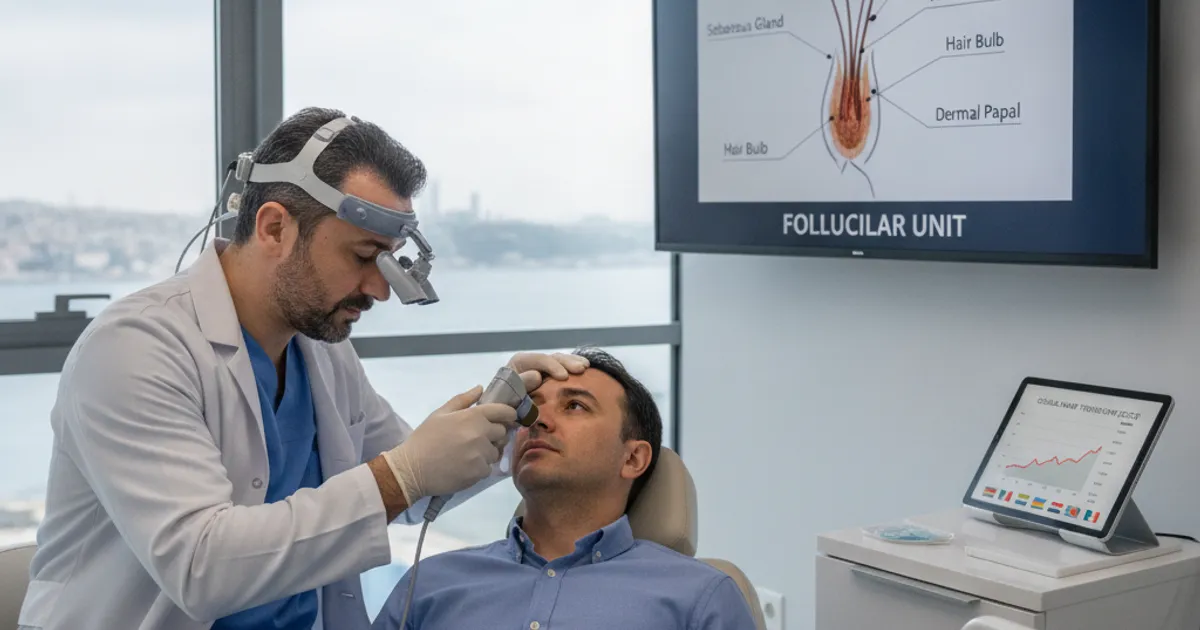
What Is a Follicular Unit? A Simple Definition
A follicular unit is the natural grouping of hair follicles as they grow in the skin. It's not a single hair — it's a small cluster of one to four (sometimes more) terminal hairs, along with the tiny muscles, sebaceous glands, and connective tissue that surround them. Surgeons extract these units intact during a hair transplant and move them to thinning or bald areas. Thinking in follicular units rather than individual hairs is the foundation of modern transplant planning, because it mirrors how hair actually grows.
The Anatomy of a Follicular Unit: What's Inside Each Graft
Each follicular unit is a tiny organ. When you look at a graft under magnification, you'll see a complex structure that must be handled gently to survive the transplant. Here's what's inside:
- Hair follicles — the actual shafts and roots, typically 1–4 terminal hairs per unit (this is a general-knowledge range, not a database figure).
- Sebaceous gland — produces oil that conditions the hair and skin.
- Arrector pili muscle — the tiny muscle that makes hair stand up (goosebumps).
- Blood vessels — small capillaries that supply nutrients; these must reconnect after grafting.
- Nerve endings — sensory nerves around the follicle.
- Connective tissue sheath — the collagen capsule that protects the unit during handling.
To visualize this, imagine a cross-section of the skin: the hair shafts emerge through the surface, the sebaceous gland sits attached to the upper part of the follicle, the arrector pili muscle stretches from the follicle to the epidermis, and a network of tiny blood vessels wraps around the lower portion. The entire structure is encased in a connective tissue sheath. Keeping this entire unit intact during surgery is what allows the hair to survive and grow in its new location.
Why Follicular Units Matter for Natural-Looking Results
Natural hair doesn't grow in evenly spaced single hairs — it grows in these small clusters. If a surgeon implants individual hairs too far apart or in perfect rows, the result looks pluggy or artificial. By keeping follicular units intact and placing them at natural angles and densities, the transplant blends with existing hair. This is why graft anatomy directly affects how natural the final result looks.
- Preserving the unit keeps the hair's natural grouping and growth direction.
- Intact sebaceous glands help the graft stay healthy and produce oil after healing.
- Keeping the connective tissue sheath reduces trauma during extraction and implantation.
- Matching the original density and angle patterns avoids a doll's-head look.
Follicular Unit Extraction (FUE) vs. Follicular Unit Transplantation (FUT): How Grafts Are Harvested
Both FUE and FUT move follicular units, but they harvest them differently. FUE extracts individual units directly from the donor area using a small punch tool, leaving tiny circular scars. FUT removes a strip of scalp from the donor area and dissects it into individual grafts under a microscope. Each method has trade-offs in terms of scarring, graft survival, and session size.
| Feature | FUE (Follicular Unit Extraction) | FUT (Follicular Unit Transplantation) |
|---|---|---|
| Harvest method | Individual punches around each unit | Strip excision, then microscopic dissection |
| Scarring | Small dot scars, often hidden by short hair | Linear scar across the donor area |
| Graft handling | More manipulation per graft | Less manipulation, often higher survival in large sessions |
| Typical session size | Often smaller to moderate | Can be larger in one session |
| Recovery | Faster surface healing | Longer healing at the strip site |
| Best for | Short hairstyles, smaller cases | Large cases, maximizing graft yield |
How Graft Anatomy Affects Planning: Density, Donor Supply, and Session Size
Because each follicular unit contains multiple hairs, surgeons plan in terms of units rather than hairs. A patient with a good donor supply might have thousands of units available, but the actual number of hairs is higher. Planning involves balancing the desired density against what the donor area can safely give without looking thin. Session size — how many grafts are moved in one sitting — depends on donor density, scalp elasticity, and the technique used.
- Donor density: how many follicular units per square centimeter are available in the safe donor zone.
- Scalp laxity: how much skin can be removed (FUT) or how easily units can be extracted (FUE).
- Graft quality: units with more hairs per graft give more coverage per graft.
- Recipient area size: larger bald areas need more grafts, which may require multiple sessions.
- Surgeon skill: careful handling preserves graft survival, affecting the final density.
Aftercare: Protecting Follicular Units in the First 10 Days
Newly transplanted follicular units are fragile for the first week to 10 days. They need to settle and reconnect with the blood supply. What you do during this window can affect how many grafts survive. Here's a practical aftercare sequence:
- Day 1–2: Sleep with your head elevated (about 45 degrees) to reduce swelling. Avoid touching or scratching the grafts. Use a neck pillow to keep pressure off the recipient area.
- Day 2–3: Gently wash the donor area with a mild shampoo as instructed by your clinic. Do not rub the recipient area; let water run over it. Pat dry with a clean towel.
- Day 3–5: Start gentle washing of the recipient area using a cup of lukewarm water and mild shampoo, letting the suds sit for a minute before rinsing. Do not use direct water pressure.
- Day 5–7: Continue gentle washing. Scabs may begin to loosen. Do not pick or scratch them. Avoid strenuous exercise, saunas, and swimming.
- Day 7–10: Most scabs should be gone or nearly gone. You can usually return to normal washing and light exercise, but still avoid direct sun exposure and harsh chemicals.
- Throughout: Keep the area moisturized if your clinic recommends it. Avoid alcohol and smoking, which can impair healing. Follow your clinic's specific instructions closely.
Long-Term Recovery and When to Expect Growth
After the initial healing phase, transplanted hairs typically shed within 2–4 weeks — this is normal and doesn't mean the grafts failed. The follicles rest, then begin producing new hair. Growth timelines vary by person, but here's a general picture:
- Weeks 1–2: Initial healing; scabs form and fall off. Transplanted hairs may start to shed.
- Weeks 2–4: Most transplanted hairs shed. The scalp may look thin or patchy — this is expected.
- Months 1–3: Follicles are in a resting phase. Little visible growth. Some patients notice tiny stubble.
- Months 3–4: New hair begins to emerge. Growth is fine and may be uneven.
- Months 4–6: Noticeable growth. Hair thickens and lengthens. About 60% of final result visible.
- Months 6–9: Significant improvement. Hair continues to thicken and mature.
- Months 9–12: Most patients see the bulk of their final result. Hair looks natural and blends with existing hair.
- Months 12–18: Final maturation. Some patients see continued thickening up to 18 months.
Questions to Ask Your Clinic About Graft Handling
Not all clinics handle grafts the same way. Since graft survival directly affects your result, it's worth asking specific questions during your consultation. Here are some to start with:
- How do you dissect and store grafts between extraction and implantation?
- What is your typical graft survival rate, and how do you measure it?
- How many follicular units per square centimeter do you plan for my recipient area?
- Do you use magnification and chilled holding solutions to protect grafts?
- Who handles the grafts — the surgeon or technicians — and what is their training?
- How do you prevent dehydration and trauma during the procedure?
FAQ: Follicular Units and Graft Anatomy
How many hairs are in a follicular unit?
Most follicular units contain 1 to 4 terminal hairs. The exact number varies by person and body area. Some units can have more, but 1–4 is typical for scalp hair. (This is a general-knowledge range, not a database figure.)
Does a graft always contain one follicular unit?
Not necessarily. A graft is the piece of tissue that's moved, and it can contain one or more follicular units. In FUT, grafts are often dissected to contain a single unit, while FUE grafts may contain one or more units depending on the punch size.
Can follicular units be split to increase graft numbers?
Some clinics may split units, but this can damage the follicles and reduce survival. It's generally better to keep units intact and plan the session based on the natural units available.
Why do some clinics talk about hairs instead of grafts?
Hairs and grafts are different measures. A graft can contain multiple hairs, so a clinic quoting 2,000 grafts might be moving 4,000 hairs. Always ask for clarification on whether the number refers to grafts or hairs.
More Guides
- How Long After Finasteride Before a Hair Transplant?
Planning a hair transplant while on finasteride? Learn the typical waiting period, why timing matters, and how to coordinate with your surgeon for best results.
- Early Symptoms of Hair Loss: What to Watch For First
Learn the early symptoms of hair loss, how to track them, and when to see a specialist. Plan ahead with treatment options and costs.
- Alopecia Treatment: A Comprehensive Guide
A practical guide to alopecia treatment: types, diagnosis, medications, surgery, recovery timeline, and aftercare. Plan your hair restoration with confidence.
- Hair Loss Causes: What You Can and Can't Control
Understand hair loss causes, what's controllable, and how to plan a transplant. Practical guide to factors, aftercare, and when to see a specialist.