
Why Is My Hairline Receding on Only One Side?
Asymmetric hair loss explained: causes, diagnosis, treatment options, and whether a hair transplant can fix a receding hairline on one side.
What Is Asymmetric Hair Loss?
Asymmetric hair loss means your hairline is receding unevenly — one side moves back faster or further than the other. It's more common than most people realise, and it doesn't automatically mean something serious is going on. Hair loss is rarely perfectly symmetrical, even in classic male pattern baldness. But when the difference between sides becomes obvious, it's worth understanding why. The medical term for one-sided hair loss is unilateral or asymmetric alopecia. It can affect just the hairline, or extend into the temples and mid-scalp. Some people notice it as a subtle unevenness in photos; others see a clear M-shape where one arm of the M is deeper than the other.
Common Causes of a Receding Hairline on One Side
The cause determines whether the loss is permanent, reversible, or stabilisable. Here are the main culprits behind one-sided hairline recession.
- Androgenetic alopecia (male or female pattern hair loss) — genetics don't always affect both sides equally. It's common for one temple to recede earlier or more aggressively than the other.
- Traction alopecia — repeated pulling from tight hairstyles, hats, or habitual hair twirling can damage follicles on one side more than the other.
- Alopecia areata — an autoimmune condition that can cause patchy loss, sometimes starting at one side of the hairline.
- Frontal fibrosing alopecia — a scarring form of hair loss that often begins asymmetrically along the hairline, more common in women.
- Trichotillomania — compulsive hair pulling, which is often focused on one side or one spot.
- Localised skin conditions — infections, cysts, or scarring on one part of the scalp can destroy follicles in that area only.
- Trauma or surgery — scars from accidents, burns, or previous procedures can create a one-sided bald patch.
- Thyroid issues, iron deficiency, or hormonal imbalances — these usually cause diffuse thinning, but can sometimes show up unevenly.
| Cause | Typical Pattern | Reversible? |
|---|---|---|
| Androgenetic alopecia | Gradual temple recession, often uneven | No, but treatable |
| Traction alopecia | Localised to pulled area | Yes, if caught early |
| Alopecia areata | Patchy, smooth bald spots | Often yes, can recur |
| Frontal fibrosing alopecia | Banded, scarring hairline loss | No, needs early treatment |
| Trichotillomania | Irregular patches, broken hairs | Yes, with behavioural therapy |
| Scarring from trauma | Permanent bald patch | No, transplant may help |
Symptoms and How Asymmetric Hair Loss Is Diagnosed
The first sign is usually visual — you notice one temple looks thinner in the mirror or in photos. But the symptoms go beyond appearance, and a proper diagnosis matters because treatment depends entirely on the cause.
- One side of the hairline sits noticeably further back than the other
- Thinning or miniaturised hairs along the affected side
- Scalp itching, redness, or tenderness in the area (suggests inflammation or scarring alopecia)
- Smooth, round bald patches (points to alopecia areata)
- Broken hairs of different lengths (suggests pulling or trichotillomania)
- Loss of eyebrow or body hair alongside scalp loss (can indicate frontal fibrosing alopecia)
A dermatologist or hair restoration specialist will typically start with a detailed history — when you first noticed it, whether it's progressing, family history, hairstyle habits, and any recent illnesses or stress. Then they'll examine the scalp, often using a dermatoscope to look at follicle health and hair shaft quality. Blood tests may be ordered to rule out thyroid problems, iron deficiency, or hormonal issues. In some cases, a small scalp biopsy is taken to confirm scarring alopecia or another inflammatory condition.
Treatment Options for One-Sided Hairline Recession
Treatment depends on the cause. For genetic hair loss, the goal is to slow or stop progression and possibly regrow some hair. For temporary causes like traction or nutritional deficiency, removing the trigger often allows recovery. Here are the main options.
- Finasteride — a prescription oral medication that blocks DHT, the hormone responsible for androgenetic alopecia. It can slow loss and sometimes regrow hair, but results vary and it's for men only.
- Minoxidil — a topical solution or foam applied to the scalp. It improves blood flow to follicles and can stimulate growth. Available over the counter for both men and women.
- PRP (platelet-rich plasma) — injections of your own concentrated platelets into the scalp to stimulate follicle activity. Often used alongside other treatments.
- Ketoconazole shampoo — an anti-fungal that may help with inflammation-related shedding.
- Corticosteroid injections or creams — used for alopecia areata to calm the immune response.
- Behavioural therapy — for trichotillomania, often combined with medication.
- Hair transplant surgery — for permanent, stable hair loss where follicles are gone.
| Treatment | Best For | Typical Duration | Prescription Needed? |
|---|---|---|---|
| Finasteride | Androgenetic alopecia (men) | Ongoing | Yes |
| Minoxidil | Androgenetic alopecia (men & women) | Ongoing | No (topical) |
| PRP | Early to moderate thinning | 3–6 sessions, then maintenance | No |
| Corticosteroids | Alopecia areata | Short-term | Yes |
| Hair transplant | Stable, permanent loss | One-off procedure | No |
Is a Hair Transplant Suitable for Asymmetric Hair Loss?
A hair transplant can work very well for one-sided hairline recession — but only if the underlying cause is stable and the donor area is healthy. The surgeon needs to know why the loss happened before planning anything. If the cause is active — like alopecia areata, an ongoing infection, or uncontrolled traction — transplanting into that area is risky. The condition could destroy the newly transplanted follicles too. For genetic hair loss that has stabilised, a transplant can restore symmetry by filling in the receded side. The surgeon will design a hairline that matches the other side as closely as possible, using follicular unit extraction (FUE) or follicular unit transplantation (FUT).
- Best candidates: stable androgenetic alopecia, scarring from trauma, or traction alopecia that's been resolved for at least a year
- Poor candidates: active alopecia areata, frontal fibrosing alopecia without treatment, or any ongoing inflammatory condition
- Donor hair quality matters — if the back and sides are thinning too, there may not be enough grafts for a good result
- Realistic expectations: a transplant won't stop future loss on the untreated side, so ongoing medication is often recommended
What to Expect During a Hair Transplant Consultation
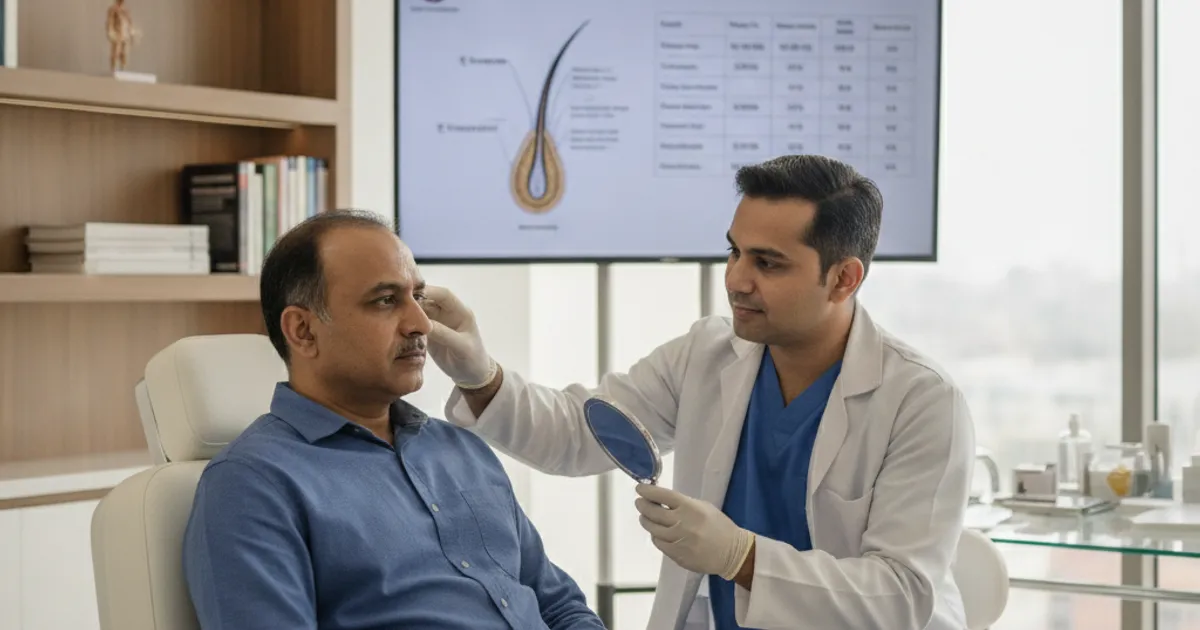
A good consultation is thorough. The surgeon should examine your scalp, review your medical history, and discuss your goals. They'll also assess whether you're a suitable candidate and explain the risks and limitations.
- Scalp examination with a dermatoscope to assess follicle health and donor density
- Discussion of your hair loss history — when it started, how fast it's progressed, any treatments tried
- Blood tests or biopsy if the cause isn't clear
- Hairline design — the surgeon will map out a plan that creates symmetry
- Graft estimate — how many follicular units are needed to fill the receded area
- Discussion of risks: infection, scarring, poor growth, and the need for ongoing medication
- Cost breakdown and what's included (consultation, surgery, follow-up)
- Realistic timeline — results take 12–18 months to fully mature
Frequently Asked Questions About One-Sided Hair Loss
Is one-sided hair loss always a sign of something serious?
No. Many cases are just an uneven expression of genetic hair loss. But if the loss is patchy, sudden, or accompanied by scalp symptoms, it's worth getting checked by a dermatologist.
Can a hair transplant fix a receding hairline on one side?
Yes, if the cause is stable and the donor area is healthy. The surgeon can transplant grafts to the receded side to create a more symmetrical hairline. But if the underlying condition is still active, surgery may not be appropriate.
Will medication like finasteride or minoxidil help one-sided loss?
If the cause is androgenetic alopecia, yes — these treatments can slow or stop progression and may regrow some hair. They work on the whole scalp, so they can help both sides, but the receded side may not fully catch up.
How do I know if my hair loss is genetic or something else?
A dermatologist can usually tell by examining your scalp and asking about your history. Genetic loss tends to be gradual and follows a pattern. Other causes may be patchy, sudden, or accompanied by inflammation or scaling.
Can stress cause hair loss on just one side?
Stress-related shedding (telogen effluvium) usually affects the whole scalp, not just one side. But stress can trigger or worsen conditions like alopecia areata, which can be one-sided.
Is PRP effective for asymmetric hair loss?
PRP can help stimulate follicles in early to moderate thinning, including one-sided loss. It's often used alongside minoxidil or finasteride. Results vary, and it's not a cure for scarring alopecias.
More Guides
- Hair Loss After Weight Loss Surgery: Timeline & Fixes
Hair loss after weight loss surgery is common. Learn the timeline, causes, treatments like minoxidil and PRP, and whether a hair transplant is right for you.
- Stress-Related Hair Loss: Recovery Time and Treatment
How long does stress-induced hair loss take to recover? Learn about telogen effluvium, diagnosis, treatments, and when a transplant may help.
- Female Hair Loss at the Back of the Head: Causes & Fixes
Learn why women lose hair at the back of the head, how it's diagnosed, and the best treatment options including minoxidil, PRP, and hair transplant suitability.
- Wellbutrin and Hair Loss: What You Need to Know
Learn how Wellbutrin may cause hair loss, how it's diagnosed, and what treatments—including hair transplant—can help you regrow hair.