
ARTAS Robotic Hair Transplant: How It Works, Cost & Results
ARTAS robotic hair transplant explained: how the system works, candidacy, recovery, results, cost by hair loss stage, and how it compares to manual FUE and FUT.
What Is ARTAS Robotic Hair Transplant?
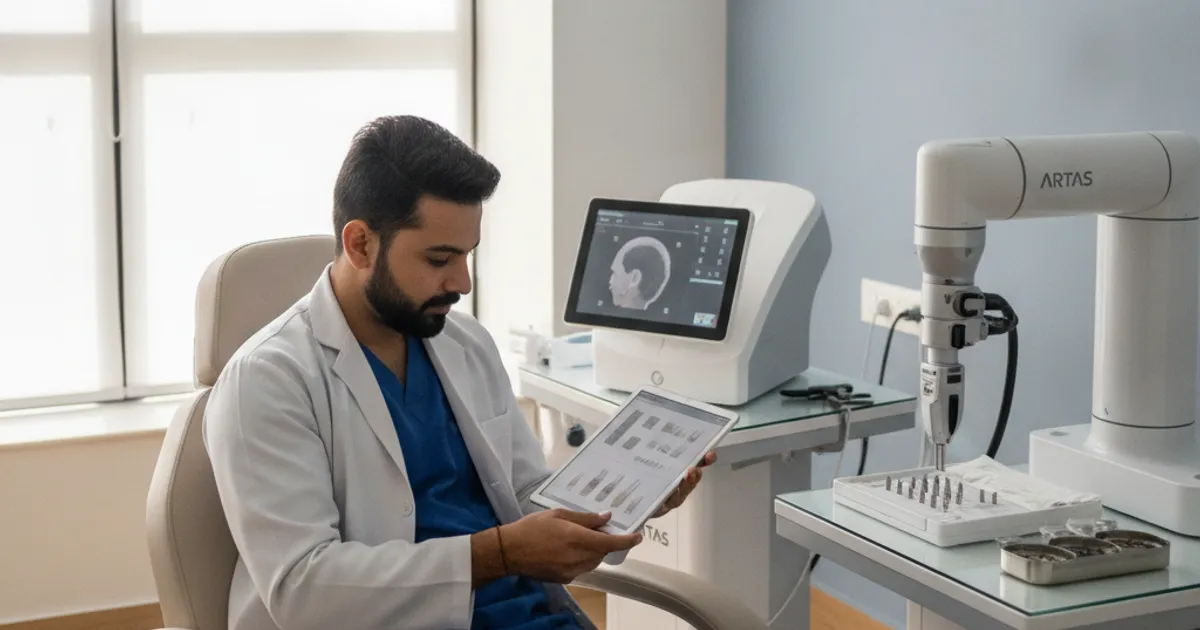
An ARTAS robotic hair transplant is a follicular unit extraction (FUE) procedure where a computer-assisted robotic arm helps harvest individual hair follicles from the back and sides of the scalp. Instead of a surgeon manually punching out each graft one at a time, the ARTAS system uses imaging software and a robotic arm to identify, align, and extract follicular units. The surgeon still designs the hairline, plans the graft distribution, and places the grafts — the robot handles part of the harvesting. It is one specific tool within the broader FUE category, not a different type of transplant altogether.
How the ARTAS System Works: Step-by-Step
The procedure follows a fairly consistent sequence. The exact details vary by clinic, but the broad flow looks like this:
ARTAS vs. Manual FUE vs. FUT: Key Differences
All three approaches move hair from a donor area to a thinning area. The differences come down to how the donor hair is removed, what that means for scarring, and how the procedure is priced and staffed.
| Feature | ARTAS Robotic FUE | Manual FUE | FUT (Strip) |
|---|---|---|---|
| Donor harvesting | Robotic arm with imaging guidance | Surgeon uses manual punch | Surgeon removes a strip of scalp |
| Scarring | Small dot scars | Small dot scars | Linear scar across donor area |
| Speed of harvesting | Often faster for large sessions | Depends on surgeon and team | Fast strip removal, slower dissection |
| Surgeon involvement | High — planning and placement | High throughout | High throughout |
| Typical graft range | Varies by patient and clinic | Varies widely | Often higher graft counts per session |
| Recovery | Similar to FUE | Similar to FUE | Longer donor healing, stitch removal |
| Best for | Patients wanting FUE with less manual harvesting fatigue | Patients wanting surgeon-led FUE | Patients needing very high graft counts or with limited FUE donor |
In practice, the choice between ARTAS and manual FUE is less about which is 'better' and more about which clinic and surgeon you trust. A skilled manual FUE surgeon can match or beat robotic results. A poorly planned robotic case will still look poorly planned.
Who Is a Good Candidate for ARTAS?
ARTAS is generally suited to the same patients who would be good candidates for FUE. The robot does not change your underlying candidacy — it changes how the donor hair is harvested.
- You have a stable or slowly progressing pattern of hair loss.
- Your donor area (back and sides) has enough density to supply grafts.
- You want to avoid a linear strip scar.
- You are comfortable with a shaved or short-trimmed donor area during recovery.
- You have realistic expectations about density and coverage.
- You are in good general health and can follow aftercare instructions.
Recovery Timeline and Aftercare
Recovery from ARTAS is broadly similar to manual FUE. The donor area heals as small puncture wounds rather than a strip, so there is no linear scar and no stitches. Most people can return to desk work within a few days, though visible redness and scabbing take longer to settle.
- Follow your clinic's washing and medication instructions exactly.
- Avoid strenuous exercise, saunas, and swimming for the period your surgeon advises.
- Protect the scalp from sun exposure for several months.
- Do not pick at scabs or scratch the recipient area.
- Attend follow-up appointments so the clinic can track healing and growth.
Results: What to Expect and When
Results from ARTAS depend on the same variables as any FUE procedure: graft survival, surgeon planning, hairline design, and how your body heals. The robot does not guarantee better density or a more natural look on its own.
- Transplanted hairs usually shed in the first few weeks before new growth starts.
- Early growth typically becomes visible within a few months.
- Noticeable improvement usually develops over the first several months.
- Final density and hairline maturity are typically assessed around a year after the procedure.
- Results are permanent for the transplanted follicles, but native hair can continue to thin over time.
Cost of ARTAS Hair Transplant
ARTAS pricing is usually quoted per graft or as a flat fee for a session, and it tends to sit at the higher end of the FUE range because of the equipment and staffing involved. Prices vary significantly by country, city, clinic reputation, and the number of grafts needed. The figures below are averaged case pricing by stage of hair loss — they are medians, not quotes, and your actual price will depend on your assessment.
- Per-graft pricing is common, but flat session fees also exist.
- Larger sessions cost more but the per-graft rate sometimes drops.
- Travel, accommodation, and aftercare products are often not included.
- Some clinics charge separately for PRP, medication, or follow-up visits.
- Currency and exchange rates can shift the real cost if you travel abroad.
What's Typically Included in an ARTAS Quote
Quotes vary a lot between clinics, so it's worth asking for a written breakdown before you commit. Here's a checklist of what to confirm:
Choosing a Clinic for ARTAS Hair Transplant
The robot is a tool, not a guarantee. The surgeon's experience, the clinic's aftercare, and how honestly they assess your candidacy matter more than the brand of machine in the room. When comparing clinics, look at surgeon credentials, how many ARTAS cases they perform per month, whether they show a range of results, and what happens if something goes wrong.
- Ask how many ARTAS procedures the surgeon performs per month.
- Request before-and-after photos of patients with similar hair loss to yours.
- Confirm who actually performs the harvesting and who places the grafts.
- Ask about the clinic's revision or touch-up policy.
- Check whether follow-up is included or charged separately.
- Read reviews across multiple platforms, not just the clinic's own site.
Frequently Asked Questions About ARTAS
Is an ARTAS hair transplant better than manual FUE?
Not automatically. ARTAS can speed up harvesting and reduce some of the physical fatigue that affects manual FUE over long sessions, but the final result still depends on the surgeon's planning, hairline design, and graft placement. A skilled manual FUE surgeon can produce results equal to or better than a robotic procedure. The right choice depends on the clinic and surgeon, not the machine alone.
Does ARTAS leave a scar?
ARTAS uses small punches to extract individual follicular units, so it leaves tiny dot scars rather than a linear strip scar. These are usually very small and can be hidden by short hair, but they are not invisible. Scarring varies between patients and depends on healing and how the donor area is managed.
How long does an ARTAS procedure take?
Procedure length depends on the number of grafts. Smaller sessions can take a few hours, while larger sessions can run most of a day. The robotic harvesting step is often faster than manual extraction, but the overall appointment length also includes anaesthesia, recipient site creation, and graft placement.
How much does an ARTAS hair transplant cost?
ARTAS pricing varies widely by country, city, clinic, and the number of grafts required. It generally sits at the higher end of the FUE price range because of the equipment and staffing involved. The most reliable way to get an accurate figure is to request a written quote from a clinic after an assessment. Averaged case pricing by stage of hair loss is a useful reference point, but it is not a substitute for a personal quote.
If you're weighing up ARTAS against manual FUE or FUT, the most useful next step is to compare clinics directly. Look at how they assess candidacy, what their quotes include, and what their patients say about aftercare. The technology is only one part of the equation.
More Guides
- Hair Transplant for Curly Hair: Graft and Technique Tips
A plain-English guide to hair transplants for curly hair: how surgeons adapt graft harvesting and placement, recovery, results, costs, and who it suits.
- How Long Does a Hair Transplant Last? Long-Term Durability
How long does a hair transplant last? We explain the procedure, recovery, durability, costs by stage of hair loss, and how it compares to alternatives.
- Hair Transplant Revision: When a Second Procedure Makes Sense
Considering a hair transplant revision? Learn how a second procedure works, who it suits, recovery, results, and costs. Expert explainer from Clinic Reccy.
- Hair Transplant for Norwood 6 and 7: What's Possible
A clear look at hair transplant options for Norwood 6 and 7 hair loss: graft limits, staging, recovery, costs, and realistic results.