
Hair Transplant Density: Realistic vs Overpromised
Hair transplant density explained: what's realistic by hair-loss stage, why clinics overpromise, and how to plan and protect your results.
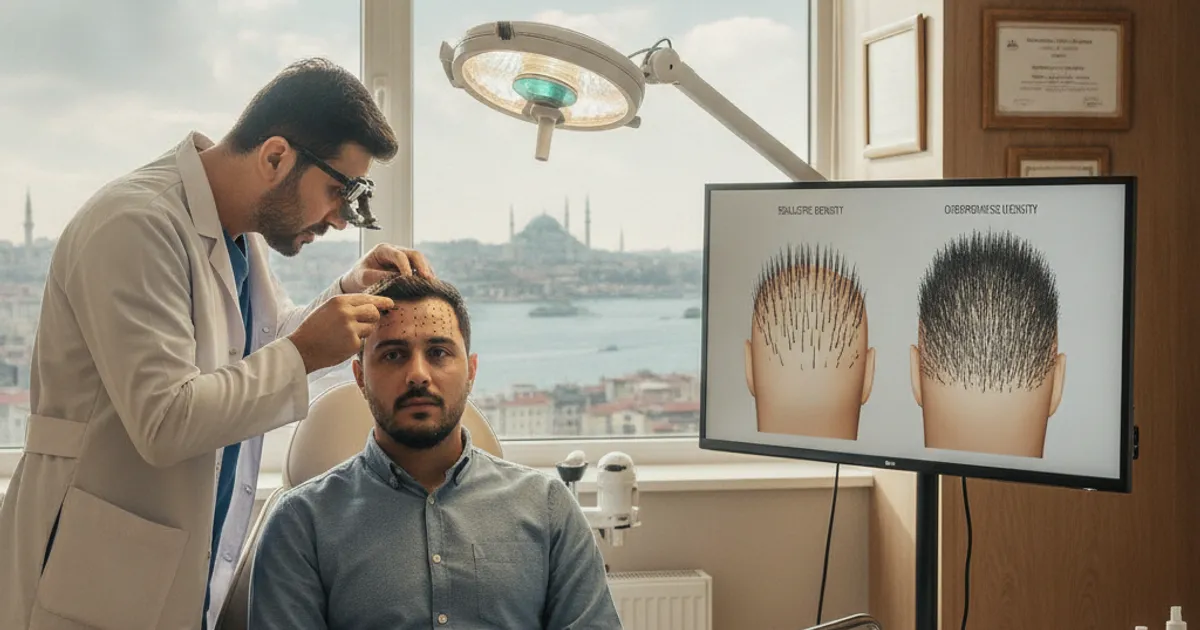
Hair Transplant Density: What's Realistic vs Overpromised?
If you're researching hair transplant density, you've probably seen clinics promise "maximum density" or "full head of hair" results. The reality is more nuanced. Density in a hair transplant is measured in grafts per square centimeter (grafts/cm²), and what you can realistically achieve depends on your donor hair supply, the size of the area being treated, and your stage of hair loss. Understanding these limits before you book a consultation will help you separate honest assessments from marketing hype.
What Density Actually Means in a Hair Transplant
Density refers to how many follicular unit grafts are placed per square centimeter of scalp. A graft contains one to four hairs, so density is often expressed in grafts/cm² or hairs/cm². Natural density on a healthy scalp varies widely, but transplanted density rarely matches your original hair. Most surgeons aim for a density that looks natural and provides adequate coverage, not a perfect replication of your teenage hairline.
Realistic Density by Hair-Loss Stage
Your stage of hair loss (often measured on the Norwood scale) heavily influences what density is achievable. Early-stage loss usually allows for higher density in smaller areas, while advanced loss requires spreading limited donor hair over a larger area, resulting in lower overall density. The ranges below are approximate, general guidance based on typical surgical planning—not exact guarantees for your case. Here's a general guide to what's realistic:
| Hair-Loss Stage | Typical Area Treated | Approximate Density Range (grafts/cm²) | What to Expect |
|---|---|---|---|
| Early (Norwood 2–3) | Hairline and temples | 30–40+ (approximate) | High density possible; natural-looking hairline |
| Moderate (Norwood 4–5) | Frontal and mid-scalp | 20–30 (approximate) | Good coverage; some thinning may remain |
| Advanced (Norwood 6–7) | Large areas including crown | 10–20 (approximate) | Lower density; focus on coverage and framing |
- Early loss: You have more donor hair relative to the treated area, so higher density is feasible.
- Moderate loss: Density is balanced against covering a larger area; expect moderate density.
- Advanced loss: Donor supply is limited; density is lower but can still improve appearance significantly.
Why Some Clinics Overpromise Density (and How to Spot It)
Some clinics overpromise density to attract patients. They may quote unrealistically high graft counts, show cherry-picked results, or use vague language like "full density." Overpromising often leads to disappointment and sometimes to poor surgical planning that wastes donor hair. Watch for these red flags:
- Guarantees of "full density" or "no visible thinning"—no surgeon can guarantee this.
- Quotes of extremely high graft numbers without assessing your donor supply.
- Pressure to book immediately or discounts that expire quickly.
- No discussion of donor limitations or the possibility of future loss.
The Density Trade-Off: Coverage vs. Thickness
Every graft you place in one area is a graft you can't use elsewhere. This creates a trade-off between coverage (spreading grafts over a larger area) and thickness (concentrating grafts for higher density in a smaller area). For advanced hair loss, surgeons often prioritize coverage to frame the face, accepting lower density. For early loss, they can focus on higher density in the hairline. Understanding this trade-off helps you set realistic expectations.
| Strategy | Best For | Advantages | Limitations |
|---|---|---|---|
| High density, smaller area | Early hair loss | Natural-looking hairline, thicker result | Leaves less donor hair for future loss |
| Moderate density, larger area | Moderate to advanced loss | Better overall coverage, conservative donor use | Lower density in any one spot |
Planning Your Procedure Around Realistic Density
Planning for realistic density starts with an honest assessment of your donor hair and goals. Follow these steps to ensure your expectations align with what's achievable:
- Get a donor hair assessment: ask the clinic to measure your donor density and calculate the total grafts available.
- Discuss your hair-loss stage and how it may progress; plan for future loss, not just today's.
- Ask for a written graft estimate and the expected density range for each treated area.
- Review before-and-after photos of patients with similar hair loss and donor characteristics.
- Clarify whether a second procedure may be needed and what that would cost.
- Set a budget that includes potential touch-ups, not just the initial surgery.
Aftercare That Protects Your Density Results
After surgery, proper aftercare is crucial for graft survival and optimal density. The first few weeks are especially important—grafts are fragile and can be dislodged. Follow your clinic's instructions closely, and keep these tips in mind:
- Avoid touching, scratching, or picking at the graft sites.
- Sleep with your head elevated for the first few nights to reduce swelling.
- Wash your hair gently as directed, using mild shampoo and cool water.
- Avoid strenuous exercise, saunas, and swimming for at least two weeks (general guidance—confirm timing with your surgeon).
- Protect your scalp from sun exposure with a hat or sunscreen (after healing).
- Attend all follow-up appointments so your surgeon can monitor healing.
Questions to Ask a Clinic About Density Claims
Before committing to a clinic, ask direct questions about their density claims. A reputable clinic will welcome your questions and provide clear, evidence-based answers. Use this checklist:
- What density (grafts/cm²) do you expect to achieve in each area?
- How did you calculate my donor supply and total available grafts?
- Can you show me results from patients with my hair-loss stage and donor characteristics?
- What happens if I'm not satisfied with the density—what's your touch-up policy?
- Do you recommend a second procedure, and when?
- Are there any guarantees, and what exactly do they cover?
FAQ: Hair Transplant Density
Can I get back my original hair density with a transplant?
No. Transplanted density rarely matches your original density. Most surgeons aim for a natural-looking result that provides good coverage, but it won't be as dense as your teenage hair.
How many grafts per square centimeter is considered high density?
As a rough guide, 30–40 grafts/cm² in the hairline is often considered high density, while 20–30 grafts/cm² is common in other areas. Figures above 40 are unusual and may not be necessary for a natural look. These are approximate ranges—your surgeon will advise based on your case.
Will my density increase after the transplant?
The transplanted density is set at the time of surgery. However, as the grafts grow in over roughly 6–12 months (general guidance; individual timelines vary), the visual density improves. Some clinics offer PRP or other treatments to support growth, but these don't create new grafts.
What if I'm not happy with the density?
If density falls short, a second procedure can add more grafts if you have sufficient donor hair. Discuss touch-up policies with your clinic before surgery.
How Density Is Actually Measured and Planned
Grafts per square centimeter is the headline number, but it tells you less than most patients assume. A graft is a naturally occurring cluster of one to four hairs, so two clinics quoting the same graft count can deliver very different hair counts depending on the mix of single- and multi-hair grafts in your donor area. A plan built mostly from single-hair grafts will look thinner than the same graft number built from denser clusters. This is one reason comparing graft counts between clinics is misleading unless you also know the hair-per-graft ratio.
Surgeons typically plan density in zones rather than a single number across the whole scalp. The hairline usually receives the highest density because it is the most visible and is viewed front-on. Density is then stepped down gradually as you move back through the mid-scalp and crown. This graduated approach mimics how natural hair thins toward the crown and avoids an abrupt, plug-like edge where dense transplanted hair meets thinning native hair.
Two other measurements matter as much as density: the total number of grafts your donor area can safely supply over your lifetime, and the surface area being treated. Density is simply grafts divided by area, so the same donor supply spread over a larger bald area produces a lower number. A surgeon who measures your donor density, calculates a safe lifetime harvest, and then divides it across your treatment zones is doing the planning that separates a durable result from a short-lived one.
What Density Looks Like at Each Stage of Healing
Many patients judge density too early and panic unnecessarily. Transplanted hair goes through a predictable cycle, and understanding the timeline prevents you from misreading normal stages as failure.
- Days to weeks after surgery: tiny scabs form around each graft. The density you see now is not your final result and some crusting is normal.
- Weeks two to eight: much of the transplanted hair sheds. This is expected and does not mean the grafts failed; the follicles remain beneath the skin and enter a resting phase.
- Months three to five: new growth begins. Early growth often looks patchy and uneven, which is normal.
- Months six to nine: density becomes visibly fuller as more grafts emerge and thicken. This is when most patients first see meaningful change.
- Months twelve to eighteen: the result matures. Grafts thicken, texture settles, and the final density is usually apparent. Some patients notice continued subtle improvement beyond this window.
Because density matures slowly, judging a clinic's work or your own result before roughly a year is unreliable. This is also why reputable clinics show results at twelve months or later rather than at a few weeks, when swelling and styling can flatter an unfinished result.
Factors That Affect Your Density Beyond Graft Count
Graft numbers get the attention, but several other variables shape how dense your result actually looks. Two patients with identical graft counts can end up with noticeably different visual density.
- Hair caliber: thicker individual hairs cover more scalp and read as denser, so coarse hair creates more visual coverage per graft than fine hair.
- Hair color versus scalp color: high contrast between dark hair and light scalp makes thinning more visible, so those patients may need more density to achieve the same look.
- Curl and wave: wavy or curly hair tends to provide more coverage and hide gaps better than very straight hair.
- Donor hair quality and density: a rich, dense donor area supports more grafts; a thin or miniaturizing donor area limits what is safe to harvest.
- Scalp laxity and healing: how your scalp heals and scars affects how closely grafts can be packed without compromising blood supply.
- Graft handling and placement technique: how carefully grafts are dissected, stored, and placed influences survival, and survival directly affects final density.
This is why copying a friend's graft count or a stranger's result is a poor strategy. Your hair characteristics and donor quality are unique, and a good consultation accounts for them rather than quoting a number pulled from someone else's case.
It also explains why chasing maximum density can backfire. Packing grafts too tightly can reduce blood supply to each graft and lower survival, so more grafts placed does not always mean more hair that grows. Experienced surgeons balance density against graft survival rather than maximizing the number on paper.
Will my transplanted density match my original hair?
Rarely. Transplanted density generally looks natural and provides solid coverage but seldom replicates the density you had in your teens or twenties. Most surgeons aim for a result that frames the face and looks appropriate for your age rather than a perfect restoration.
Can I get higher density with a second procedure?
Sometimes, if your donor area can safely supply more grafts and your first result has matured. A second session can add density to specific zones, but it depends on remaining donor supply and how your scalp healed. Discuss this during planning rather than assuming it will be available.
Does a higher graft count always mean a denser result?
No. Final density depends on graft survival, the hair-per-graft ratio, hair caliber, and how grafts are distributed across zones. A high count with poor survival or a plan skewed toward single-hair grafts can look thinner than a lower, well-planned count.
Why do some clinics quote much higher graft numbers than others?
Quotes can differ because of how donor supply is assessed, whether the number reflects a safe lifetime harvest, and sometimes because of marketing pressure. Ask how the number was calculated and whether it accounts for future hair loss before treating a high quote as better.
How soon can I judge my density?
Wait until at least twelve months, when the result has matured. Earlier stages include shedding and uneven early growth that are normal and not a reliable indication of your final density.
More Guides
- How Long After Finasteride Before a Hair Transplant?
Planning a hair transplant while on finasteride? Learn the typical waiting period, why timing matters, and how to coordinate with your surgeon for best results.
- Early Symptoms of Hair Loss: What to Watch For First
Learn the early symptoms of hair loss, how to track them, and when to see a specialist. Plan ahead with treatment options and costs.
- Alopecia Treatment: A Comprehensive Guide
A practical guide to alopecia treatment: types, diagnosis, medications, surgery, recovery timeline, and aftercare. Plan your hair restoration with confidence.
- Hair Loss Causes: What You Can and Can't Control
Understand hair loss causes, what's controllable, and how to plan a transplant. Practical guide to factors, aftercare, and when to see a specialist.