
When Do Scabs Fall Off After a Hair Transplant?
Scabs after a hair transplant usually fall off between day 7 and day 14. Here's the day-by-day timeline, how to wash safely, and when to worry.
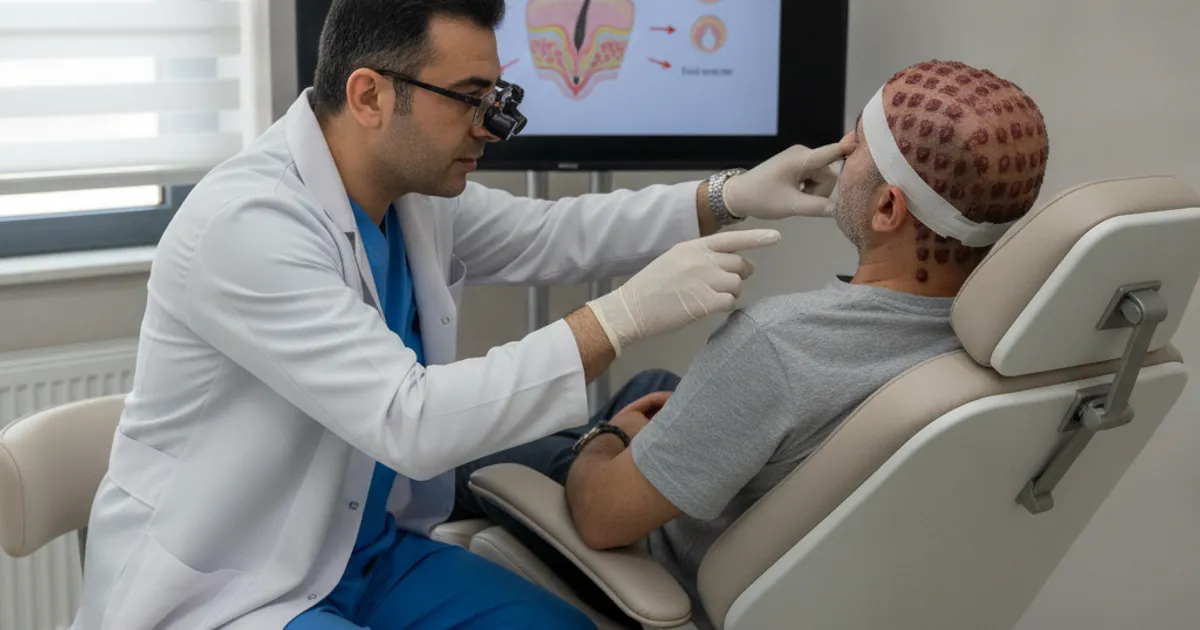
When do scabs fall off after a hair transplant? Most scabs fall off between day 7 and day 14 after your procedure, with the bulk shedding around day 10. By the end of week two, the recipient area is usually scab-free and looks pink rather than crusted.
The typical scab healing timeline: day by day
Every scalp heals at its own pace, but the sequence is fairly predictable. Here's what most patients see in the first two weeks.
| Day | What's happening | What you'll see |
|---|---|---|
| Day 1–2 | Tiny wounds close over each graft | Small red dots and fresh crusts form |
| Day 3–5 | Crusts harden and dry out | Visible scabs across the recipient area |
| Day 6–8 | Scabs start to loosen at the edges | Flaking, itching, first scabs lift off |
| Day 9–12 | Main shedding phase | Most scabs come away in the shower |
| Day 13–14 | Final crusts clear | Pink, slightly tender scalp with no scabs |
- FUE patients often finish shedding scabs a day or two earlier than FUT patients.
- Scabs on the donor strip (FUT) can take a little longer because the wound is a line, not dots.
- If you're still heavily crusted after three weeks, mention it to your clinic.
What affects when scabs fall off?
Two people can have the same procedure on the same day and shed scabs a week apart. The usual reasons:
- Technique: FUE leaves smaller puncture wounds than FUT's strip incision.
- Graft count: more grafts means more scabs.
- Skin type: oily skin tends to heal and shed faster than very dry skin.
- Aftercare: following your clinic's wash routine speeds things up; skipping it slows them down.
- Smoking and poor circulation: both delay wound healing.
- Medications: blood thinners and some steroids can affect crust formation.
FUE vs FUT: does the technique change scab shedding?
Yes, slightly. FUE creates thousands of tiny circular wounds, so the scabs are small and flake off quickly. FUT removes a strip of scalp, so the donor area has a single linear incision that crusts differently from the recipient dots.
FUE
Cost varies by clinic and graft count
- ✓ Small dot scabs across the recipient area
- ✓ Most scabs gone by day 10–12
- ✓ Donor area heals with tiny pinpoint marks
- ✓ Easier to wash gently without disturbing a line
FUT
Cost varies by clinic and graft count
- ✓ Dot scabs in the recipient area plus a linear donor scar
- ✓ Recipient scabs gone by day 12–14
- ✓ Donor line crusts for 2–3 weeks
- ✓ Stitches or staples removed around day 10–14
How to wash your hair and remove scabs safely
Your clinic will give you a specific wash protocol, but the general approach is the same everywhere: be gentle, use lukewarm water, and let the water do the work. Never scrub.
- Days 1–3: don't touch the recipient area. Some clinics allow a light cup-rinse with saline or prescribed lotion.
- Day 4 onward: start washing with a mild, fragrance-free shampoo using your fingertips — no nails, no circular rubbing.
- Day 7–10: most clinics let you increase pressure slightly and use a soft sponge or the flat of your fingers.
- Day 10–14: scabs should be mostly gone. If any remain, keep washing gently — don't pick.
- Pat dry with a clean towel. Don't rub.
What NOT to do while scabs are healing
Most problems during the scab phase come from doing too much, not too little. Avoid these:
- Don't pick, scratch, or peel scabs — even if they itch.
- Don't use harsh shampoos, dandruff treatments, or scalp scrubs.
- Don't swim in pools, lakes, or the ocean until your clinic clears you.
- Don't wear tight hats or helmets that rub the recipient area.
- Don't dye, bleach, or chemically treat your hair for at least 4 weeks.
- Don't expose the scalp to direct sun without a loose hat or SPF.
- Don't smoke or drink heavily — both slow healing.
When to worry: signs of infection or poor healing
Mild redness, itching, and tenderness are normal. These are not:
- Spreading redness or warmth around the grafts
- Pus, yellow discharge, or a bad smell
- Fever
- Severe pain that gets worse instead of better
- Scabs still firmly attached after 3 weeks
- Bleeding from the recipient area after day 3
What happens after scabs fall off?
Once the scabs are gone, the scalp looks pink and a bit shiny. That's normal. Here's what to expect next:
- Weeks 2–4: transplanted hairs shed — this is shock loss, not failure.
- Months 2–3: the scalp looks mostly bare; new growth is starting under the skin.
- Months 4–6: visible new growth appears.
- Months 9–12: final density and texture settle in.
- Pinkness fades over 4–8 weeks for most people.
Related guides
Frequently asked questions
Can I speed up scab shedding?
Only by following your clinic's wash routine. There's no cream or supplement that safely speeds it up. Picking scabs off early risks pulling grafts with them.
What if my scabs fall off too early?
A few scabs coming off early is usually fine. If large patches come off in the first 3–4 days, call your clinic — they may want to check the grafts.
Do scabs falling off mean the hair is falling out?
No. The hair shaft often sheds with the scab, but the follicle stays in place. New growth starts from that follicle in a few months.
How long until I can stop worrying about scabs?
Once the recipient area is scab-free, usually by day 14, you can wash normally. Just avoid harsh products and sun for a few more weeks.
More Guides
- Hair Transplant and Blood Thinners: Safety and Timing
Can you have a hair transplant on blood thinners? Learn why they matter, which ones raise bleeding risk, how long to stop before surgery, and when to restart.
- Finasteride and PSA Testing: What You Need to Know
Finasteride lowers PSA levels, so your test results need careful interpretation. Learn how finasteride affects PSA, the adjustment factor, and what to tell your
- Can You Cure a Receding Hairline? What's Realistic
Can you cure a receding hairline? Learn what's realistic with medications, transplants, and lifestyle changes, plus expected results and costs.
- Minoxidil Hair Thinning Before Growth: Is It Normal?
Is minoxidil hair thinning before growth normal? Yes, it's a common sign the treatment is working. Learn why it happens, how long it lasts, and when to worry.