
DHT and Hair Loss: How Dihydrotestosterone Shrinks Follicles
DHT shrinks hair follicles in genetically prone people. Learn causes, symptoms, diagnosis, and treatments like finasteride, minoxidil, and transplants.
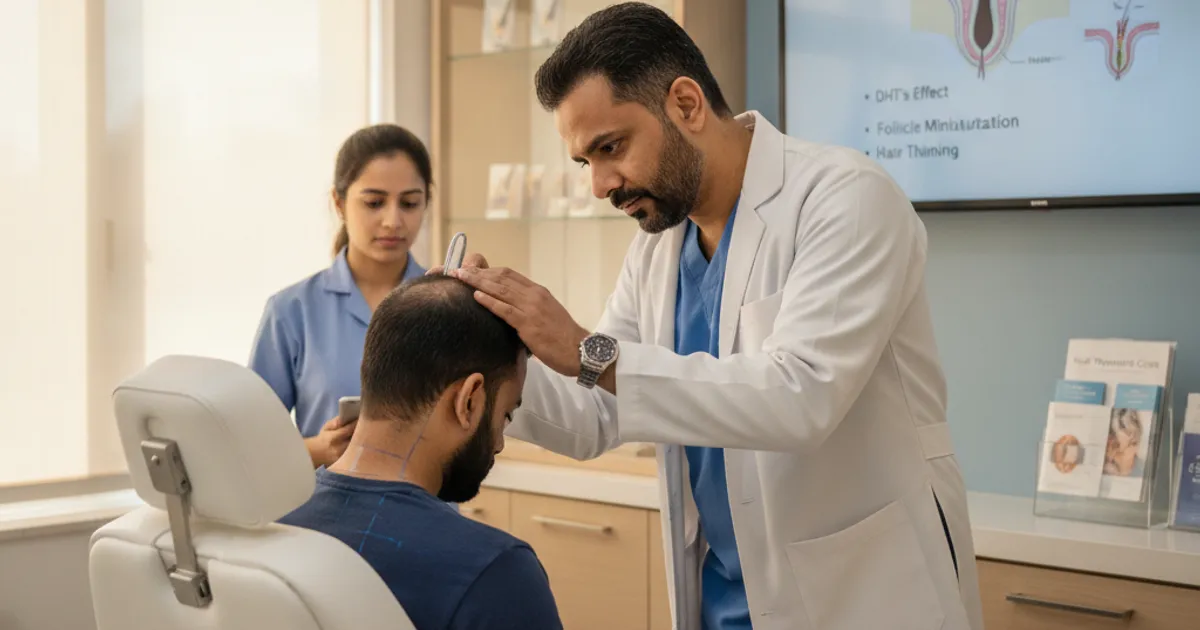
What Is DHT and Why Does It Matter for Hair Loss?
DHT stands for dihydrotestosterone. It's an androgen — a male sex hormone — that your body makes from testosterone via an enzyme called 5-alpha-reductase. DHT plays important roles in male development, but it also has a well-known dark side: in people with a genetic predisposition, DHT binds to receptors in hair follicles and gradually shrinks them. This process is called miniaturization, and it's the primary driver of androgenetic alopecia — commonly known as male pattern baldness and female pattern hair loss. DHT doesn't cause hair loss in everyone. It only becomes a problem when follicles are genetically sensitive to it. That sensitivity is inherited, which is why pattern baldness tends to run in families. If you're losing hair and wondering whether DHT is involved, the short answer is: if your thinning follows a typical pattern (receding temples, thinning crown, widening part), DHT is very likely playing a central role.
How DHT Shrinks Hair Follicles: The Miniaturization Process
The mechanism behind DHT-related hair loss is a slow, progressive process called follicular miniaturization. It doesn't happen overnight. Each hair follicle goes through growth cycles (anagen, catagen, telogen), and DHT gradually shortens the growth phase while making the hair shaft thinner and shorter with each cycle. Over time, a thick terminal hair becomes a fine, wispy vellus hair — and eventually the follicle may stop producing visible hair altogether. The key point is that the follicle doesn't disappear immediately. It shrinks. That's why early intervention matters: miniaturized follicles can often be revived with treatment, but completely scarred or dormant follicles cannot.
- DHT binds to androgen receptors in genetically susceptible hair follicles.
- The binding triggers a signaling cascade that shortens the anagen (growth) phase.
- Each subsequent hair cycle produces a thinner, shorter, less pigmented hair.
- Over multiple cycles, terminal hairs become vellus-like (fine and barely visible).
- Eventually, the follicle may become dormant and stop producing hair entirely.
- Follicles in the safe zone (back and sides of the scalp) are typically resistant to DHT.
Causes and Risk Factors of DHT-Related Hair Loss
DHT-related hair loss is fundamentally a genetic condition. You inherit a sensitivity to DHT from one or both parents — not just your mother's father, as the old myth suggests. Both maternal and paternal genetics contribute. Beyond genetics, several factors can influence how quickly DHT-related thinning progresses or how severe it becomes. Hormonal changes, certain medications, and lifestyle factors can all play a role, though genetics remain the dominant driver.
- Genetics: inherited sensitivity of hair follicles to DHT (polygenic — multiple genes involved).
- Hormonal activity: natural DHT levels and androgen receptor sensitivity vary between individuals.
- Age: DHT-related hair loss typically begins after puberty and progresses with age.
- Family history: a strong history of pattern baldness on either side increases risk.
- Certain medical conditions: prostate conditions and hormonal disorders can affect DHT levels.
- Medications: some drugs can influence androgen levels or hair cycling (always consult a doctor).
- Stress and lifestyle: severe stress can accelerate shedding, though it's not the root cause of DHT sensitivity.
Symptoms: Recognizing DHT-Driven Hair Loss
DHT-related hair loss has a characteristic pattern that distinguishes it from other types of shedding (like telogen effluvium or alopecia areata). The hallmark is gradual, patterned thinning — not sudden widespread shedding. Men typically notice a receding hairline, thinning at the temples, and a thinning crown. Women usually experience diffuse thinning along the part line and over the top of the scalp, often with a widening part. Recognizing these patterns early gives you the best chance of effective treatment.
- Receding hairline at the temples (M-shaped pattern in men).
- Thinning at the crown or vertex of the scalp.
- Gradual widening of the part line (common in women).
- Hairs becoming finer, shorter, and lighter in color in affected areas.
- Increased shedding during washing or brushing (though not always obvious).
- A noticeable difference in hair density compared to the back and sides of the scalp.
| Pattern | Typical Area | Who It Affects | Key Sign |
|---|---|---|---|
| Receding hairline | Temples and frontal hairline | Mostly men | M-shaped recession |
| Crown thinning | Vertex (top back of scalp) | Men and women | Visible scalp through hair |
| Diffuse thinning | Top of scalp, widening part | Mostly women | Part line widens over time |
| Advanced pattern baldness | Front, mid-scalp, and crown | Men | Large areas of bare scalp |
How DHT-Related Hair Loss Is Diagnosed
Diagnosing DHT-related hair loss is usually straightforward for a dermatologist or hair restoration specialist. There's no single blood test that confirms 'DHT hair loss' — DHT levels in the blood don't reliably correlate with follicle sensitivity. Instead, diagnosis is based on clinical history, visual assessment of the pattern, and sometimes additional tools. A proper diagnosis rules out other causes of hair loss (thyroid issues, iron deficiency, autoimmune conditions, telogen effluvium) before confirming androgenetic alopecia.
- Medical and family history: pattern of loss, duration, family history of baldness.
- Visual scalp examination: assessing the pattern and distribution of thinning.
- Hair pull test: checking for active shedding versus gradual miniaturization.
- Dermoscopy (trichoscopy): magnified view of follicles to assess miniaturization.
- Blood tests: to rule out thyroid dysfunction, iron deficiency, and other causes.
- Photographic documentation: tracking progression over time.
Treatment Options for DHT-Related Hair Loss
Treatment for DHT-related hair loss falls into two broad categories: medications that address the hormonal mechanism, and procedures that restore hair physically. The most effective approach often combines both. It's important to understand that medications can slow or partially reverse miniaturization, but they can't bring back hair from completely dormant follicles. That's where hair transplantation comes in. Below are the main treatment options, including real medications and therapies.
- Finasteride: an oral prescription drug that inhibits 5-alpha-reductase type II, reducing DHT levels in the scalp. Clinically proven to slow hair loss and promote regrowth in many men.
- Minoxidil: a topical (or oral, off-label) treatment that prolongs the growth phase and improves blood flow to follicles. Available over the counter.
- PRP (platelet-rich plasma): injections of concentrated platelets from your own blood to stimulate follicle activity. Evidence is mixed but growing.
- Ketoconazole shampoo: an antifungal shampoo with mild anti-androgen effects, sometimes used as an adjunct.
- Low-level laser therapy (LLLT): devices that may stimulate follicles, though evidence is moderate.
- Hair transplant surgery: relocates DHT-resistant follicles from the back and sides of the scalp to thinning areas.
| Treatment | Type | How It Works | Best For |
|---|---|---|---|
| Finasteride | Oral prescription | Reduces DHT production | Slowing loss and regrowth in men |
| Minoxidil | Topical or oral | Prolongs growth phase | Early to moderate thinning |
| PRP therapy | Injection | Growth factor stimulation | Adjunct to other treatments |
| Ketoconazole shampoo | Topical | Mild anti-androgen effect | Adjunct therapy |
| Low-level laser therapy | Device | Stimulates follicle activity | Early thinning, adjunct |
| Hair transplant | Surgical | Relocates DHT-resistant follicles | Moderate to advanced loss with donor hair |
Is a Hair Transplant Suitable for DHT-Related Hair Loss?
A hair transplant can be an excellent option for DHT-related hair loss — but it's not right for everyone, and timing matters. The procedure works by moving DHT-resistant follicles from the back and sides of the scalp (the 'safe zone') to thinning or bald areas. Because those transplanted follicles retain their resistance to DHT, they typically continue to grow for decades. However, a transplant doesn't stop the progression of DHT-related loss in the native, non-transplanted hair. Without medication, you may continue to lose hair around the transplanted areas, leading to an unnatural result over time. Most surgeons recommend combining a transplant with finasteride or minoxidil to protect the existing hair.
- Good candidates: stable or slowly progressing hair loss, sufficient donor hair density, realistic expectations.
- Less suitable: very advanced baldness with limited donor supply, active widespread shedding, unrealistic expectations.
- Timing: many surgeons prefer to operate when loss has stabilized or is well-controlled with medication.
- Medication after transplant: finasteride and/or minoxidil are often recommended to protect native hair.
- Donor area: the back and sides of the scalp are typically DHT-resistant and provide the transplant grafts.
- Realistic goals: transplants restore density and frame the face; they don't create a full head of hair from nothing.
FAQ: DHT and Hair Loss
Here are answers to some of the most common questions about DHT and hair loss.
Does DHT cause hair loss in everyone?
No. DHT only causes hair loss in people whose hair follicles are genetically sensitive to it. DHT is present in everyone, but only those with inherited follicle sensitivity experience miniaturization and pattern baldness.
Can I lower DHT naturally to stop hair loss?
Some natural approaches (like certain supplements or lifestyle changes) may have mild effects on DHT, but none are clinically proven to be as effective as finasteride. If you're serious about treating DHT-related hair loss, talk to a doctor about proven options.
Is finasteride safe for long-term use?
Finasteride is generally well-tolerated, but it can cause side effects in some men, including sexual dysfunction. Most side effects resolve after stopping the medication. Discuss risks and benefits with your doctor.
Can women have DHT-related hair loss?
Yes. Women can also experience androgenetic alopecia driven by DHT sensitivity, though the pattern is usually diffuse thinning rather than receding hairlines. Treatment options differ for women, especially regarding finasteride.
Will a hair transplant cure DHT-related hair loss?
No. A transplant relocates DHT-resistant follicles, but it doesn't stop DHT from affecting your native hair. Most surgeons recommend medication alongside surgery to protect existing hair.
How do I know if my hair loss is DHT-related?
The pattern is the biggest clue: receding temples, crown thinning, or a widening part. A dermatologist or hair restoration specialist can confirm the diagnosis and rule out other causes.
More Guides
- Hair Loss After Weight Loss Surgery: Timeline & Fixes
Hair loss after weight loss surgery is common. Learn the timeline, causes, treatments like minoxidil and PRP, and whether a hair transplant is right for you.
- Stress-Related Hair Loss: Recovery Time and Treatment
How long does stress-induced hair loss take to recover? Learn about telogen effluvium, diagnosis, treatments, and when a transplant may help.
- Female Hair Loss at the Back of the Head: Causes & Fixes
Learn why women lose hair at the back of the head, how it's diagnosed, and the best treatment options including minoxidil, PRP, and hair transplant suitability.
- Wellbutrin and Hair Loss: What You Need to Know
Learn how Wellbutrin may cause hair loss, how it's diagnosed, and what treatments—including hair transplant—can help you regrow hair.