
Robotic vs Manual FUE Hair Transplant: Which Is Better?
Robotic vs manual FUE hair transplant compared: cost, recovery, results, and suitability. Find out which technique suits your hair loss stage best.
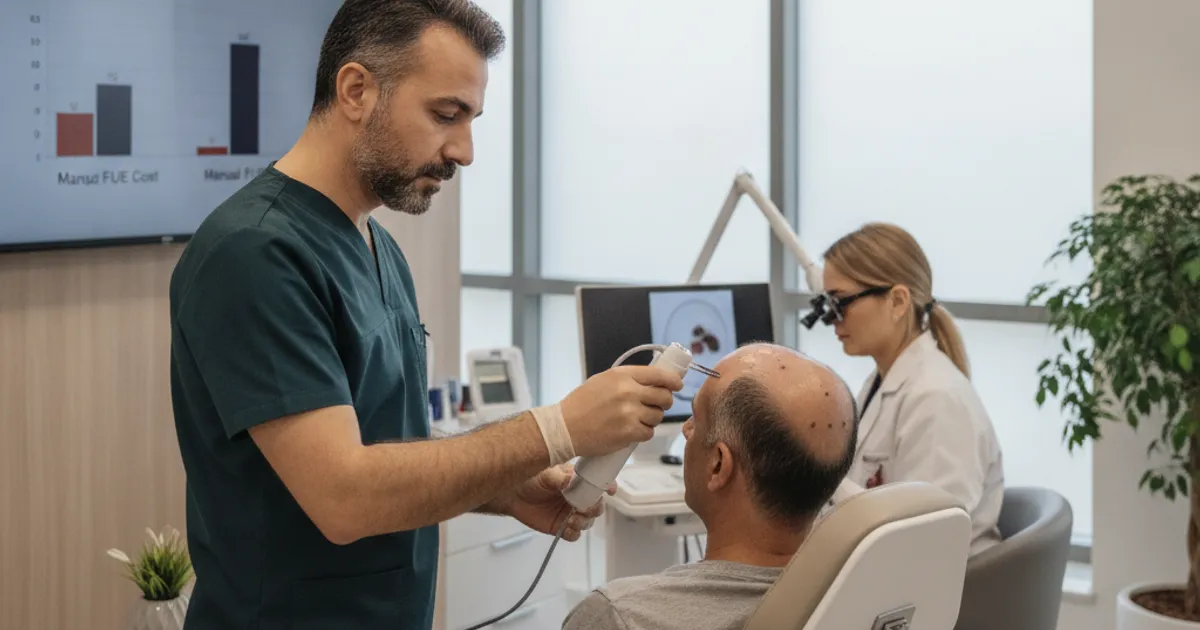
Robotic hair transplant is not automatically better than manual FUE. The right choice depends on your hair loss pattern, budget, and how much control you want over the procedure. For most people, manual FUE remains the more flexible and affordable option, while robotic systems offer consistency and speed in the right hands. This guide breaks down the real differences, including costs by stage of hair loss, recovery timelines, and who each technique suits best.
What Is Manual FUE?
Manual follicular unit extraction (FUE) is a hair transplant technique where a surgeon uses handheld punches to remove individual hair follicles from the donor area, usually the back and sides of the scalp. The extracted grafts are then implanted into thinning or bald areas. Manual FUE relies entirely on the surgeon's skill, experience, and judgment. It allows for real-time adjustments during the procedure, which can be important if your scalp has unusual characteristics or if the surgeon needs to change the extraction pattern mid-session. Manual FUE is the most widely available type of hair transplant worldwide and is performed in clinics of all sizes.
What Is Robotic Hair Transplant?
Robotic hair transplant uses a computer-assisted system to help extract follicles. The most well-known example is the ARTAS system. The robot uses imaging to map the donor area and then extracts grafts with a mechanical arm. The surgeon still oversees the procedure and handles implantation, but the extraction step is automated. Robotic systems are designed to improve consistency, reduce fatigue for the surgeon, and potentially speed up the extraction phase. However, they are not available everywhere, and the technology adds significant cost to the procedure.
Key Differences: Robotic vs Manual FUE
| Factor | Manual FUE | Robotic Hair Transplant |
|---|---|---|
| Extraction method | Handheld punch, surgeon-controlled | Computer-assisted robotic arm |
| Surgeon involvement | High — every step manual | Moderate — robot extracts, surgeon implants |
| Procedure time | Longer, depends on surgeon speed | Potentially faster extraction phase |
| Flexibility | High — real-time adjustments possible | Lower — follows pre-set algorithm |
| Availability | Widely available | Limited to clinics with robotic systems |
| Learning curve | Depends on surgeon experience | Requires training on the specific system |
| Graft handling | Surgeon-controlled | Mechanical, may reduce human error |
| Best for | Most hair loss patterns, complex cases | Straightforward cases with good donor density |
The biggest practical difference is control. Manual FUE gives the surgeon full control at every moment. Robotic systems trade some of that flexibility for consistency and speed. If your donor area is uniform and your hair loss pattern is straightforward, a robot can do a good job. If your case is more complex — previous transplants, scarring, unusual hair angles — a skilled manual surgeon often has the edge.
Cost Comparison: Robotic vs Manual FUE
Robotic hair transplant costs more than manual FUE in almost every market. The technology itself is expensive, and clinics pass that cost on to patients. Manual FUE is more affordable because it relies on the surgeon's hands rather than a machine. That said, the gap narrows when you compare top-tier manual surgeons to robotic clinics — the most experienced manual surgeons charge premium rates that can approach robotic pricing. Below are average case prices by stage of hair loss. These are general ranges, not quotes from specific clinics.
For a more detailed breakdown, the table below shows typical price ranges for each stage, along with the graft counts you can expect. Robotic procedures generally add $2,000–$5,000 to the total compared to manual FUE for the same stage.
| Stage of Hair Loss | Typical Graft Count | Manual FUE (USD) | Robotic FUE (USD) |
|---|---|---|---|
| Early (minimal thinning) | 1,000–1,500 | $4,000–$6,000 | $6,000–$9,000 |
| Moderate (visible thinning) | 1,500–2,500 | $6,000–$10,000 | $8,000–$14,000 |
| Advanced (extensive baldness) | 2,500–4,000 | $10,000–$18,000 | $13,000–$23,000 |
Results and Recovery: Which Heals Faster?
Recovery after FUE — whether manual or robotic — follows a similar timeline. The main difference is how the donor area looks immediately after surgery. Robotic systems sometimes create more uniform extraction sites, which can mean slightly less visible scarring in the first few days. But once the scabs heal and the hair grows back, the long-term difference in scarring is minimal. Final results take 12 to 18 months to fully develop in both cases. The skill of the surgeon and the quality of post-op care matter more than whether a robot was used.
| Recovery Factor | Manual FUE | Robotic Hair Transplant |
|---|---|---|
| Day 1–3 | Small scabs, mild swelling | Similar, sometimes less donor trauma |
| Week 1–2 | Scabs fall off, redness fades | Comparable healing timeline |
| Month 1–3 | Shock loss possible, grafts settle | Same shock loss risk |
| Month 6 | Early growth visible | Early growth visible |
| Month 12–18 | Final results | Final results |
| Scarring | Minimal, depends on punch size | Minimal, uniform extraction pattern |
| Pain level | Mild to moderate, managed with meds | Similar, some report less discomfort |
Which One Should You Choose?
There is no universal winner. The right choice comes down to your specific situation. Here is a simple breakdown to help you decide.
- Choose manual FUE if you want maximum surgeon control, have a complex hair loss pattern, need a more affordable option, or want access to a wider range of clinics.
- Choose robotic hair transplant if you have a straightforward pattern with good donor density, want the consistency of a computer-assisted system, and are willing to pay a premium.
- Consider your surgeon first. A highly experienced manual FUE surgeon will often outperform a less experienced robotic operator.
- Think about travel. Robotic systems are not available in every city, so you may need to travel further for the procedure.
- Ask about graft survival rates. Both techniques can achieve excellent results when performed well — the key is the skill behind the tool.
FAQ: Robotic vs Manual FUE
Is robotic hair transplant better than manual FUE?
Not inherently. Robotic systems offer consistency and speed, but manual FUE gives the surgeon more flexibility. The best choice depends on your hair loss pattern, budget, and the experience of the surgeon performing the procedure.
Does robotic hair transplant hurt less?
Some patients report slightly less discomfort during the extraction phase because the robot makes rapid, uniform movements. However, pain levels are generally similar between the two techniques, and both are performed under local anesthesia. Individual pain tolerance and surgeon technique play a bigger role than the tool itself.
How much more does robotic hair transplant cost?
Robotic procedures typically cost $2,000–$5,000 more than manual FUE for the same stage of hair loss. For early-stage cases, manual FUE averages $4,000–$6,000 while robotic averages $6,000–$9,000. For advanced cases, manual FUE runs $10,000–$18,000 and robotic runs $13,000–$23,000. The exact difference varies by clinic and region.
Can I get a robotic hair transplant if I have advanced hair loss?
It depends on your donor area. Robotic systems work best when donor hair is dense and uniform. For advanced hair loss with limited donor supply, a skilled manual surgeon may be able to extract more grafts strategically.
What to Expect During a Robotic Hair Transplant Procedure
Understanding the step-by-step process of a robotic hair transplant can help you prepare and know what to expect. Here’s a typical workflow:
- Consultation and planning: The surgeon assesses your donor area and hair loss pattern, often using digital imaging to create a personalized treatment plan.
- Donor area preparation: The back and sides of the scalp are trimmed and numbed with local anesthesia.
- Robotic extraction: The ARTAS system uses high-resolution cameras to identify and extract individual follicular units. The robot’s arm rotates and aligns to the natural angle of each follicle, minimizing damage.
- Graft collection: Extracted grafts are collected in a specialized container and kept hydrated.
- Site creation: The surgeon creates recipient sites in the balding areas, either manually or with robotic assistance, depending on the system.
- Implantation: The surgeon or trained technicians carefully place each graft into the recipient sites.
- Post-operative care: You’ll receive instructions for cleaning, medication, and follow-up visits.
The extraction phase with a robot is typically faster and more consistent, but the overall procedure time may be similar to manual FUE because implantation remains a meticulous, hands-on step. Most patients are awake throughout, with local anesthesia ensuring comfort.
Potential Risks and Limitations of Each Technique
Both robotic and manual FUE are generally safe when performed by qualified professionals, but each has specific risks and limitations to consider.
Manual FUE risks:
- Outcome heavily dependent on surgeon skill; less experienced surgeons may cause higher graft transection rates or uneven extraction.
- Longer extraction times can increase graft dehydration if not managed carefully.
- Fatigue during long sessions may affect consistency, especially in large cases.
Robotic FUE risks:
- Limited ability to adapt to unusual scalp conditions, such as scarring or very curly hair, which may require manual intervention.
- High cost and limited availability of robotic systems.
- Potential for mechanical errors or system malfunctions, though rare.
- The robot may not optimize graft selection as well as an experienced surgeon in complex cases.
Frequently Asked Questions
Is robotic hair transplant more painful than manual FUE?
Pain levels are similar because both use local anesthesia. Some patients report less discomfort during extraction with robotic systems due to the precision and speed, but individual experiences vary.
Can I choose which technique I want?
In many clinics, yes. However, your surgeon may recommend one over the other based on your scalp characteristics, hair loss pattern, and the clinic’s expertise. It’s important to discuss your options openly.
How long does a robotic hair transplant take compared to manual FUE?
The extraction phase with a robot is often faster, but the overall procedure time is similar because implantation is still performed manually. Expect several hours for either technique, depending on the number of grafts.
Does robotic FUE leave less scarring?
Robotic systems may create more uniform extraction sites, which can lead to slightly less visible scarring in the short term. However, long-term scarring is minimal with both techniques when performed correctly.
Is robotic hair transplant suitable for everyone?
No. Robotic systems work best for patients with straightforward hair loss patterns and good donor density. Those with scarring, previous transplants, or unusual hair characteristics may benefit more from manual FUE.
More Guides
- Dermatologist vs Hair Transplant Clinic for Receding Hairline
Compare dermatologist vs hair transplant clinic for a receding hairline: costs, results, recovery, and which option suits your stage of hair loss.
- SMP vs Hair Transplant for Alopecia: Which Suits You?
Compare SMP vs hair transplant for alopecia: costs, results, recovery, pain, and suitability. Find out which option fits your stage of hair loss.
- Exosomes vs PRP for Hair Loss: Which Is Worth It?
Exosomes vs PRP for hair loss compared: costs, results, recovery, and who each treatment suits. Find out which is worth it for your stage of hair loss.
- Hair Transplant vs Hair System: Long-Term Cost and Results
Compare hair transplant vs hair system: long-term costs, results, recovery, and suitability to decide which option fits your needs and budget.