
Scarring Alopecia: Causes, Diagnosis & Treatment
Scarring alopecia destroys hair follicles permanently. Learn causes, symptoms, diagnosis, treatment, and whether a hair transplant can help.
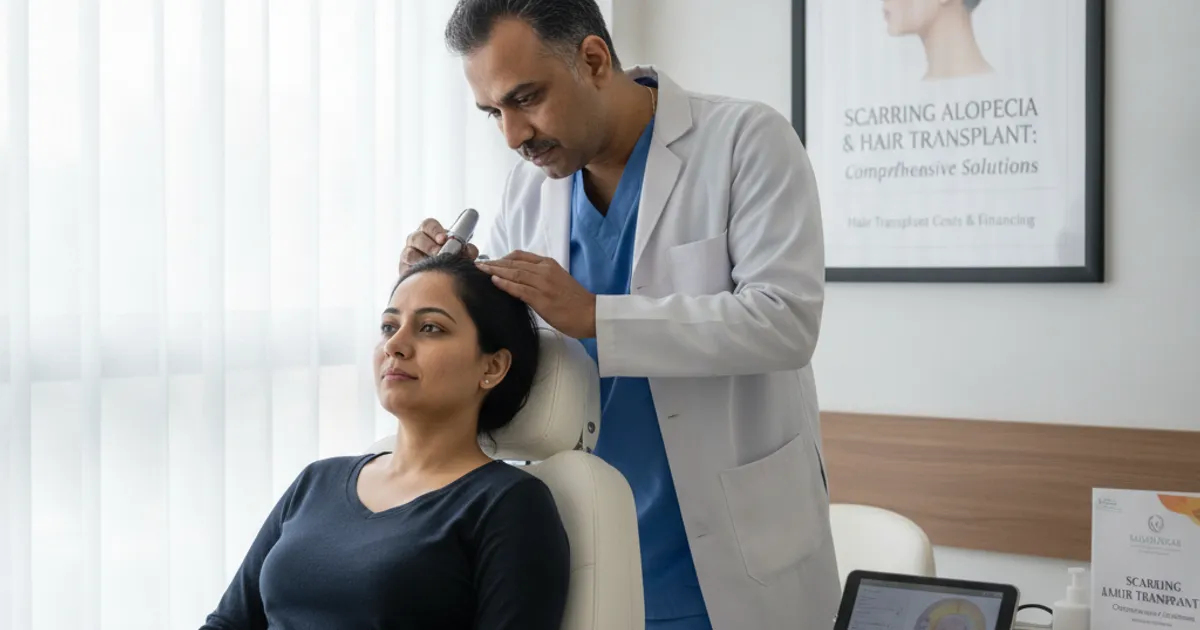
What Is Scarring Alopecia (Cicatricial Alopecia)?
Scarring alopecia, also called cicatricial alopecia, is a group of hair loss conditions where the hair follicle is destroyed and replaced with scar tissue. Unlike common pattern baldness, where follicles shrink but stay alive, scarring alopecia kills the follicle permanently. Once that happens, the hair cannot grow back on its own. The condition can affect anyone, and it often starts as small patches of hair loss that slowly expand. Because the damage is irreversible, early diagnosis matters a great deal. The sooner a doctor identifies the type and starts treatment, the better the chance of saving the remaining hair.
Causes and Types of Scarring Alopecia
Doctors divide scarring alopecia into two broad groups: primary and secondary. In primary scarring alopecia, the inflammation targets the hair follicle itself. In secondary scarring alopecia, something else damages the follicle from the outside, such as an infection, injury, or another skin disease. The exact cause of many primary types is not fully understood, but the immune system is thought to play a central role in most of them.
- Lichen planopilaris — an autoimmune condition that causes inflammation around the upper part of the follicle, often with redness and scaling.
- Frontal fibrosing alopecia — a variant of lichen planopilaris that mainly affects the hairline and eyebrows, most often in women.
- Discoid lupus erythematosus — a form of lupus that can cause scarring hair loss on the scalp, usually with redness and scaling.
- Folliculitis decalvans — a chronic bacterial infection that leads to pus-filled bumps, crusting, and scarring patches.
- Central centrifugal cicatricial alopecia — a common type in women of African descent, often linked to certain hair care practices.
- Dissecting cellulitis — a painful condition with lumps and pus on the scalp, more common in men of African descent.
- Secondary causes — burns, trauma, radiation, severe infections, or long-term traction from tight hairstyles.
Symptoms and Warning Signs
Scarring alopecia does not always look dramatic at first. Many people notice a small bald patch, some itching, or a bit of redness and assume it will pass. The problem is that the inflammation can quietly destroy follicles for months before the hair loss becomes obvious. Knowing the warning signs helps you act early.
- Patches of hair loss that slowly get bigger
- Itching, burning, or tenderness in the affected area
- Redness, scaling, or flaking around the bald patches
- Pus-filled bumps or crusting on the scalp
- Loss of eyebrows or eyelashes
- Smooth, shiny skin where hair used to be
- A widening part line or thinning at the crown
- Hair that pulls out easily around the edges of a bald patch
How Is Scarring Alopecia Diagnosed?
Diagnosis usually starts with a detailed history and a close look at your scalp. A dermatologist will ask when the hair loss started, whether it itches or hurts, what hair products and styles you use, and whether you have other health conditions. From there, several tests can help pin down the exact type.
- Scalp examination with a dermatoscope to check for loss of follicular openings and signs of inflammation
- Pull test to see how easily hairs come out around the edges of a patch
- Scalp biopsy — a small sample of skin taken to look at the follicles under a microscope
- Blood tests to rule out thyroid problems, lupus, or other autoimmune conditions
- Fungal culture or swab if an infection is suspected
- Photographs to track changes over time
| Test | What It Checks | Why It Matters |
|---|---|---|
| Dermatoscopy | Scalp surface and follicular openings | Helps distinguish scarring from non-scarring hair loss |
| Pull test | How easily hair comes out | Shows whether the condition is still active |
| Scalp biopsy | Follicle structure and inflammation | Confirms the type of scarring alopecia |
| Blood tests | Autoimmune or hormonal issues | Rules out underlying causes |
| Fungal culture | Infection | Guides antibiotic or antifungal treatment |
Treatment Options for Scarring Alopecia
Treatment for scarring alopecia aims to stop the inflammation, slow or halt the hair loss, and preserve the hair you still have. There is no cure that brings back hair from scarred follicles, so the focus is on controlling the condition. The right approach depends on the type and how active it is. Some treatments are topical, some are injected, and some are taken by mouth.
- Topical corticosteroids — creams or lotions applied to the scalp to reduce inflammation
- Intralesional corticosteroid injections — shots directly into the affected areas
- Oral medications — such as hydroxychloroquine, doxycycline, or immunosuppressants for more stubborn cases
- Antibiotics — for types like folliculitis decalvans
- Minoxidil — sometimes used to support remaining hair, though it does not reverse scarring
- PRP (platelet-rich plasma) — may help in some cases by promoting healing, but evidence is limited
- Laser therapy — low-level laser may reduce inflammation in certain types
- Hair care changes — avoiding tight styles, harsh chemicals, and heat
| Treatment | How It Works | Best For |
|---|---|---|
| Topical steroids | Reduces surface inflammation | Mild, localized cases |
| Steroid injections | Delivers medication deep into the scalp | Active patches |
| Oral antibiotics | Fights bacterial infection | Folliculitis decalvans |
| Hydroxychloroquine | Modulates the immune system | Lichen planopilaris, lupus |
| Minoxidil | Supports remaining hair growth | Non-scarred areas |
| PRP | Uses growth factors from your blood | Adjunct therapy in some cases |
Is a Hair Transplant Suitable for Scarring Alopecia?
A hair transplant can sometimes help people with scarring alopecia, but it is not a straightforward fix. The key rule is that the condition must be inactive and stable for at least a year before surgery is considered. If inflammation is still present, a transplant can trigger more scarring and the new grafts may not survive. Even in stable cases, the scar tissue may have poor blood supply, which can limit graft survival. A surgeon will usually test a small area first to see how the scalp responds. If you are exploring surgical options, it helps to understand how procedures like FUE work and what they involve.
Related Hair Loss Conditions
Scarring alopecia is just one of many reasons people lose hair. Some conditions look similar but have very different causes and treatments. If you are not sure which one you have, comparing the basics can help you ask better questions at your appointment. Androgenetic alopecia is the most common form and is driven by genetics and hormones. Telogen effluvium is a temporary shedding condition often triggered by stress, illness, or medication. Alopecia areata is an autoimmune condition that causes smooth, round patches. Traction alopecia comes from years of tight hairstyles and can become permanent if not caught early. Diffuse thinning spreads across the whole scalp rather than forming distinct patches.
Frequently Asked Questions
Can hair grow back with scarring alopecia?
No. Once a follicle is destroyed by scarring, it cannot produce hair again. Treatment focuses on stopping the inflammation and saving the hair that is still there.
Is scarring alopecia contagious?
No, it is not contagious. It is an inflammatory or autoimmune condition, not an infection you can pass to others.
How fast does scarring alopecia progress?
It varies. Some people lose hair slowly over years, while others see rapid progression in months. Early treatment can slow it down.
Can I have a hair transplant if I have scarring alopecia?
Sometimes, but only if the condition has been inactive for at least a year. A surgeon will assess your scalp and may test a small area first.
What is the difference between scarring and non-scarring alopecia?
In non-scarring alopecia, the follicle stays alive and hair can regrow. In scarring alopecia, the follicle is destroyed and replaced by scar tissue, so hair loss is permanent.
Which doctor should I see for scarring alopecia?
A dermatologist is the best starting point. They can diagnose the type and start treatment. If you later consider a transplant, you would also see a hair restoration surgeon.
More Guides
- Minoxidil Contact Dermatitis: Signs and Alternatives
Learn the signs of minoxidil contact dermatitis, how it's diagnosed, treatment options, and alternatives like finasteride, PRP, and hair transplant surgery.
- Can Radiotherapy Cause Hair Loss? What to Expect
Radiotherapy can cause temporary or permanent hair loss. Learn the causes, symptoms, diagnosis, treatment options, and whether a hair transplant is suitable.
- Hair Loss After Illness or High Fever: When Does It Stop?
Hair loss after illness or high fever is usually temporary telogen effluvium. Learn causes, symptoms, diagnosis, treatment, and when a hair transplant may help.
- Can Dandruff Cause Hair Loss? Facts vs Folklore
Does dandruff cause hair loss? We separate fact from folklore, explain the real connection, diagnosis, treatments, and when a hair transplant makes sense.