
ARTAS Hair Transplant: How It Works and Who It's For
A clear guide to ARTAS hair transplant: how the robotic system works, recovery, results, cost factors, who it suits, and how it compares to other techniques.
What Is ARTAS Hair Transplant?
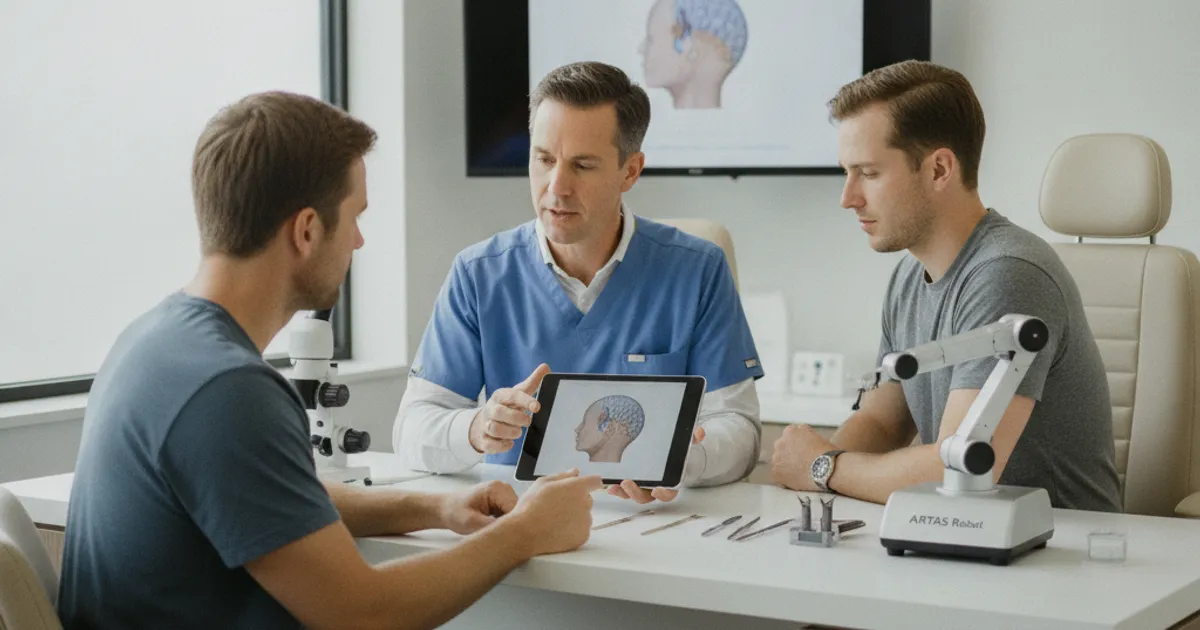
ARTAS is a robotic hair transplant system used to assist with follicular unit extraction (FUE). It combines high-resolution imaging, robotic arm technology, and software algorithms to identify, isolate, and extract individual hair follicles from the back and sides of the scalp. The goal is to improve the consistency and precision of graft harvesting while reducing some of the manual fatigue associated with traditional FUE. ARTAS is not a fully automated transplant — a surgeon still designs the hairline, plans the session, and oversees the procedure. Think of it as a tool that helps the surgeon harvest grafts more uniformly, not a replacement for surgical judgment.
How ARTAS Works: Step-by-Step Procedure
The ARTAS procedure follows a structured workflow. While exact protocols vary by clinic, the general sequence looks like this:
- Consultation and planning: The surgeon assesses your donor area, hair loss pattern, and goals. Blood tests and scalp evaluation may be done. The hairline is designed and the number of grafts estimated.
- Preparation: The donor area is trimmed and numbed with local anesthesia. You may receive sedation depending on the clinic's protocol.
- Imaging: The ARTAS system takes high-resolution digital images of the donor scalp to map follicular units — groups that typically contain one to four hairs.
- Robotic extraction: The robotic arm uses the imaging data to align with each follicular unit and make precise, minimally invasive punches to extract grafts. The system adjusts punch depth and angle based on real-time feedback.
- Graft collection: Extracted grafts are collected and sorted by the clinical team, then held in a solution to preserve viability.
- Recipient site creation: The surgeon creates tiny incisions in the recipient area using custom blades or needles, matching the natural angle and direction of hair growth.
- Implantation: The surgical team places the grafts into the recipient sites. This step is typically manual.
- Post-op care: The donor and recipient areas are cleaned and dressed. You receive aftercare instructions and follow-up appointments.
Recovery After ARTAS: What to Expect
Recovery from ARTAS is similar to conventional FUE because the extraction method is still minimally invasive — no linear strip is removed. Most people experience mild swelling, tenderness, and small scabs in the donor and recipient areas. The robot's small punch size may reduce some trauma, but it does not eliminate the normal healing process. Here's a typical timeline, though individual healing varies:
- First 24–48 hours: Mild discomfort, swelling, and tightness. Sleep with your head elevated. Avoid touching or scratching the grafts.
- Days 3–7: Scabs form and begin to flake. You can usually wash your hair gently with a mild shampoo after the first few days, following your clinic's instructions.
- Weeks 1–2: Most scabs are gone. You may return to desk work within a few days, but avoid strenuous exercise and sweating for about a week to ten days.
- Weeks 2–4: Shock loss may occur — some transplanted hairs shed before new growth begins. This is normal and temporary.
- Months 1–3: The donor area heals fully. Redness in the recipient area fades gradually. You can usually resume normal hair care and light exercise.
Results and Timeline: When Will You See Growth?
ARTAS results follow the same biological timeline as other FUE techniques. The follicles need time to recover from transplantation and re-enter the growth phase. Expect a gradual process, not an overnight change. The ranges below are typical, but your own timeline may differ:
- Months 1–3: Shedding of transplanted hairs is common. Don't panic — the follicles are still alive.
- Months 3–6: Early growth begins. You may notice fine, thin hairs emerging. Density is still low.
- Months 6–9: Noticeable improvement in coverage and density. Many people feel comfortable going without a hat by this stage.
- Months 9–12: The majority of growth is visible. Hair thickens and matures.
- Months 12–18: Final results. Some people see continued maturation beyond 12 months, especially with larger sessions.
Who Is a Good Candidate for ARTAS?
ARTAS works best for people with specific characteristics. It's not a one-size-fits-all solution, and candidacy depends on your hair loss pattern, donor quality, and expectations. Generally, good candidates include:
- People with early to moderate hair loss (often classified as Norwood 2–5) who have a stable donor area.
- Those with straight or wavy hair — the robot tends to perform more consistently on these hair types than on very curly or tightly coiled hair.
- People who want a minimally invasive FUE procedure with the potential for more uniform graft harvesting.
- Those with realistic expectations about density, timeline, and the need for possible future sessions.
- People without active scalp infections, uncontrolled medical conditions, or unrealistic goals.
ARTAS Cost: What Affects the Price?
ARTAS hair transplant cost varies widely by clinic, location, and the size of the session. There is no single price — the robot itself adds equipment and operational costs, but the surgeon's skill and the number of grafts are the biggest drivers. Factors that influence the price include:
- Number of grafts: More grafts mean more time, more materials, and higher cost. Sessions can range from a few hundred to several thousand grafts.
- Surgeon experience and clinic reputation: Established clinics with experienced ARTAS surgeons typically charge more.
- Geographic location: Prices differ significantly between countries and cities due to labor costs, regulations, and demand.
- Anesthesia and sedation: Some clinics include these in the quote; others charge separately.
- Post-op care and follow-up: PRP therapy, medications, and follow-up visits may be bundled or extra.
- Technology fees: Some clinics charge a premium for robotic-assisted procedures.
Because pricing is highly individual, the best approach is to request a personalized quote based on your graft estimate. Be wary of unusually low prices — they may exclude key components or reflect limited surgeon involvement. Always confirm the final price directly with the clinic.
ARTAS vs. Other Hair Transplant Techniques
ARTAS is one option among several. Here's how it compares to manual FUE and FUT (strip surgery) on the factors that matter most:
| Factor | ARTAS (Robotic FUE) | Manual FUE | FUT (Strip) |
|---|---|---|---|
| Extraction method | Robotic arm with imaging guidance | Surgeon uses manual punches | Surgeon removes a strip of scalp |
| Scarring | Small, dot-like scars | Small, dot-like scars | Linear scar |
| Precision/consistency | High for suitable hair types; relies on imaging | Depends on surgeon skill | Depends on surgeon skill |
| Speed of extraction | May be faster for large sessions in some clinics | Slower, surgeon-dependent | Faster for large sessions |
| Hair type suitability | Best for straight/wavy hair; limited for very curly hair | Adaptable to most hair types | Adaptable to most hair types |
| Recovery | Similar to FUE | Similar to FUE | Longer due to linear incision |
| Cost | Often higher due to technology | Varies | Varies |
| Surgeon involvement | Surgeon plans and oversees; robot extracts | Surgeon performs extraction | Surgeon performs extraction |
Choosing an ARTAS Clinic: Key Questions to Ask
Not every clinic that offers ARTAS uses it the same way. Some use it for the entire extraction; others use it selectively. Before booking, ask these questions to separate a good fit from a marketing pitch:
- How many ARTAS procedures does the surgeon perform per month, and what is their experience with your hair type?
- Will the surgeon be present and involved throughout the procedure, or only for planning and site creation?
- What percentage of the extraction will be robotic versus manual, and why?
- What is the clinic's policy on graft counts — do they guarantee a minimum, and what happens if fewer grafts are harvested?
- What is included in the quoted price (anesthesia, medications, PRP, follow-up visits)?
- Can you see before-and-after photos of patients with similar hair loss patterns and hair types?
- What is the clinic's complication rate and how do they handle post-op issues?
Frequently Asked Questions About ARTAS
Is ARTAS better than manual FUE?
Not necessarily. ARTAS can offer more consistent graft harvesting for suitable hair types and may reduce surgeon fatigue during large sessions. However, manual FUE performed by a skilled surgeon can produce excellent results and may be more adaptable for very curly hair or complex cases. The best choice depends on your individual characteristics and the surgeon's expertise.
Does ARTAS hurt?
The procedure is performed under local anesthesia, so you shouldn't feel pain during extraction. You may feel pressure or mild discomfort. Afterward, most people report mild soreness, swelling, and tightness that can be managed with over-the-counter pain relief.
How long does an ARTAS session take?
Session length depends on the number of grafts. Smaller sessions may take a few hours, while larger sessions can take most of a day. The robotic extraction step is often faster than manual extraction, but the overall procedure time also includes planning, anesthesia, and implantation.
Can ARTAS be used for a second transplant?
Yes, ARTAS can be used for repeat procedures, provided you have enough donor hair and the scalp has healed adequately. Your surgeon will assess donor density and scar tissue before planning a second session.
More Guides
- What Happens 10 Days After a Hair Transplant?
A clear, honest look at what happens 10 days after a hair transplant: healing, scabs, shedding, results, costs, and who it suits.
- Facial Hair Transplant: Procedure, Recovery & Results
A clear guide to facial hair transplant: how it works, recovery timeline, results, who suits it, cost, and how it compares to alternatives.
- Hair Transplant and Sleep Apnea: CPAP and Recovery
How sleep apnea and CPAP therapy affect hair transplant surgery, recovery, risks, costs, and candidacy. A clear guide for patients with OSA.
- Does a Hair Transplant Hurt? Pain, Numbing & Recovery
Does a hair transplant hurt? Learn what you actually feel, how numbing works, recovery pain timeline, and how it compares to other hair loss treatments.