
DHI Hair Transplant Recovery: Day-by-Day Timeline
A clear day-by-day DHI hair transplant recovery timeline, from surgery day to final results, plus costs, who it suits, and how it compares to FUE and FUT.
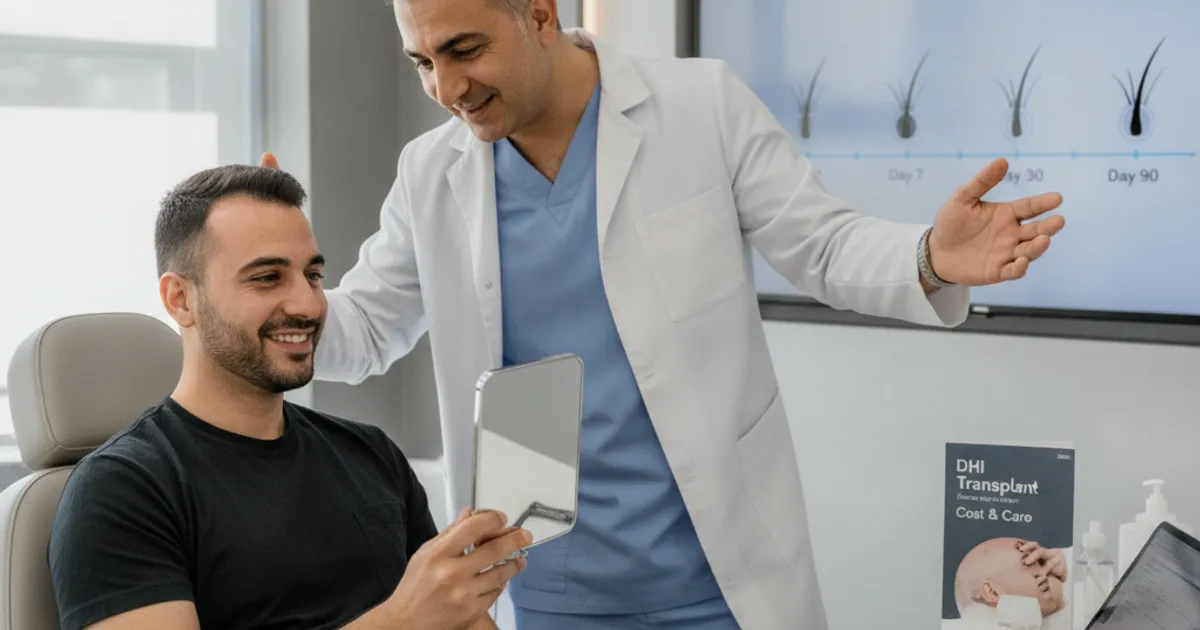
What Is DHI Hair Transplant Recovery?
DHI stands for Direct Hair Implantation. It's a hair transplant technique where the surgeon uses a specialized tool called a Choi implanter pen to extract and place grafts in one step, without making pre-cut recipient sites. Because the technique is more precise and less invasive than older methods, many people assume recovery is instant. It isn't. DHI recovery still follows a predictable biological timeline: the scalp heals, the transplanted hairs shed, new growth starts, and density fills in over roughly 6 to 12 months. What DHI does change is the speed and comfort of the early days, and how quickly you can return to normal life.
How DHI Surgery Is Performed (and Why It Shapes Recovery)
In a DHI procedure, the surgeon extracts follicular units one by one using a micro-punch, then loads each graft directly into the Choi pen. The pen creates the recipient site and deposits the graft at the same time, controlling depth and angle. This differs from FUE, where sites are pre-made with a blade before grafts are inserted. The one-step placement means the grafts spend less time outside the body, and the scalp has fewer open wounds at any given moment. That's why many DHI patients report less bleeding, less crusting, and a more comfortable first week. The trade-off is that DHI is typically slower to perform and often costs more per graft.
- Extraction and implantation happen in one step with the Choi pen.
- No pre-cut recipient sites, which reduces scalp trauma.
- Grafts are outside the body for a shorter time.
- Procedure is often longer than FUE because of the precision required.
- Typically performed under local anesthesia, so you're awake but comfortable.
DHI Recovery Day-by-Day: The First 7 Days
The first week is when most of the visible recovery happens. You'll leave the clinic with a bandage or headband, and the donor area will feel tender. Swelling typically peaks around day 3 to 4 and usually affects the forehead and around the eyes. Scabs form on the recipient area within about 48 hours and start to flake off by day 7 to 10. Most DHI patients can return to desk work within about 3 to 5 days, though you'll want to avoid heavy sweating or direct sun for at least two weeks.
| Day | What to Expect | Care Tips |
|---|---|---|
| Day 0 (surgery day) | Tenderness, tightness, mild bleeding, bandaged scalp | Sleep upright, don't touch the grafts, take prescribed medication |
| Day 1–2 | Swelling starts, scabs begin to form, donor area sore | Gentle saline spray, avoid washing unless instructed |
| Day 3–4 | Peak swelling (forehead, eyes), itching begins | Cold compresses on forehead, not on grafts |
| Day 5–7 | Swelling subsides, scabs soften, first gentle wash usually allowed | Follow clinic washing instructions exactly |
| Day 7–10 | Most scabs flake off, scalp looks pink but cleaner | No scratching, no harsh products, no sun exposure |
Weeks 2–4: Scabbing, Shedding, and Returning to Normal
By week 2, the scalp is usually scab-free and looks less angry. This is also when shock loss and shedding begin. The transplanted hairs fall out because the follicle goes into a resting phase after the trauma of surgery. It's normal, expected, and not a sign the transplant failed. The follicles remain in place and will start producing new hair in a few months. Most people are back to their normal routine, including exercise, by week 3 or 4, depending on their surgeon's advice.
- Scabs are mostly gone by day 10 to 14.
- Transplanted hair starts shedding around week 2 to 4.
- Donor area may feel tight or numb but is healing.
- Light exercise is usually fine after 7 to 10 days; intense training after 2 to 3 weeks.
- Avoid swimming pools, saunas, and direct sun for at least 4 weeks.
Months 2–6: The Ugly Duckling Phase and Early Growth
Months 2 to 4 are often called the ugly duckling phase. Most of the transplanted hair has shed, the scalp may look patchy, and new growth is just beginning. This is the point where people worry something went wrong. It didn't. By month 3, fine, thin hairs start to emerge. By month 4 to 5, you'll see noticeable new growth, though it's still thin and uneven. By month 6, many patients see a real difference in density, and the hair starts to look more natural.
Months 6–12: Final Results and Density
From month 6 onward, the hair thickens and the density improves. By month 9, many people are happy with the result, and by month 12, the transplant is considered fully mature. Some patients see continued improvement up to about 18 months, especially if they had a large session. The final result depends on graft count, hair caliber, and how well you followed aftercare. DHI's precise placement often gives a natural hairline, but the timeline for growth is the same as any other transplant technique.
- Month 6: visible density, hair still fine but filling in.
- Month 9: most of the final result is visible.
- Month 12: fully mature result for most patients.
- Month 12–18: minor thickening and maturation continues.
- Final density depends on graft count and individual healing.
DHI Recovery vs. FUE and FUT: Timeline Comparison
DHI and FUE share a similar long-term growth timeline, but the early recovery differs. DHI usually means less scabbing and faster return to work, while FUE can be quicker to perform and often cheaper. FUT involves a strip incision at the back of the scalp, which means a longer, more uncomfortable early recovery and a linear scar. The table below gives a realistic comparison of what to expect.
| Milestone | DHI | FUE | FUT |
|---|---|---|---|
| Return to desk work | 3–5 days | 3–7 days | 7–14 days |
| Scabbing clears | 7–10 days | 10–14 days | 10–14 days |
| Shedding starts | Week 2–4 | Week 2–4 | Week 2–4 |
| Early growth visible | Month 3–4 | Month 3–4 | Month 3–4 |
| Final result | Month 12 | Month 12 | Month 12 |
| Scarring | Tiny dot scars | Tiny dot scars | Linear scar |
Who DHI Suits (and Who Should Consider Alternatives)
DHI is a good fit for people who want precise hairline work, have a moderate budget, and value a smoother early recovery. It's often chosen for smaller sessions, eyebrow transplants, and cases where angle and direction matter a lot. It's less ideal for very large sessions because the procedure is slower and more expensive per graft. If cost is the main concern, FUE may be a better option. If you have loose scalp and need a large number of grafts in one session, FUT can still be relevant, though it's less popular today.
- Good for precise hairline and eyebrow work.
- Suits patients having roughly 1,000–3,000 grafts.
- Less ideal for very large sessions due to time and cost.
- FUE is often more cost-effective for larger areas.
- FUT may suit patients needing maximum grafts in one session.
Cost of DHI Hair Transplant
DHI usually costs more than FUE because it's more labor-intensive and requires a specialized tool and trained surgeon. Pricing varies widely by country, clinic, and graft count. Because no live pricing data was supplied for this topic, the cost range block below shows 'Check with clinic' for all tiers. Always confirm what's included, such as medication, PRP, and follow-up visits.
FAQ: DHI Hair Transplant Recovery
How long does DHI recovery take?
The visible recovery takes about 7 to 10 days for scabs to clear and 2 to 4 weeks for the scalp to look normal. The transplanted hair sheds around week 2 to 4, and new growth starts around month 3. Final results are usually visible by month 12.
Is DHI recovery faster than FUE?
Early recovery is often smoother with DHI because there are fewer open wounds and less scabbing. Many people return to desk work in 3 to 5 days. However, the long-term growth timeline is the same as FUE: shedding, early growth at month 3 to 4, and final results at month 12.
When can I exercise after a DHI hair transplant?
Light walking is usually fine after a few days. Most surgeons allow light exercise after 7 to 10 days and intense training after 2 to 3 weeks. Avoid swimming pools, saunas, and direct sun for at least 4 weeks.
Why does transplanted hair fall out after DHI?
Shedding is caused by shock loss. The follicle goes into a resting phase after surgery, and the hair shaft falls out. The follicle stays in place and starts producing new hair after a few months. It's a normal part of the process, not a sign of failure.
More Guides
- Hair Transplant for Men With Sensitive Skin: What to Know
Hair transplant for men with sensitive skin: techniques, recovery, results, cost factors, and how to choose a clinic that handles eczema or psoriasis.
- What Happens 10 Days After a Hair Transplant?
A clear, honest look at what happens 10 days after a hair transplant: healing, scabs, shedding, results, costs, and who it suits.
- ARTAS Hair Transplant: How It Works and Who It's For
A clear guide to ARTAS hair transplant: how the robotic system works, recovery, results, cost factors, who it suits, and how it compares to other techniques.
- Facial Hair Transplant: Procedure, Recovery & Results
A clear guide to facial hair transplant: how it works, recovery timeline, results, who suits it, cost, and how it compares to alternatives.