
How Many Grafts to Fix a Norwood 3 Hairline?
Norwood 3 hairline restoration graft counts vary by case. Learn procedure steps, recovery, costs, and who's a good candidate.
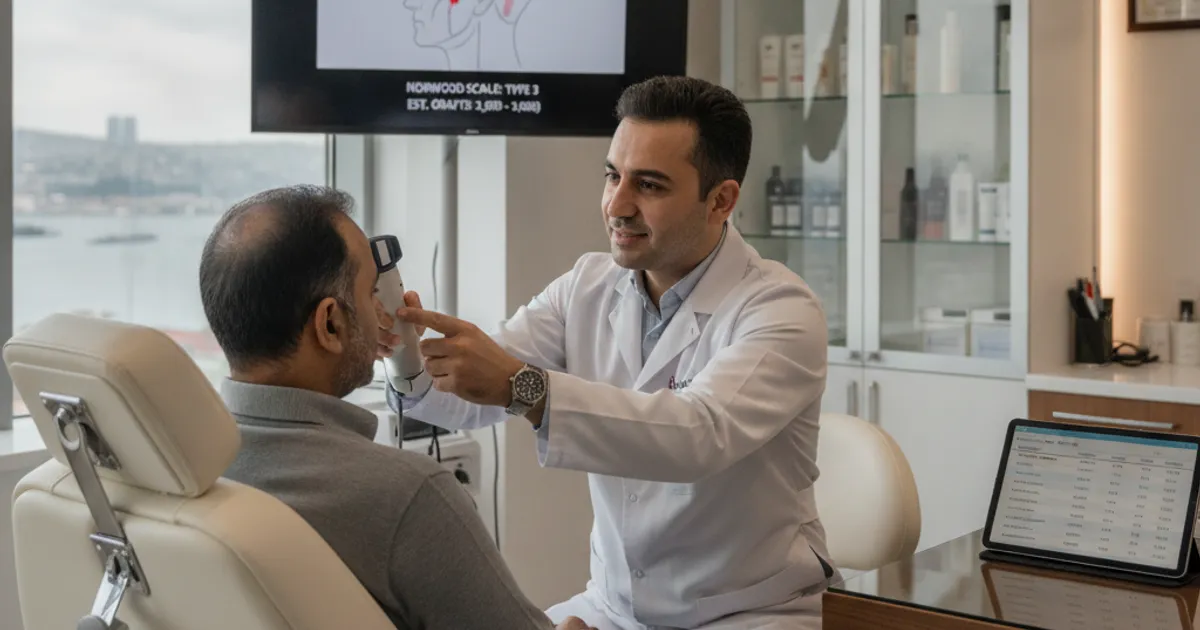
What Is a Norwood 3 Hairline?
The Norwood scale is the standard way doctors classify male pattern baldness. A Norwood 3 is where hair loss becomes visibly noticeable — you're not just receding slightly at the temples anymore. The hairline has formed deep M-shaped recession on both sides, and the forelock in the middle may be thinning too. It's the stage where most guys start seriously thinking about doing something about it.
- Deep temporal recession on both sides of the forehead
- The middle forelock often remains but may be thinner than before
- The hairline sits noticeably higher than it did in your early 20s
- Crown thinning is usually minimal or absent at this stage
- Hair loss is typically stable enough to plan a restoration
Norwood 3 is often split into two sub-stages: Norwood 3 and Norwood 3 Vertex (where the crown also starts thinning). For the purposes of graft estimates, most surgeons treat a standard Norwood 3 as a moderate frontal restoration case.
How Many Grafts Are Typically Needed for a Norwood 3?
There's no single number that fits everyone. Graft counts depend on how far back the hairline has receded, how dense your donor area is, the thickness of your hair shafts, and how aggressive you want the new hairline to look. That said, many surgeons work within a fairly predictable range for a Norwood 3.
| Case Type | Typical Graft Range | What It Covers |
|---|---|---|
| Conservative hairline rebuild | 1,200 – 1,500 grafts | Temple corners only, subtle density |
| Standard Norwood 3 restoration | 1,500 – 2,000 grafts | Temples plus forelock reinforcement |
| Aggressive/dense packing | 2,000 – 2,500 grafts | Lower hairline, higher density, more coverage |
| Norwood 3 Vertex (with crown) | 2,000 – 3,000 grafts | Frontal restoration plus crown work |
How the Procedure Is Performed
A Norwood 3 hair transplant is almost always done using either FUE (follicular unit extraction) or FUT (follicular unit transplantation, also called the strip method). FUE is more common today because it leaves minimal scarring and allows for a shorter recovery. Here's the general flow of a typical procedure.
Recovery Timeline and What to Expect
Recovery from a Norwood 3 transplant is generally straightforward, but the timeline matters. The first few days are about protecting the grafts. The first few months are about patience — because the hair will shed before it grows.
- Days 1–3: Swelling and tenderness in the forehead and donor area. Sleep propped up to reduce swelling.
- Days 4–7: Scabbing forms. You can usually wash your hair gently with surgeon-approved shampoo.
- Weeks 2–3: Most scabs fall off. The transplanted hair sheds — this is normal and expected.
- Months 2–4: The dormant phase. Very little visible growth. This is the hardest part mentally.
- Months 5–8: New hair starts growing. Density improves month by month.
- Months 12–18: Final results. The hairline is fully matured and density is at its peak.
| Timeframe | What's Happening | What You Can Do |
|---|---|---|
| First 72 hours | Grafts are fragile and anchoring | Avoid touching, sweating, or bending over |
| First 2 weeks | Healing and scabbing | Gentle washing, no strenuous exercise |
| Weeks 3–4 | Shock loss and shedding | Return to normal activities, avoid direct sun |
| Months 2–4 | Dormant phase | Be patient, take photos to track progress |
| Months 5–12 | Active growth | See your surgeon for follow-up if needed |
| Months 12–18 | Final maturation | Evaluate final result and consider a second session if desired |
Results: Growth, Density, and Realistic Outcomes
A well-executed Norwood 3 transplant can restore a natural-looking hairline that frames the face and takes years off your appearance. But it's not about getting back the hair you had at 18. It's about creating a mature, age-appropriate hairline that looks like it belongs there. Density is the key variable — you can't match your original density, but you can create the illusion of fullness with careful graft placement and angling.
Who Is a Good Candidate for Norwood 3 Restoration?
Not everyone with a Norwood 3 is a good candidate. The ideal candidate has stable hair loss, a healthy donor area, and realistic expectations. If your hair loss is still progressing rapidly, you may want to wait or start medication first to stabilize it.
- Hair loss has been stable for a period of time (your surgeon can help determine if you're ready)
- Good donor hair density at the back and sides of the scalp
- No active scalp infections or skin conditions
- Realistic expectations about density and coverage
- Willing to commit to long-term maintenance (medication or future sessions)
- Generally in good health and a non-smoker or willing to quit before surgery
Cost Considerations for Norwood 3 Hair Transplants
Hair transplant pricing varies widely depending on where you go, who does the surgery, and how many grafts you need. Most clinics charge per graft, but some offer package pricing for a set number of grafts. Below are average case prices by stage of hair loss.
Keep in mind that these are averages. A Norwood 3 case in a high-cost city like New York or London will be at the higher end, while clinics in Turkey, Mexico, or Thailand may charge significantly less. Always factor in travel, accommodation, and follow-up care if you're going abroad.
How It Compares to Other Hair Loss Treatments
A hair transplant is a permanent solution for restoring hair in bald areas, but it's not the only option. Medications like finasteride and minoxidil can slow or stop hair loss and sometimes regrow some hair, but they won't bring back a receded hairline. Here's how the main options compare.
| Treatment | How It Works | Best For | Limitations |
|---|---|---|---|
| Hair transplant (FUE/FUT) | Moves healthy follicles to bald areas | Restoring receded hairline and density | Surgical, costly, requires recovery |
| Finasteride | Blocks DHT to slow hair loss | Stabilizing loss, preventing further recession | Not for everyone, side effects possible |
| Minoxidil | Improves blood flow to follicles | Thinning crown, early-stage loss | Topical, daily use, limited regrowth |
| Low-level laser therapy | Stimulates follicles with light | Early thinning, adjunct therapy | Weak evidence, expensive for results |
| PRP injections | Uses growth factors from your blood | Thinning hair, post-transplant healing | Temporary, not for bald areas |
| Hair fibers/concealers | Cosmetic camouflage | Hiding thinning temporarily | Not a treatment, washes out |
Choosing a Clinic: What to Look For
The clinic and surgeon you choose matter more than anything else. A bad transplant is expensive to fix — and sometimes impossible to fully correct. Here's what to check before you book.
- Surgeon's experience with Norwood 3 cases specifically
- Before-and-after photos of real patients (not stock images)
- Whether the surgeon performs the critical steps or delegates to technicians
- Clear pricing with no hidden fees
- Follow-up care and revision policy
- Reviews from verified patients on independent platforms
- Credentials and medical board certifications
Frequently Asked Questions
How many grafts do I need for a Norwood 3 hairline?
Most Norwood 3 cases require between 1,500 and 2,500 grafts. A conservative hairline rebuild might need 1,200–1,500 grafts, while a denser, more aggressive restoration can require 2,000–2,500. Your surgeon will give you a specific estimate after examining your donor area and hair characteristics.
Will I need a second transplant later?
Possibly. Hair loss is progressive, so if your native hair continues to recede, you may want a second session to maintain the result. Some patients plan for a second procedure down the line. Taking medication like finasteride can help slow further loss and delay the need for another transplant.
Is a Norwood 3 transplant painful?
The procedure itself is done under local anesthesia, so you won't feel pain during surgery. Afterward, most people describe the discomfort as mild to moderate — similar to a bad sunburn. Painkillers and cold compresses usually manage it well within a few days.
How long until I see results from a Norwood 3 transplant?
You'll see the first signs of new growth around month 4–5. By month 8, you'll have a good idea of the density. Final results take 12–18 months as the hair thickens and matures. The waiting period is the hardest part for most patients.
More Guides
- Hair Transplant for Men With Sensitive Skin: What to Know
Hair transplant for men with sensitive skin: techniques, recovery, results, cost factors, and how to choose a clinic that handles eczema or psoriasis.
- What Happens 10 Days After a Hair Transplant?
A clear, honest look at what happens 10 days after a hair transplant: healing, scabs, shedding, results, costs, and who it suits.
- ARTAS Hair Transplant: How It Works and Who It's For
A clear guide to ARTAS hair transplant: how the robotic system works, recovery, results, cost factors, who it suits, and how it compares to other techniques.
- Facial Hair Transplant: Procedure, Recovery & Results
A clear guide to facial hair transplant: how it works, recovery timeline, results, who suits it, cost, and how it compares to alternatives.