
Norwood 3 FUE Transplant: Grafts, Recovery, and Costs
Norwood 3 FUE transplant guide: typical graft counts, procedure steps, recovery timeline, cost ranges, and who makes a good candidate.
What Is a Norwood 3 FUE Transplant?
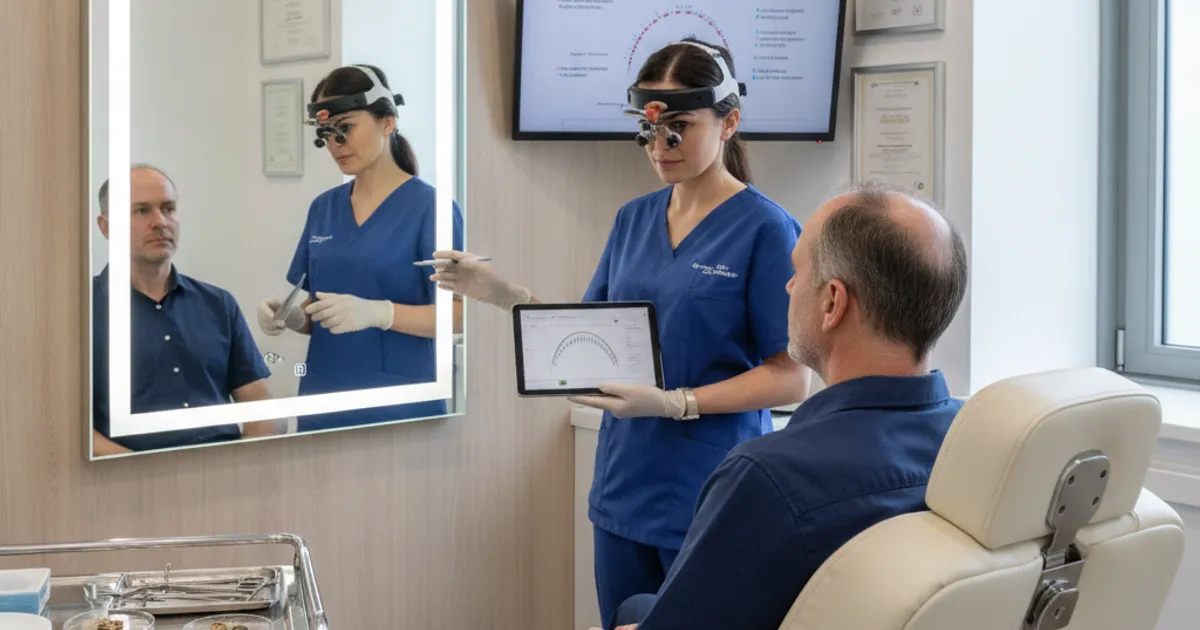
A Norwood 3 FUE transplant is a follicular unit extraction procedure for men whose hair loss has reached the Norwood 3 stage on the standard classification scale. At this point, the hairline has receded into an M-shape at the temples, but the crown is usually still intact or only minimally thinning. Because the balding area is relatively small and the donor zone on the back and sides of the scalp is typically still dense, Norwood 3 can be a reasonable stage to consider surgery. The goal is not to rebuild a teenage hairline, but to restore a mature, age-appropriate hairline that looks natural and holds up over time.
How Norwood 3 Hair Loss Is Classified
The Norwood scale is the most widely used system for describing male pattern baldness. It runs from Norwood 1 (no visible recession) to Norwood 7 (extensive loss across the top and crown). Norwood 3 sits near the start of the scale and is defined by deep temporal recession that forms a distinct M, V, or U shape. The key distinction between Norwood 2 and Norwood 3 is depth: Norwood 2 recession is mild and often considered a mature hairline, while Norwood 3 recession is clearly visible and continues to progress in most men.
- Norwood 1: No recession, full juvenile hairline.
- Norwood 2: Slight recession at the temples, often a mature hairline.
- Norwood 3: Deep M-shaped recession at both temples; the frontal tuft remains.
- Norwood 3 Vertex: Same frontal recession plus early thinning at the crown.
- Norwood 4: Frontal and crown loss begin to connect, with a bridge of hair between them.
How Many Grafts Are Needed for a Natural Norwood 3 Result?
Graft counts for Norwood 3 vary because the size of the balding area, hair caliber, color contrast, and desired density all affect the plan. Based on general industry guidance, a typical Norwood 3 case may need somewhere between 1,000 and 2,000 grafts, with many falling in the 1,200 to 1,800 range. The table below shows rough graft ranges by how much of the frontal zone needs rebuilding. These are general planning estimates, not guarantees, and a surgeon will confirm the number after an in-person or photo assessment.
| Norwood 3 Pattern | Typical Graft Range (General Guidance) | What It Usually Covers |
|---|---|---|
| Mild recession, strong existing hairline | 800 – 1,200 grafts | Temple corners only, light density |
| Classic M-shape, moderate recession | 1,200 – 1,800 grafts | Temple corners plus frontal hairline reinforcement |
| Deep recession with early crown thinning | 1,800 – 2,500 grafts | Frontal hairline plus a light pass into the crown |
- Hair caliber: coarser hair covers more scalp per graft than fine hair.
- Color contrast: dark hair against light skin shows thinning more easily and may need higher density.
- Hairline design: a conservative, mature hairline needs fewer grafts than an aggressive low one.
- Future loss: surgeons often leave donor reserves for a possible second procedure later.
- Donor density: how many grafts can be safely harvested without thinning the back and sides.
How the FUE Procedure Is Performed
FUE (follicular unit extraction) removes individual hair follicles from the donor area using a small punch tool, typically around 0.7 to 1.0 mm in diameter according to general industry practice. Unlike the older strip method (FUT), there is no linear scar, which is one reason FUE is popular for smaller cases like Norwood 3. The procedure is typically done under local anesthesia and can take most of a day depending on the graft count.
Recovery Timeline After a Norwood 3 FUE Transplant
Recovery from a Norwood 3 FUE transplant is usually straightforward because the treated area is small. Based on typical patient experiences, many people can return to desk work within a few days and to strenuous exercise within two weeks. The main annoyance is the temporary shedding of transplanted hairs, which often happens around weeks two to four and is considered normal. The table below outlines general expectations at each stage.
| Timeframe | What Typically Happens | Typical Restrictions |
|---|---|---|
| Days 1–3 | Scabbing and mild swelling; grafts are fragile | No washing the recipient area unless instructed; sleep propped up |
| Days 4–10 | Scabs soften and flake off; donor area heals | Gentle washing begins; no scratching or picking |
| Weeks 2–4 | Transplanted hairs shed (shock loss) | Avoid heavy sweating, swimming, and direct sun |
| Months 2–4 | Dormant phase; new growth starts | Normal activity resumes; be patient |
| Months 5–8 | Visible new growth and thickening | No restrictions; results begin to show |
| Months 12–18 | Final maturation of the hairline | None; assess final result with your surgeon |
Results: What to Expect and When
A well-planned Norwood 3 FUE transplant can often produce a hairline that looks natural and frames the face without looking pluggy or obvious, though results vary by individual. The key is a conservative hairline design that accounts for future loss. Results are not instant. The transplanted hair goes through a resting phase, sheds, and then regrows over several months. Based on typical outcomes, most patients see meaningful improvement by month six and the final result around 12 to 18 months.
- Natural hairline: single-hair grafts at the front create a soft, irregular edge.
- Density: you will not get the density of a full head of hair, but you can get good coverage and framing.
- Direction: grafts are placed at the same angle as your natural hair so styling looks normal.
- Longevity: results can last decades, but native hair may continue to thin without medication.
- Maintenance: many surgeons recommend finasteride or minoxidil to protect existing hair.
Who Is a Good Candidate for Norwood 3 FUE?
Not everyone with Norwood 3 hair loss is a candidate. The best candidates have stable or slowly progressing loss, good donor density, and realistic expectations. Age matters too. Younger men in their early twenties may be advised to wait or to start medication first, because the pattern of future loss is still uncertain. A surgeon will assess donor supply, hair caliber, and family history before recommending surgery.
- Hair loss has stabilized or is progressing slowly.
- Donor area on the back and sides is dense enough to supply 1,000+ grafts.
- You understand that future loss may require a second procedure.
- You are willing to use medication to protect existing hair, if recommended.
- You have realistic expectations about density and hairline position.
- You are in good general health with no uncontrolled scalp conditions.
Cost of a Norwood 3 FUE Transplant
Cost depends on the number of grafts, the clinic's location, and the surgeon's experience. Norwood 3 cases are smaller than advanced cases, so they usually cost less. The figures below are averaged case pricing medians by stage of hair loss. They represent typical total procedure costs, not per-graft rates, and actual quotes will vary by clinic.
FUE vs. Other Hair Transplant Techniques for Norwood 3
FUE is not the only option. FUT (strip harvesting) and DHI (direct hair implantation) are also used for Norwood 3 cases. Each has trade-offs in scarring, recovery, graft survival, and cost. The table below compares the main techniques for a Norwood 3-sized procedure.
| Technique | How It Works | Scarring | Best For |
|---|---|---|---|
| FUE | Individual follicles punched and extracted | Small dot scars, usually hidden | Small to medium cases, short hair styles |
| FUT | Strip of scalp removed and dissected | Linear scar across the back | Larger sessions, tighter budgets |
| DHI | Grafts implanted directly with a Choi pen | Similar to FUE | Precise hairline work, dense packing |
Frequently Asked Questions
How many grafts do I need for a Norwood 3 hair transplant?
Based on general industry guidance, most Norwood 3 cases may need between 1,000 and 2,000 grafts, with 1,200 to 1,800 being a common range. The exact number depends on the size of the receded area, your hair caliber, color contrast, and the density you and your surgeon agree on. A consultation with graft measurement is the only way to get an accurate figure.
Will a Norwood 3 FUE transplant look natural?
It can, if it is planned well. Natural results come from a conservative hairline design, single-hair grafts at the front, correct angulation, and leaving enough donor reserve for future loss. An overly low or straight hairline is the main reason transplants look unnatural, so choose a surgeon who prioritizes long-term planning over immediate density.
How long does it take to see results after a Norwood 3 FUE transplant?
Based on typical patient experiences, transplanted hair sheds around weeks two to four, then regrows over the following months. Many people see visible improvement by month five or six, and the final matured result around 12 to 18 months. Patience is important because the growth cycle is slow and uneven in the early months.
Is Norwood 3 too early for a hair transplant?
It can be. Norwood 3 is often the earliest stage where surgery makes sense, but younger men with rapidly progressing loss may be advised to wait or start medication first. The risk of operating too early is that future loss continues and the transplanted hairline ends up isolated. A surgeon will assess stability, donor supply, and family history before deciding.
More Guides
- Hair Transplant for Men With Sensitive Skin: What to Know
Hair transplant for men with sensitive skin: techniques, recovery, results, cost factors, and how to choose a clinic that handles eczema or psoriasis.
- What Happens 10 Days After a Hair Transplant?
A clear, honest look at what happens 10 days after a hair transplant: healing, scabs, shedding, results, costs, and who it suits.
- ARTAS Hair Transplant: How It Works and Who It's For
A clear guide to ARTAS hair transplant: how the robotic system works, recovery, results, cost factors, who it suits, and how it compares to other techniques.
- Facial Hair Transplant: Procedure, Recovery & Results
A clear guide to facial hair transplant: how it works, recovery timeline, results, who suits it, cost, and how it compares to alternatives.