
Red Light Therapy at Home vs In-Clinic for Hair Loss
Red light therapy at home vs in-clinic for hair loss: compare cost, results, convenience and who each option suits best.
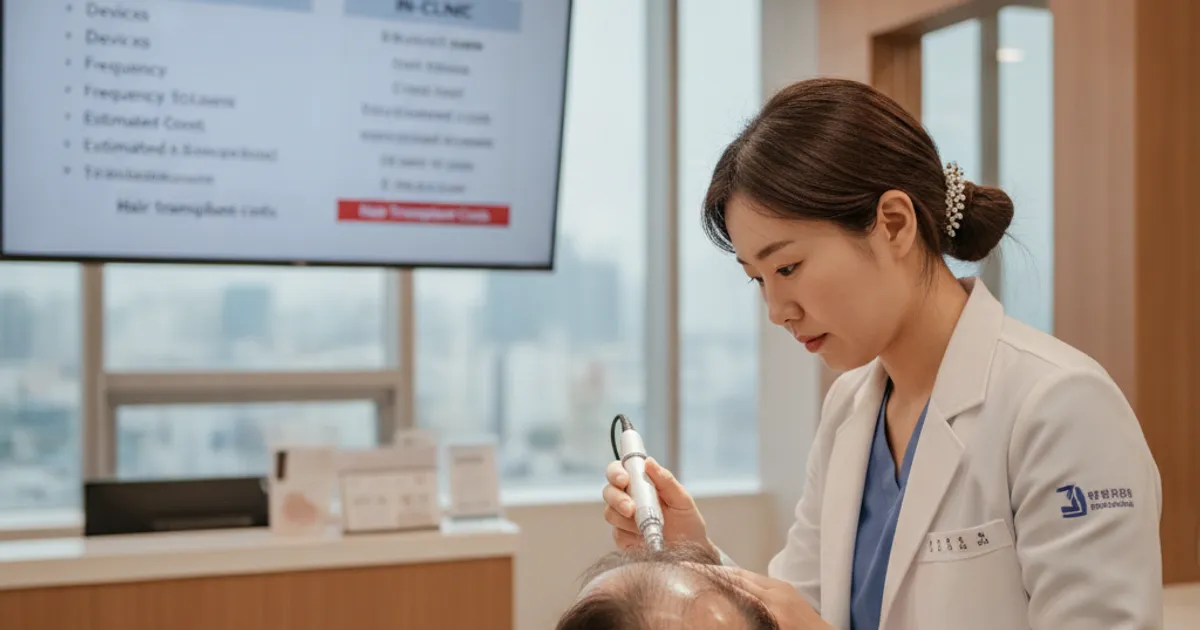
If you are losing hair and considering red light therapy, the first real decision is not whether it works but where you do it. Home devices are cheaper over time and fit around your life. In-clinic sessions are stronger, supervised and usually combined with other treatments. The right pick depends on your budget, your hair loss stage and how much effort you will actually put in.
What Each One Is
Red light therapy for hair loss uses light-emitting diodes (LEDs) or low-level laser therapy (LLLT) to stimulate blood flow and cellular activity in the hair follicle. It is sometimes called photobiomodulation. The key distinction: LLLT specifically refers to laser-based devices, while red light therapy can include LED devices. Both emit light in the red or near-infrared spectrum, but lasers are more focused and can penetrate deeper, whereas LEDs are broader and generally less powerful. The technology is similar whether you sit under a clinic panel or wear a cap at home. What changes is the power, the number of diodes, the treatment time and who is watching your progress.
- Home red light therapy: a wearable cap, band or comb you use for 10 to 30 minutes several times a week. Many devices are cleared by regulators such as the FDA as cosmetic or low-risk tools, though clearance does not guarantee effectiveness. You buy once and own it.
- In-clinic red light therapy: a professional-grade laser or LED system operated by a trained technician or doctor. Sessions are usually 15 to 30 minutes, once or twice a week, often bundled with PRP, mesotherapy or prescription treatments.
Key Differences at a Glance
| Factor | Home Device | In-Clinic Sessions |
|---|---|---|
| Upfront cost | One-time purchase | Pay per session or package |
| Ongoing cost | None after purchase | Adds up over months |
| Power and coverage | Lower, fixed | Higher, adjustable |
| Convenience | Use at home anytime | Travel to appointments |
| Supervision | None | Technician or doctor monitors |
| Combined treatments | Rarely | Often paired with PRP or meds |
| Results speed | Slower, gradual | Usually faster |
| Best for | Early thinning, maintenance | Moderate to advanced loss |
Cost: Home Devices vs In-Clinic Sessions
Home devices are a one-off buy. A decent laser cap or comb typically costs between $200 and $800, with premium models going higher. After that, your only cost is electricity and time. In-clinic red light therapy is priced per session or as a package. A single session usually costs between $50 and $150, but a full course over six to twelve months adds up fast, especially if it is bundled with PRP or other add-ons. For example, 20 sessions at $100 each is $2,000. Insurance rarely covers red light therapy for hair loss, so budget out of pocket either way.
- Home device: one-time cost, no per-session fees, no travel.
- In-clinic: per-session fees, package discounts common, travel and time costs on top.
- Combined approach: some people buy a home device and book occasional clinic sessions for a boost.
- Insurance: red light therapy for hair loss is rarely covered, so budget out of pocket either way.
Results and Recovery: What to Expect
Neither option is a quick fix. Red light therapy works by nudging follicles back into a growth phase, so you need to stick with it for months before judging results. Home devices are weaker, so progress is slower and easier to miss. In-clinic systems deliver more energy per session, which is why many people see thicker hair and less shedding sooner. There is no real recovery time for either. The main side effect is mild scalp warmth or redness, and that usually fades quickly.
- Home: results typically appear after 3 to 6 months of consistent use, sometimes longer.
- In-clinic: visible changes often reported within 2 to 4 months when sessions are regular.
- Both: stopping treatment usually means losing the gains over time.
- Both: work best alongside minoxidil, finasteride or PRP, not instead of them.
- Neither: regrows hair on completely bald, scarred areas.
Suitability: Who Each Option Fits Best
The honest answer is that red light therapy suits some people and not others, and the delivery method matters less than your stage of loss and your willingness to be consistent. If you are early and disciplined, home works. If you are further along or want professional oversight, clinic is the safer bet.
- Home device fits: early thinning, busy schedules, tight budgets, people who will actually use it 3 to 5 times a week.
- In-clinic fits: moderate to advanced loss, people who want monitoring, those combining it with PRP or prescription treatments.
- Home device does not fit: anyone who forgets routines or expects fast results.
- In-clinic does not fit: anyone who cannot commit to regular appointments or ongoing costs.
- Both fit: people using red light therapy as part of a wider hair loss plan.
Which Should You Choose?
There is no universal winner. The choice comes down to your stage of hair loss, your budget and how much structure you need. If you are early and self-motivated, start at home and reassess after six months. If you are past the early stage or want the best shot at results, go in-clinic and consider adding a home device later for maintenance.
- Step 1: Confirm your hair loss stage with a dermatologist or trichologist.
- Step 2: If early and mild, try a home device for 6 months and track photos monthly.
- Step 3: If moderate or advanced, book in-clinic sessions and ask about combining with PRP or medication.
- Step 4: If budget allows, use both: clinic for progress, home for maintenance.
- Step 5: Review results at 6 and 12 months. If nothing changes, look at other options like hair transplant.
FAQ
Is at-home red light therapy as effective as in-clinic?
Not usually. In-clinic devices deliver more power per session and are often combined with other treatments, so results tend to come faster. Home devices can still help, especially for early thinning, but they require more patience and consistency.
How long before I see results from red light therapy?
Most people need at least 3 to 6 months of regular use before noticing changes. In-clinic sessions may show results slightly sooner, but neither option works overnight. A 2014 review in Lasers in Surgery and Medicine found that studies typically report improvements after 3 to 6 months of consistent use.
Can I use a home device and still get clinic sessions?
Yes. Many people use a home device for maintenance between clinic visits. Just tell your clinician what you are using so they can adjust your plan.
Does red light therapy work for advanced hair loss?
It is less effective once follicles are dormant or scarred. At advanced stages, it is usually combined with medication, PRP or considered alongside hair transplant surgery.
Device Quality and What the Specs Actually Mean
Two home devices can look identical and perform very differently. The numbers that matter are the wavelength, the irradiance (power delivered per unit area), the treatment time the manufacturer recommends, and the coverage area. Red light therapy for hair typically uses wavelengths in the red band (around 650 nm) and near-infrared band (around 800 to 900 nm). Near-infrared penetrates deeper into tissue, which is why many hair devices combine both. Irradiance is often listed in milliwatts per square centimeter; higher output generally means shorter sessions, but only if the light is actually reaching the scalp rather than being blocked by hair.
Be skeptical of devices that advertise a large diode count without stating output or coverage. A cap with many low-power LEDs spread thinly may deliver less useful energy to the follicle than a smaller array of stronger emitters. Look for a stated wavelength, stated irradiance, a clear treatment schedule, and ideally independent testing or regulatory clearance as a low-risk device. Regulatory clearance confirms basic safety, not that the product regrows hair, so treat it as a floor rather than a guarantee.
- Check wavelength: red and near-infrared bands are the ones studied for hair; be wary of vague claims like 'full spectrum'
- Check irradiance and session length together, since one without the other tells you little
- Check coverage: a comb suits a receding hairline, a cap suits diffuse thinning across the scalp
- Check the return policy and warranty, because you will not know if it suits you for several months
- Check whether replacement parts or battery service are available, since these devices are used for years
How to Judge Whether It Is Working
Hair changes slowly, and memory is unreliable, so the only honest way to assess progress is to record it. Take photos under the same lighting, at the same angle, with the same hair length and dryness, roughly monthly. A simple approach is a fixed spot in a room, a phone on a stand, and shots of the crown, hairline and part line. Without a baseline you cannot tell whether shedding slowed, stayed the same, or whether you are simply noticing it more.
Expect a possible early shedding phase. Some people notice increased shedding in the first weeks of treatment, which is generally described as a temporary shift in the hair cycle rather than a sign of failure. It usually settles. What you are looking for over months is reduced shedding, less scalp visibility, and finer 'baby' hairs along the hairline or part. If you see none of these after a reasonable trial, that is useful information, not a personal failing.
Practical Questions People Ask Before Starting
A few recurring concerns are worth addressing directly, because they affect whether treatment is safe and worth the effort for you.
Can I use a home device if I am also on minoxidil or finasteride?
Red light therapy is generally used alongside medication rather than instead of it, and the two are not thought to conflict. Still, tell your prescribing doctor what devices you are using so your whole plan is coordinated.
Is it safe if I have a photosensitive condition or take medication that increases light sensitivity?
Some medications and conditions make skin more reactive to light. If that applies to you, or if you have a skin condition on the scalp, get medical advice before starting either home or in-clinic treatment.
Does it work on a completely bald or scarred area?
No. Light therapy works on follicles that are still present and functioning. Areas that are smooth and shiny, or scarred from surgery or injury, generally do not respond, and a transplant assessment is more appropriate there.
Can I overdo it by using the device more often than recommended?
More is not better. Follow the manufacturer or clinic schedule; exceeding it does not speed results and may irritate the scalp. Consistency over months matters far more than extra sessions.
What happens if I stop?
Gains from red light therapy are generally maintained only while you keep using it. Stopping usually means gradual loss of the benefit over time, so plan for it as an ongoing routine rather than a short course.
Should I protect my eyes?
Yes. Both home and clinic devices emit bright light, and eye protection is standard practice. Follow the device instructions and wear the supplied goggles or shields.
More Guides
- Dermatologist vs Hair Transplant Clinic for Receding Hairline
Compare dermatologist vs hair transplant clinic for a receding hairline: costs, results, recovery, and which option suits your stage of hair loss.
- SMP vs Hair Transplant for Alopecia: Which Suits You?
Compare SMP vs hair transplant for alopecia: costs, results, recovery, pain, and suitability. Find out which option fits your stage of hair loss.
- Exosomes vs PRP for Hair Loss: Which Is Worth It?
Exosomes vs PRP for hair loss compared: costs, results, recovery, and who each treatment suits. Find out which is worth it for your stage of hair loss.
- Hair Transplant vs Hair System: Long-Term Cost and Results
Compare hair transplant vs hair system: long-term costs, results, recovery, and suitability to decide which option fits your needs and budget.