
Trichoscopy for Hair Loss: What Your Dermatologist Sees
Trichoscopy for hair loss explained: what your dermatologist sees under the microscope, how it guides transplant planning, and practical next steps.
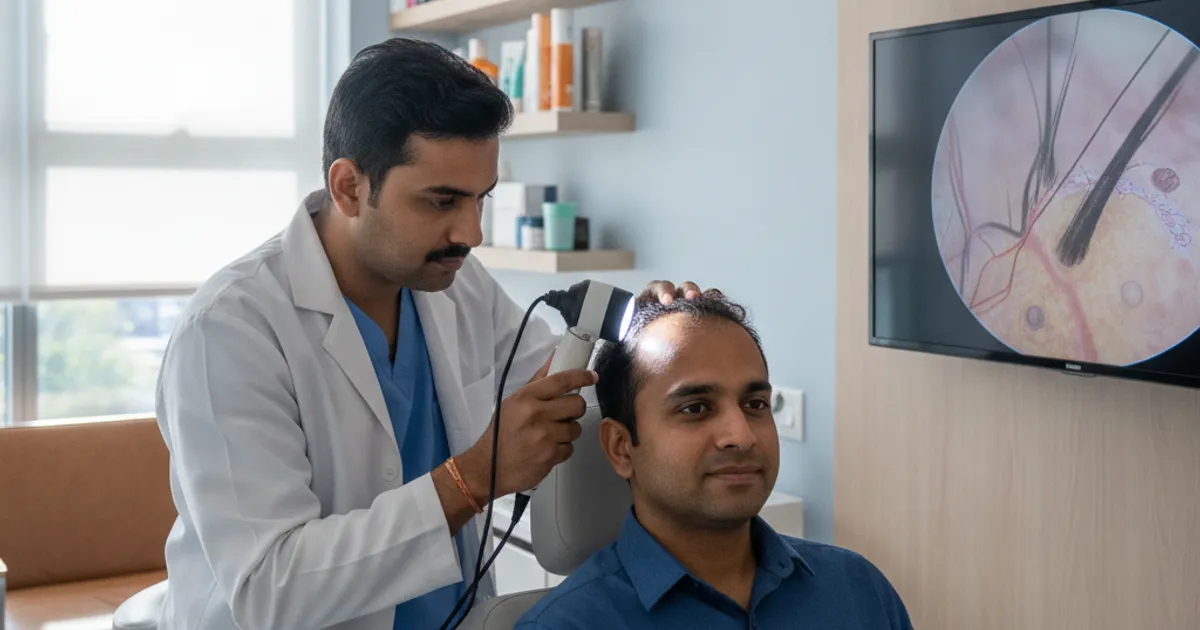
What Is Trichoscopy? A Dermatologist's Window Into Hair Loss
Trichoscopy is a non-invasive scalp and hair examination using a specialized magnifying device called a dermatoscope. Think of it as a high-powered magnifying glass that lets your dermatologist see the hair shaft, the scalp surface, and the openings where hair exits the skin (follicular ostia) in fine detail. No cuts, no biopsies, no downtime. The whole exam usually takes a few minutes, and you walk out with real information instead of a guess. If you are researching trichoscopy for hair loss, this is the starting point: it tells you what type of hair loss you actually have before anyone talks about surgery.
- Non-invasive: no incisions, no anesthesia, no recovery time
- Quick: typically completed in a single office visit
- Detailed: shows hair shaft thickness, density, and scalp inflammation
- Objective: gives your dermatologist measurable findings, not just impressions
Why Trichoscopy Matters Before Any Hair Transplant Decision
A hair transplant moves healthy, permanent follicles from one part of your scalp to another. That only works if you still have enough healthy donor hair and if the underlying cause of your hair loss is stable. Trichoscopy helps answer both questions. It can distinguish between conditions that look similar to the naked eye but behave very differently. For example, androgenetic alopecia (pattern hair loss) is generally stable and transplant-friendly. Scarring alopecias, on the other hand, can keep destroying follicles after surgery, which means a transplant could fail or make things worse. Trichoscopy also helps your dermatologist judge donor area quality, which directly affects how many grafts are realistically available.
- Confirms the type of hair loss before committing to surgery
- Rules out scarring or inflammatory conditions that surgery could worsen
- Assesses donor area density and follicle health
- Helps set realistic expectations for graft numbers and coverage
- Guides whether medical treatment should come first
What Your Dermatologist Actually Sees Under the Microscope
Under trichoscopy, your scalp looks like a landscape. Your dermatologist examines hair shaft diameter, density per square centimeter, follicular openings, and signs of inflammation or scaling. They look for specific patterns: hairs that vary in thickness (called anisotrichosis), yellow dots, black dots, exclamation-mark hairs, and perifollicular scaling. Each pattern points toward a different diagnosis. This is not about counting every hair on your head. It is about recognizing the signature that different hair-loss conditions leave behind.
Close-up trichoscopy image showing follicular openings, hair shaft thickness variation, and perifollicular scaling on the scalp.
- Hair shaft diameter variation: a hallmark of androgenetic alopecia
- Yellow dots: empty follicles that may indicate alopecia areata or other conditions
- Black dots: broken hairs often seen in alopecia areata or trichotillomania
- Exclamation-mark hairs: short, tapered hairs typical of alopecia areata
- Perifollicular scaling or redness: suggests inflammation or scarring alopecia
- Follicular ostia: whether openings are present, narrowed, or absent
Trichoscopy Findings by Hair-Loss Stage: What They Mean for Planning
Trichoscopy findings change as hair loss progresses. Early-stage loss usually shows preserved follicular openings and mild miniaturization, which means medical treatment may still be very effective. Moderate loss shows more miniaturized hairs and reduced density, but the donor area is often still strong enough for a transplant. Advanced loss shows significant miniaturization across the top of the scalp and sometimes donor area thinning, which limits how much can be safely harvested. Your dermatologist uses these findings to decide whether you are a candidate for surgery now, later, or not at all.
| Hair-Loss Stage | Typical Trichoscopy Findings | Planning Implication |
|---|---|---|
| Early | Mild hair shaft diameter variation, preserved follicular openings, minimal scaling | Medical therapy often first-line; monitor with repeat trichoscopy |
| Moderate | Increased miniaturized hairs, reduced density, stable donor area | Transplant may be appropriate; combine with medical therapy |
| Advanced | Widespread miniaturization, reduced donor density, possible scarring signs | Limited graft availability; surgery may not be advisable without stabilization |
How Trichoscopy Guides Your Hair Restoration Plan
Trichoscopy is not just a diagnostic tool. It shapes the entire treatment plan. Once your dermatologist knows what is causing your hair loss, they can recommend the right combination of medical therapy, surgical intervention, and follow-up. Here is how that typically unfolds.
- Diagnosis confirmation: identifies whether you have pattern hair loss, alopecia areata, scarring alopecia, or another condition
- Treatment selection: determines whether you need medication, PRP, surgery, or a combination
- Donor area assessment: estimates how many grafts are safely available
- Surgical timing: decides whether to operate now or stabilize the condition first
- Baseline documentation: creates a record to compare against future trichoscopy exams
- Monitoring: tracks whether treatment is working over time
Preparing for a Trichoscopy Appointment: Practical Steps
Trichoscopy is simple, but a little preparation helps you get the most out of the visit. Your dermatologist needs a clear view of your scalp and hair. Products, recent treatments, and even hairstyles can affect what they see. Here is a practical checklist to follow before your appointment.
- Wash your hair the day before or the morning of the appointment
- Avoid hairspray, gel, mousse, dry shampoo, and oils on the day of the exam
- Do not dye, bleach, or chemically treat your hair in the week before
- Bring a list of medications, supplements, and hair products you use
- Note when your hair loss started and whether it is shedding or thinning
- Take photos of your hair from different angles to show progression
- Ask whether the clinic uses trichoscopy routinely or only on request
After Trichoscopy: Actionable Next Steps and Aftercare
Once the exam is done, your dermatologist will discuss findings and recommend a plan. That plan might include prescription medication, over-the-counter treatments, PRP sessions, or a referral for surgical consultation. If you are considering a hair transplant, trichoscopy results should be part of your pre-operative workup. After the appointment, follow the recommended treatment consistently. Hair loss treatments take time, often several months, before you see visible change. Repeat trichoscopy at intervals your dermatologist recommends to track progress objectively.
- Start or adjust treatment exactly as prescribed
- Take clear, consistent photos monthly to track changes
- Avoid changing products or treatments without telling your dermatologist
- Schedule follow-up trichoscopy as recommended, often every 6 to 12 months
- If surgery is planned, complete all pre-operative testing and instructions
Choosing a Clinic That Uses Trichoscopy Properly
Not every clinic offering hair transplants uses trichoscopy as part of the evaluation. Some rely on visual inspection alone, which can miss important diagnostic details. When you are researching clinics, ask directly whether trichoscopy is included in the consultation and whether the dermatologist performing it has experience with hair and scalp disorders. A clinic that documents trichoscopy findings and shares them with you is generally more thorough than one that does not.
- Ask if trichoscopy is part of the standard consultation or an add-on
- Confirm the person performing it is a dermatologist or trained specialist
- Request copies of your trichoscopy images and findings
- Ask how findings influence their surgical or medical recommendations
- Check whether they offer follow-up trichoscopy to monitor results
Frequently Asked Questions About Trichoscopy for Hair Loss
Is trichoscopy painful?
No. Trichoscopy is completely non-invasive. The dermatoscope rests on or near your scalp, and you may feel slight pressure but no pain. There is no need for anesthesia or recovery time.
How long does a trichoscopy exam take?
The examination itself usually takes just a few minutes. Including consultation and discussion of findings, you can expect the entire appointment to last around 15 to 30 minutes.
Can trichoscopy replace a scalp biopsy?
In many cases, trichoscopy provides enough information to make a diagnosis without a biopsy. However, if scarring alopecia or another complex condition is suspected, your dermatologist may still recommend a biopsy for confirmation.
How often should I have trichoscopy done?
If you are actively treating hair loss, your dermatologist may recommend repeat trichoscopy every 6 to 12 months. If your condition is stable, less frequent monitoring may be appropriate. Follow your dermatologist's guidance.
Trichoscopy vs. Other Hair and Scalp Tests: How They Differ
Trichoscopy is often confused with a scalp biopsy or a hair pull test, but these are different tools used for different purposes. Understanding where trichoscopy fits helps you ask better questions and know what to expect from each step of an evaluation.
- Trichoscopy: a magnified visual exam of the scalp surface and hair shafts. Non-invasive, done in the office, gives immediate pattern-based information. It shows what is visible above and at the skin surface.
- Scalp biopsy: a small tissue sample taken under local anesthesia and examined in a lab. It looks at structures beneath the skin, such as follicle anatomy and inflammation at depth. It is reserved for cases where the diagnosis is unclear or a scarring condition is suspected.
- Hair pull test: the clinician gently pulls a small bundle of hairs to see how many come out and what phase they are in. It is quick and gives a rough sense of active shedding, but it does not show shaft-level detail the way trichoscopy does.
- Blood tests: used to check for underlying contributors such as thyroid problems, iron status, or hormonal issues. These complement trichoscopy rather than replace it.
- Photography and hair counts: standardized photos and density measurements track change over time. Trichoscopy adds the microscopic detail that plain photos cannot capture.
In practice these tools are combined. Trichoscopy is usually the first detailed look because it is fast and non-invasive, and it often narrows the diagnosis enough that a biopsy is unnecessary. When trichoscopy shows features suggesting scarring, a biopsy may be recommended to confirm before any surgery is considered.
Limitations and What Trichoscopy Cannot Tell You
Trichoscopy is powerful, but it is not a complete picture on its own. Knowing its limits keeps expectations realistic and helps you understand why your dermatologist may order additional tests.
- It examines the surface and the immediate follicle opening, not the full depth of the follicle or the tissue beneath the skin.
- It depends on the skill and experience of the person interpreting the images, so findings can vary between clinicians.
- It cannot by itself identify systemic causes of shedding such as nutritional deficiencies, thyroid disease, or medication side effects; those require lab work.
- Image quality can be affected by heavy product buildup, recent chemical treatments, or dense hairstyles that are hard to part.
- It shows a snapshot in time. A single exam may not reveal whether a condition is actively progressing or stabilizing, which is why repeat exams and baseline documentation matter.
- It does not predict the final outcome of treatment or surgery with certainty; it informs the plan and helps set realistic expectations.
Common Questions Patients Ask About Trichoscopy
Does trichoscopy hurt?
No. It is a non-invasive surface exam. The device rests near or against the scalp and magnifies the view. There are no incisions, needles, or anesthesia involved, and you can return to normal activities immediately.
How long does the appointment take?
The trichoscopy portion itself is typically quick, often just a few minutes, though the full visit including consultation and discussion of findings takes longer. Timing varies by clinic and by how many areas need to be examined.
Will my hair be shaved or cut?
Generally no. The clinician parts the hair to view the scalp. In some cases small areas may be parted closely or lightly trimmed for a clearer image, but this is usually minimal and discussed with you beforehand.
Can I wear my hair normally to the appointment?
Yes, but avoid heavy styling products, oils, and dry shampoo on the day of the exam, since they can obscure the scalp surface. Clean, product-free hair gives the clearest view.
Is trichoscopy covered by insurance?
Coverage varies widely by country, insurer, and how the visit is coded. Ask your clinic about costs and whether the exam is billed as part of a consultation before your appointment.
How often should trichoscopy be repeated?
There is no single schedule. Your dermatologist may suggest follow-up exams at intervals to track whether treatment is working or whether a condition is progressing. The right interval depends on your diagnosis and treatment plan.
Can trichoscopy be done on a beard or eyebrows?
Yes. The same technique can be used on other hair-bearing areas, which is useful when hair loss affects the beard or eyebrows and a diagnosis needs to be confirmed.
More Guides
- How Long After Finasteride Before a Hair Transplant?
Planning a hair transplant while on finasteride? Learn the typical waiting period, why timing matters, and how to coordinate with your surgeon for best results.
- Early Symptoms of Hair Loss: What to Watch For First
Learn the early symptoms of hair loss, how to track them, and when to see a specialist. Plan ahead with treatment options and costs.
- Alopecia Treatment: A Comprehensive Guide
A practical guide to alopecia treatment: types, diagnosis, medications, surgery, recovery timeline, and aftercare. Plan your hair restoration with confidence.
- Hair Loss Causes: What You Can and Can't Control
Understand hair loss causes, what's controllable, and how to plan a transplant. Practical guide to factors, aftercare, and when to see a specialist.