
Hair Transplant for a Receding Hairline With a Cowlick
How surgeons plan and perform a hair transplant for a receding hairline with a cowlick, including graft angle control, recovery, results, cost, and candidacy.
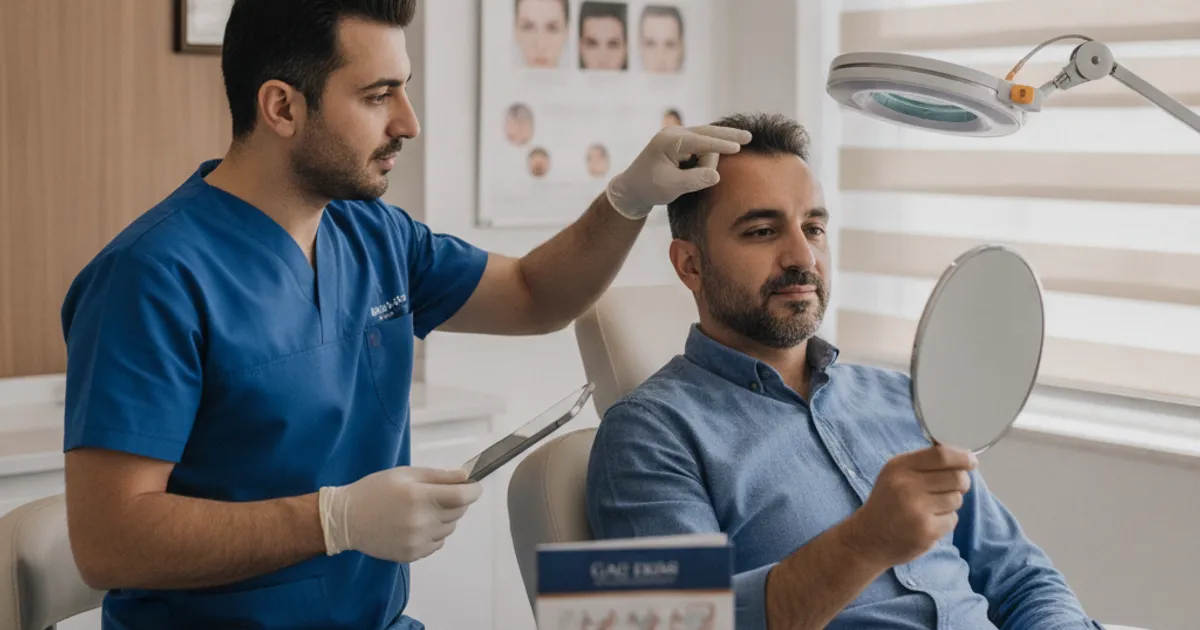
What Is a Cowlick and Why It Complicates a Receding Hairline Transplant
A cowlick is a small area of hair that grows in a different direction from the surrounding hair. On the front hairline, it usually shows up as a whorl or a stubborn tuft that points forward, sideways, or straight up. Many people have at least one cowlick somewhere on the scalp, and many never think about it until they start losing hair around it. When a receding hairline meets a cowlick, the transplant becomes less about simply filling a gap and more about matching a natural growth pattern that already exists. If the surgeon ignores the cowlick, the new hairline can look flat, stiff, or visibly out of sync with the patient's own hair. That is why cowlick-sensitive hairline work is a distinct planning problem, not just a bigger version of a standard transplant.
How Surgeons Plan a Hairline Around a Cowlick
Planning starts before any incisions are made. The surgeon maps the existing hairline, marks the cowlick, and studies how the hair lies when it is dry and when it is wet. Direction tends to matter more than density in this part of the scalp. A cowlick that points forward can fight grafts angled backward, and the result may be a patch of hair that sticks out or lies flat in the wrong direction. Good planning typically accounts for the transition zone between the cowlick and the rest of the hairline, so the change in direction looks gradual rather than abrupt. The surgeon also considers how the hairline will age, which generally means leaving enough room for future loss and not over-harvesting the donor area.
- Mapping the cowlick's exact direction, whorl pattern, and how it behaves when hair is styled differently.
- Marking a hairline that follows the patient's natural growth rather than a generic template.
- Deciding graft angles and curl direction for each zone, especially the transition between cowlick and normal hair.
- Planning density so the cowlick area is not over-packed, which can look pluggy or unnatural.
- Leaving a buffer zone for future hair loss so the result holds up over time.
- Checking donor hair characteristics, since curl and caliber can affect how well grafts blend with a cowlick.
How the Procedure Is Performed: Graft Placement and Angle Control
The procedure itself is usually FUE or FUT, and the cowlick changes the details rather than the overall method. The surgeon creates recipient sites with specific angles and directions that mimic the cowlick's natural flow. This is often the part that separates a good result from a mediocre one. Grafts placed at the wrong angle may stand up, lie flat against the surrounding hair, or create a visible line where the cowlick ends. Many surgeons use custom-cut blades or needle sizes to control the angle precisely, and some use magnification to check direction as they work. The graft itself has to be handled carefully so the follicle is not damaged, because a damaged graft may grow in a distorted direction even if the site was correct.
Recovery Timeline After a Cowlick Hairline Transplant
Recovery from a cowlick hairline transplant generally follows the same broad timeline as any other hair transplant, though the cowlick area may feel more sensitive early on because the grafts are placed at precise angles. Patients commonly see scabbing and redness for roughly the first week to ten days. The transplanted hair often sheds in the second to fourth week, which is normal and does not mean the grafts have failed. New growth typically starts around month three to four, with meaningful density showing up between months six and nine. The final result is usually judged at twelve to eighteen months, because the cowlick area needs time for the hair to grow long enough to lie in its natural direction. These are general ranges from standard clinical experience, not a guarantee for any individual.
| Timeframe | What to Expect |
|---|---|
| First few days | Swelling, tenderness, and small scabs around recipient sites. Sleep elevated and avoid touching the grafts. |
| First week to ten days | Scabs loosen and fall off. Redness fades. Many patients feel ready to return to desk work, though this varies. |
| Second to fourth week | Transplanted hair sheds. This is expected and temporary. The scalp may look patchy. |
| Around month three to four | New growth begins. Hair is short and may not yet follow the cowlick's direction clearly. |
| Months six to nine | Density improves and the hairline shape becomes visible. Cowlick direction starts to read naturally. |
| Twelve to eighteen months | Final result. Hair is long enough to lie in its natural pattern and blend with the cowlick. |
Results: What to Expect and How Cowlicks Affect Final Appearance
A well-planned cowlick hairline transplant aims to look like a hairline that was always there. The cowlick remains, because it is part of the patient's natural growth pattern, but it typically no longer looks isolated or awkward. The new hair is designed to blend into it, and the transition zone helps hide the boundary between transplanted and native hair. Results depend heavily on how much native hair the patient still has, the quality of the donor hair, and how well the surgeon matched angles. Patients with a strong cowlick and a receding hairline sometimes get better results than they expect, because the cowlick can help disguise the transplant by breaking up the hairline and making it look less uniform. That is a possibility, not a promise.
Who Is a Good Candidate for This Approach
The best candidates for a cowlick-sensitive hairline transplant are generally people with a stable or slowly progressing receding hairline, good donor hair density, and a clear cowlick pattern that the surgeon can work with. Stability tends to matter more than age. Someone with aggressive loss may be advised to wait or to plan conservatively, while someone with a settled hairline is often a straightforward candidate. Patients who style their hair forward or who have a strong whorl at the front should be evaluated carefully, because the transplant has to work with that styling habit, not against it.
- Receding hairline with a visible cowlick or whorl at the front.
- Stable or slowly progressing hair loss, ideally tracked over time with photos and your surgeon's input.
- Good donor hair density and quality on the back and sides of the scalp.
- Realistic expectations about density and the fact that the cowlick will remain.
- No active scalp conditions that would interfere with healing or graft survival, as assessed by your surgeon.
- Willingness to follow aftercare instructions and attend follow-up appointments.
Cost Considerations for a Receding Hairline With a Cowlick
Cost for a cowlick hairline transplant is typically driven by graft count, technique, and clinic location rather than the cowlick itself. A cowlick does not usually add a separate fee, but it can increase the time spent on planning and placement, which some clinics may factor into their pricing. The biggest variable is usually how much hair needs to be restored. Early-stage loss typically needs fewer grafts, while advanced loss typically needs more. Because there is no real-time pricing data available for this topic, the figures below are not provided. Instead, ask clinics directly for a quote based on your stage of loss, and compare several consultations before deciding.
How It Compares to Alternatives: FUE vs. FUT vs. Non-Surgical Options
FUE and FUT are the two main surgical options, and both can generally handle a cowlick hairline. FUE tends to leave less linear scarring and is often preferred for shorter hairstyles, while FUT can sometimes yield more grafts in a single session and may be considered for advanced loss. Neither technique is inherently better for a cowlick; the difference is largely in how the surgeon plans and places the grafts. Non-surgical options like minoxidil, finasteride, and low-level laser therapy can slow loss and improve density in some people, but they generally cannot rebuild a receding hairline or change a cowlick. They are often used alongside surgery rather than instead of it.
| Option | How It Works | Best For | Limitations |
|---|---|---|---|
| FUE | Individual follicular units are extracted and placed one by one. | Patients who want minimal scarring and shorter hairstyles. | Can be slower and may require multiple sessions for high graft counts. |
| FUT | A strip of scalp is removed and dissected into grafts. | Advanced loss needing high graft counts in one session. | Leaves a linear scar and requires more downtime. |
| Minoxidil | Topical treatment that can slow loss and improve density. | Early-stage loss and maintenance. | Generally does not rebuild a hairline or change a cowlick. |
| Finasteride | Oral medication that reduces hair loss progression. | Men with androgenetic alopecia. | Requires ongoing use and has potential side effects; discuss with a doctor. |
| Low-level laser therapy | Light therapy that may support hair growth. | Adjunct to other treatments. | Evidence is mixed and results are generally modest. |
Choosing a Clinic for Cowlick-Sensitive Hairline Work
Not every clinic treats a cowlick as a planning issue. Some focus on graft count and speed, which can sometimes produce a hairline that looks fine in photos but wrong in person. It is worth looking for a surgeon who talks about direction, angle, and transition zones without being prompted. Ask to see before-and-after photos of patients with a similar cowlick pattern, and ask how the surgeon plans to handle the cowlick specifically. A good clinic will typically explain the trade-offs and set realistic expectations rather than promising a perfect result.
- Ask the surgeon to explain how they plan graft angles around a cowlick.
- Request before-and-after photos of patients with a similar hairline and cowlick pattern.
- Ask whether the clinic uses magnification or custom blades for angle control.
- Ask about the clinic's approach to future hair loss and whether they plan conservatively.
- Check aftercare and follow-up policies, including how long the clinic monitors results.
- Be cautious of clinics that promise a specific graft count before examining your scalp.
FAQ
Will a hair transplant get rid of my cowlick?
No. A cowlick is generally understood as a natural growth pattern, and a transplant is designed to work with it, not remove it. The surgeon places grafts so the new hairline blends into the cowlick and the transition looks natural. In many cases the cowlick can actually help the result look less uniform.
Is a cowlick hairline transplant more expensive?
Usually not as a separate fee. Pricing is typically based on graft count, technique, and clinic location. A cowlick can add planning and placement time, which some clinics may factor into their pricing, but it is not typically billed as an add-on. Always confirm pricing directly with the clinic.
How long before I see the final result?
New growth typically starts around month three to four, and meaningful density often shows up between months six and nine. The final result is usually judged at twelve to eighteen months, because the cowlick area needs time for the hair to grow long enough to lie in its natural direction. These are general ranges, not a guarantee.
Can I have a cowlick hairline transplant if I have advanced hair loss?
It depends on your donor hair and how much coverage you need. Advanced loss usually requires more grafts and a more conservative hairline plan. A surgeon will assess your donor density and discuss whether surgery is realistic or whether a non-surgical approach should come first.
More Guides
- Hair Transplant for Men With Scalp Tattoos: What to Know
Scalp tattoos and hair transplants can coexist. Learn how ink affects surgery, recovery, results, candidacy, cost, and alternatives in this plain-English guide.
- No-Shave FUE Transplant: What It Is and Who It Suits
Learn how a no-shave FUE hair transplant works, who it suits, recovery, results, and cost. A clear, factual guide to this minimally shaven technique.
- Hair Transplant Revision: When to Fix and When to Wait
A practical guide to hair transplant revision surgery: why it's needed, when to fix vs. wait, how it's performed, recovery, costs, and alternatives.
- Hair Transplant for Fine Hair: Graft Selection & Density
Fine hair changes how a hair transplant is planned. Learn about graft selection, density limits, recovery, costs, and who suits this approach.