
Hair Transplant Revision: Costs, Timing, and Candidacy
Considering hair transplant revision? Learn what it is, how it's performed, recovery, results, candidacy, costs, and how it compares to alternatives.
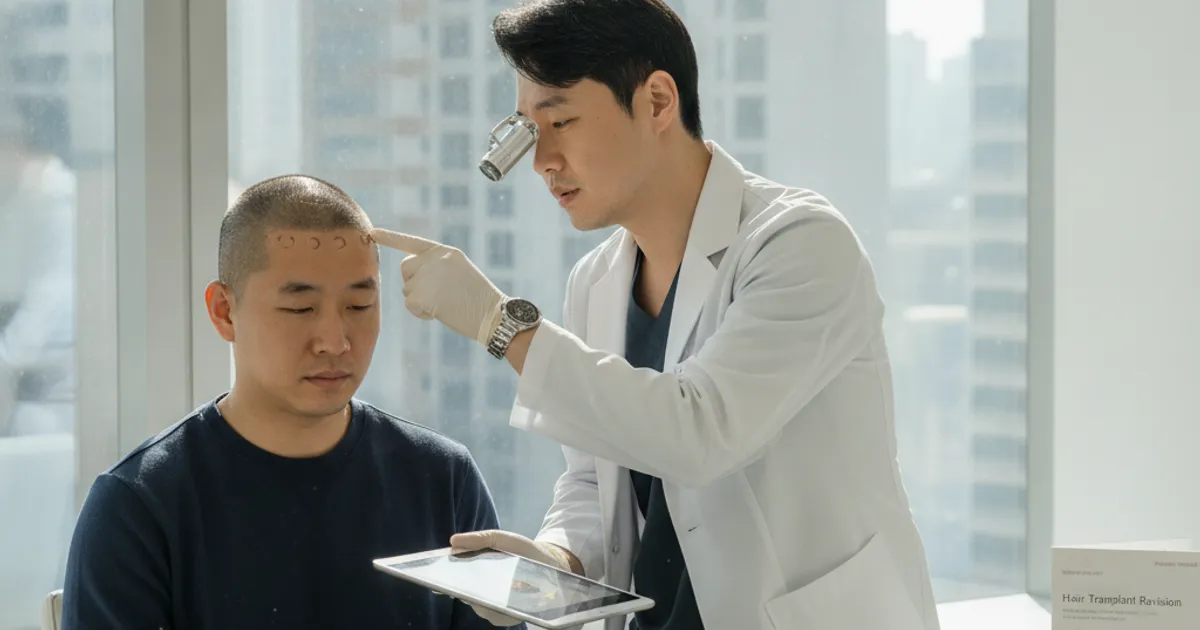
What Is a Hair Transplant Revision?
A hair transplant revision is a second procedure done to correct or improve the outcome of a previous transplant. It's not just a "top-up" session for additional balding — it's a targeted repair. People seek revision for a range of reasons: unnatural hairline placement, poor density, visible scarring, cobblestone texture, or grafts that simply didn't grow. Sometimes the original surgery was too conservative; other times it was too aggressive or poorly planned. A revision aims to fix those issues while preserving the healthy grafts you already have.
How a Revision Procedure Is Performed
The approach depends entirely on what needs fixing. A surgeon will first assess the previous work — graft angle, hairline design, density, and scar condition — usually with the help of photos and sometimes trichoscopy. From there, the plan might involve adding grafts, removing misplaced ones, or both. In some cases, scar tissue is excised before new grafts are placed. The procedure itself is still follicular unit extraction (FUE) or strip (FUT), but the execution is more delicate because the surgeon is working around existing scars and compromised tissue.
- Grafting into scar tissue: scarred skin has reduced blood flow, so grafts need careful placement and often lower density per session.
- Removing misplaced grafts: sometimes individual grafts are excised (with tiny punches) to correct angles or hairlines.
- Hairline redesign: adding singles in front of or between existing plugs to soften a harsh line.
- Donor repair: if the donor area was over-harvested, the surgeon may use body hair or redistribute remaining grafts.
- Staged approach: many revisions are split into two or more sessions to protect blood supply and donor reserves.
Recovery After a Revision Transplant
Recovery from a revision is broadly similar to a primary transplant, but there are a few differences. Scar tissue can heal more slowly, and the risk of poor graft survival is higher, so surgeons tend to be more cautious with aftercare instructions. Swelling, scabbing, and redness are normal in the first week to ten days. Most people can return to desk work within a few days, though visible crusting lasts longer. Any excision sites (if grafts were removed) may take a bit more time to settle.
- Days 1–3: rest, avoid touching grafts, sleep elevated to reduce swelling.
- Days 4–10: gentle washing begins, scabs loosen, redness peaks.
- Weeks 2–4: shock loss possible (temporary shedding of existing hair), especially around worked areas.
- Months 2–4: dormant phase; little visible change.
- Months 5–8: new growth becomes noticeable.
- Months 10–12: final density and texture emerge; scar maturation continues up to 18 months.
Results: What to Expect and When
Revision results are usually more modest than first-time transplants in terms of raw graft numbers, but the goal is quality over quantity — a more natural look, better density in a specific zone, or a repaired hairline. Because scar tissue can limit growth yield, surgeons often quote a survival rate lower than what's typical in virgin scalps. You'll see early growth around month 4–5, with meaningful improvement by month 8. Final results take a full year, sometimes longer if multiple sessions are planned.
Who Is a Good Candidate for Revision Surgery?
Not everyone who's unhappy with a transplant is a good revision candidate. The key factors are donor supply, scalp elasticity, scar condition, and overall health. If your donor area is already depleted, a surgeon may recommend other options (like scalp micropigmentation or hair fibers) rather than risk further scarring. Age and stability of hair loss also matter — revising a hairline in someone whose loss is still progressing can lead to future problems.
- You have visible cosmetic issues (pluggy hairline, gaps, unnatural angles) from a prior procedure.
- Your donor area still has enough density to supply grafts without creating a new problem.
- You've waited at least 12 months after the original surgery to let full growth and healing occur.
- Your hair loss has stabilized (or is medically controlled).
- You have realistic expectations and understand that revision is often a multi-step process.
- You're in good general health and don't have uncontrolled scalp conditions.
Cost of Hair Transplant Revision
Revision pricing is rarely published as a flat rate because every case is different. Surgeons often charge per graft, but the per-graft rate for revision work tends to be higher than for primary transplants due to the added complexity. Some clinics charge a consultation fee that's credited toward surgery. The table below shows average case pricing by stage of hair loss, based on typical revision scenarios. These are medians from aggregated data, not quotes — your actual cost will depend on graft count, technique, and location.
| Stage of Hair Loss | Average Revision Cost (USD) | What It Typically Covers |
|---|---|---|
| Early (minor repair, small session) | Varies by clinic | Hairline refinement or small scar repair |
| Moderate (moderate repair, 1–2 sessions) | Varies by clinic | Density improvement, angle correction |
| Advanced (complex repair, multiple sessions) | Varies by clinic | Scar excision, donor redistribution, staged procedures |
Revision vs. Alternatives: Comparison
Revision surgery isn't the only path. Depending on your situation, other options may make more sense — especially if donor hair is limited or you want a non-surgical fix. The table below compares the main alternatives on key factors.
| Option | Best For | Typical Cost (USD) | Downtime | Permanence |
|---|---|---|---|---|
| Revision transplant | Correcting cosmetic issues, adding density | Varies by clinic | 1–2 weeks visible healing | Permanent (grafts are permanent) |
| Scalp micropigmentation (SMP) | Camouflaging scars, creating illusion of density | Varies by clinic | 3–5 days | Semi-permanent (fades over years, needs touch-ups) |
| Hair fibers / concealers | Temporary coverage for thinning or gaps | Varies by clinic | None | Temporary (washes out) |
| Non-surgical medical therapy (finasteride/minoxidil) | Slowing loss, improving existing hair | Varies by clinic | None | Ongoing use required |
| Hair system / toupee | Full coverage when donor is depleted | Varies by clinic | None | Temporary (replaced every 1–3 years) |
Choosing a Clinic for Revision Surgery
Revision work is a niche skill. Not every clinic that performs transplants does revisions well, and some won't take on repair cases at all. Look for surgeons who specifically mention repair or corrective work in their portfolio and can show before-and-after photos of revision cases (not just primary transplants). Ask directly how many revisions they perform per month and what their approach is to scar tissue. A good revision surgeon will be honest about limitations and may recommend against surgery if your donor supply is too compromised.
- Ask for revision-specific before-and-after photos, not general transplant results.
- Confirm the surgeon's experience with scar tissue and graft excision.
- Check whether pricing is per graft or per session, and what's included (PRP, follow-up, medications).
- Look for clinics that offer staged planning rather than promising everything in one session.
- Read patient reviews carefully — look for mentions of revision or repair work specifically.
- Ensure the clinic has a clear policy on what happens if growth is poor.
Frequently Asked Questions
How soon after a failed transplant can I have revision surgery?
Most surgeons recommend waiting at least 12 months after the original procedure. This allows full growth, healing, and scar maturation. Doing a revision too early can compromise graft survival and make it harder to assess what actually needs fixing.
Will a revision transplant fix a bad hairline completely?
It can significantly improve it, but "complete" correction isn't guaranteed. Revision surgery can soften a harsh hairline, add singles, and remove misplaced grafts, but scar tissue and limited donor supply may prevent a perfect result. Most patients see a major cosmetic improvement, not perfection.
Is revision surgery more painful than a first transplant?
Not necessarily. The discomfort is similar — local anesthesia is used, and most people report pressure rather than pain during the procedure. However, if scar tissue is being excised or grafts removed, there may be slightly more soreness during recovery.
Can I get a revision if my donor area is already thin?
Possibly, but it depends on how much donor hair remains. If the donor area is over-harvested, a surgeon may recommend alternatives like scalp micropigmentation, hair fibers, or a hair system instead of risking further depletion. A consultation with a surgeon experienced in repair work is essential.
More Guides
- Hair Transplant for Men With Scalp Tattoos: What to Know
Scalp tattoos and hair transplants can coexist. Learn how ink affects surgery, recovery, results, candidacy, cost, and alternatives in this plain-English guide.
- No-Shave FUE Transplant: What It Is and Who It Suits
Learn how a no-shave FUE hair transplant works, who it suits, recovery, results, and cost. A clear, factual guide to this minimally shaven technique.
- Hair Transplant Revision: When to Fix and When to Wait
A practical guide to hair transplant revision surgery: why it's needed, when to fix vs. wait, how it's performed, recovery, costs, and alternatives.
- Hair Transplant for Fine Hair: Graft Selection & Density
Fine hair changes how a hair transplant is planned. Learn about graft selection, density limits, recovery, costs, and who suits this approach.